Learn how to choose between the Spanish preterite and imperfect with the film-and-photo model, triggers, verbs that change meaning, examples and games.
This lesson teaches the single most important decision in Spanish past-tense grammar: preterite or imperfect? If you can make the choice, you can tell stories, describe your childhood and report events. The good news is that you do not need a long list of rules. One mental picture, the film and the photograph, answers most cases, and a handful of signal words and special verbs complete the toolkit.
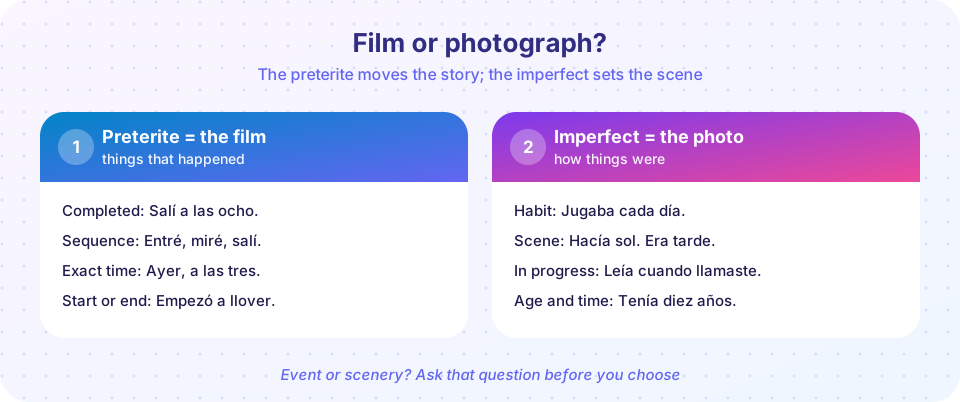
The film-and-photo model: the preterite advances the story, the imperfect sets the scene.
Acción puntual: an action seen as one completed point or whole.
Acción en curso: an action seen as ongoing.
Trasfondo (background): the circumstances against which events happen.
Interrupción: a sudden event cutting an ongoing action.
Verbo de estado: a verb of state or mental activity, often in the imperfect.
Imagine you tell a story using two tools. The preterite is a film camera: it records events one after another, and each event starts and finishes. The imperfect is a photograph of the scene: it shows who was there, what the weather was like and what people were doing, without caring about the start or the end. Now read this passage:
Eran las siete de la tarde y llovía. Mi hermano dormía en el sofá. De repente, alguien llamó a la puerta. Abrí y vi a mi tía.
It was seven in the evening and it was raining. My brother was sleeping on the sofa. Suddenly someone knocked at the door. I opened it and saw my aunt.
The first three verbs (eran, llovía, dormía) are the photograph: time, weather and a situation in progress. The next three (llamó, abrí, vi) are the film: three events in order. Writers move back and forth: an imperfect sets the stage, a preterite makes something happen, and the imperfect returns to describe the new situation.
The most typical pattern is an ongoing action (imperfect) interrupted by an event (preterite): Comía cuando llegó mi padre. (I was eating when my father arrived.) Mientras caminábamos por el parque, empezó a llover. (While we were walking in the park, it began to rain.) The word mientras (while) almost always accompanies the imperfect, and de repente (suddenly) almost always accompanies the preterite. Two simultaneous ongoing actions use two imperfects: Mientras yo estudiaba, mi hermana escuchaba música.
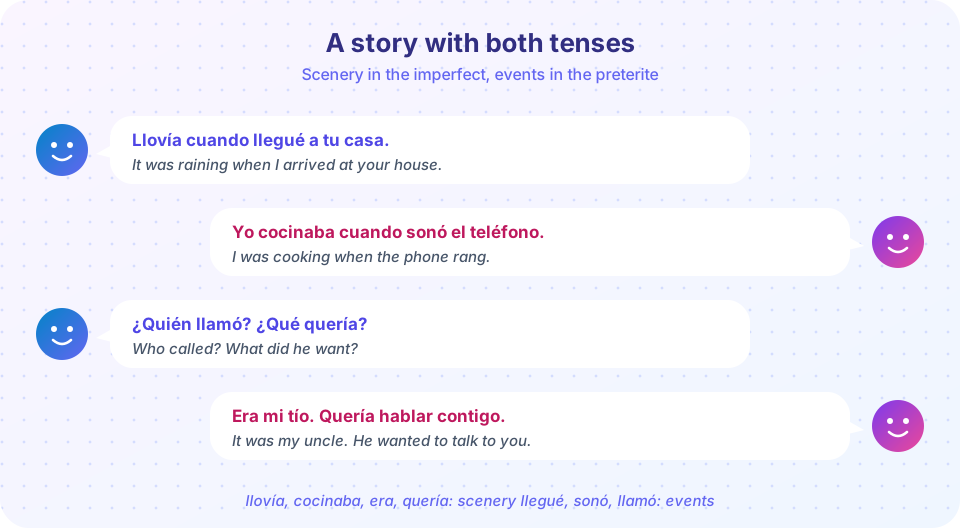
A mini-dialogue where imperfect verbs set the scene and preterite verbs report the events.
Preterite: ayer, anoche, el año pasado, hace dos días, una vez, de repente, en ese momento, entonces, por fin, primero, luego.
Imperfect: siempre, nunca, a menudo, todos los días, cada semana, mientras, de niño, cuando era joven, normalmente, generalmente.
Remember they are clues, not laws. Siempre usually signals the imperfect, but it also appears with the present perfect (Siempre he vivido aquí), and una vez can introduce a story told in the preterite (Una vez fui a Perú). The clues work most of the time, and the speaker's view decides the rest.
Read this paragraph and decide why each verb is in its tense before you read the explanation.
Era sábado por la tarde. Yo estaba en casa y no tenía nada que hacer. Entonces llamé a Lucía, que vivía en la ciudad vecina. Ella me contestó enseguida y me invitó a su fiesta de cumpleaños. Me puse una chaqueta, tomé el tren y llegué a las ocho. Había mucha gente y la música sonaba muy fuerte.
It was Saturday afternoon. I was at home and had nothing to do. Then I called Lucía, who lived in the neighboring city. She answered me at once and invited me to her birthday party. I put on a jacket, took the train and arrived at eight. There were many people and the music was playing very loudly.
Imperfect (scenery): era (day), estaba (state), tenía (nothing to do), vivía (where she lived), había (many people), sonaba (the music playing).
Preterite (events): llamé, contestó, invitó, puse, tomé, llegué. Each one moves the plot forward, and each is complete.
Notice that entonces (then) triggers the first preterite, a trick that helps you find the plot line. Exercise: write your own paragraph about last Saturday using three imperfect verbs for scenery (era, estaba, había) and four preterite verbs for events. Then read it aloud and check that every event verb is a step in the story.
English used to and would both map to the imperfect: Cuando era niño, jugaba al fútbol cada tarde.
English was ...-ing is often an imperfect, but also check the whole sentence: I was reading when you called is imperfect + preterite.
English had to often needs the preterite when it really happened (Tuve que irme) and the imperfect when it only describes an obligation (Tenía que irme, pero me quedé: I had to leave, but I stayed).
English I knew with saber is imperfect, but I found out is the preterite.
Choose the tense that fits. After you click you will see a short explanation.
Preterite or imperfect?
<style>*{box-sizing:border-box}body{margin:0;padding:14px;font-family:system-ui,-apple-system,'Segoe UI',sans-serif;background:linear-gradient(135deg,#faf5ff,#eff6ff);color:#1e1b4b}.card{background:#fff;border-radius:18px;box-shadow:0 8px 22px rgba(67,56,202,.16);padding:16px;max-width:560px;margin:0 auto}button{font:inherit;font-weight:600;border:0;border-radius:999px;padding:8px 16px;margin:4px 4px 0 0;color:#fff;background:linear-gradient(135deg,#6366f1,#ec4899);cursor:pointer}button.alt{background:#eef2ff;color:#3730a3}input{font:inherit;padding:6px 10px;border:2px solid #c7d2fe;border-radius:10px;width:150px}.small{font-size:.85rem;color:#475569}</style><style>.q{margin:0 0 14px;padding:10px 12px;border-radius:12px;background:#f8fafc}.q .s{font-weight:700;margin-bottom:6px}.q .e{font-size:.85rem;color:#475569;font-style:italic}.q button{background:#eef2ff;color:#3730a3}.q button.right{background:#16a34a;color:#fff}.q button.wrong{background:#dc2626;color:#fff}.fb{font-size:.9rem;margin-top:6px}</style><divclass="card"><divid="box"></div><pid="score"class="small"></p></div><script>var items=[{"s":"Cuando era niño, ___ en el parque.","o":["jugué","jugaba"],"a":1,"x":"A habit in childhood: imperfect.","en":"When I was a child I used to play in the park."},{"s":"Ayer ___ paella con mis amigos.","o":["comí","comía"],"a":0,"x":"A single completed event with ayer: preterite.","en":"Yesterday I ate paella with my friends."},{"s":"Hacía frío cuando ___ de casa.","o":["salí","salía"],"a":0,"x":"Salí is the event that happened against the weather background.","en":"It was cold when I left the house."},{"s":"De repente, la luz ___.","o":["se apagó","se apagaba"],"a":0,"x":"De repente introduces a sudden event: preterite.","en":"Suddenly the light went out."},{"s":"Eran las tres y ___.","o":["llovió","llovía"],"a":1,"x":"Time and weather scenery: imperfect.","en":"It was three o'clock and it was raining."},{"s":"Anoche ___ ocho horas.","o":["dormí","dormía"],"a":0,"x":"A bounded duration, a completed action: preterite.","en":"Last night I slept eight hours."},{"s":"Cuando ___ diez años, me mudé a Madrid.","o":["tenía","tuve"],"a":0,"x":"Age is a background fact: imperfect.","en":"When I was ten, I moved to Madrid."},{"s":"Mientras ella ___, yo cocinaba.","o":["leyó","leía"],"a":1,"x":"Mientras joins two ongoing actions: both imperfect.","en":"While she was reading, I was cooking."}];var good=0,done=0;var box=document.getElementById('box');
items.forEach(function(it,k){var d=document.createElement('div');d.className='q';var s=document.createElement('div');s.className='s';s.textContent=it.s;d.appendChild(s);var e=document.createElement('div');e.className='e';e.textContent=it.en;d.appendChild(e);var fb=document.createElement('div');fb.className='fb';
it.o.forEach(function(o,j){var b=document.createElement('button');b.textContent=o;b.onclick=function(){if(d.dataset.done)return;d.dataset.done='1';done++;if(j===it.a){good++;b.className='right';fb.textContent='Correct. '+it.x;}else{b.className='wrong';fb.textContent='Not quite. '+it.x;}document.getElementById('score').textContent='Score: '+good+' / '+done;};d.appendChild(b);});
d.appendChild(fb);box.appendChild(d);});</script>
Now conjugate the verb in brackets with the tense the context requires.
Tell the story
<style>*{box-sizing:border-box}body{margin:0;padding:14px;font-family:system-ui,-apple-system,'Segoe UI',sans-serif;background:linear-gradient(135deg,#faf5ff,#eff6ff);color:#1e1b4b}.card{background:#fff;border-radius:18px;box-shadow:0 8px 22px rgba(67,56,202,.16);padding:16px;max-width:560px;margin:0 auto}button{font:inherit;font-weight:600;border:0;border-radius:999px;padding:8px 16px;margin:4px 4px 0 0;color:#fff;background:linear-gradient(135deg,#6366f1,#ec4899);cursor:pointer}button.alt{background:#eef2ff;color:#3730a3}input{font:inherit;padding:6px 10px;border:2px solid #c7d2fe;border-radius:10px;width:150px}.small{font-size:.85rem;color:#475569}</style><style>.row{margin:0 0 12px;padding:10px 12px;border-radius:12px;background:#f8fafc}.ok{background:#dcfce7}.no{background:#fee2e2}.near{background:#fef9c3}.en{font-size:.85rem;color:#475569;font-style:italic}</style><divclass="card"><divid="list"></div><buttonid="chk">Check answers</button><buttonid="rst"class="alt">Clear</button><pid="score"class="small"></p></div><script>var items=[{"s":"Ayer ___ (llegar) a las ocho. (yo)","a":["llegué"],"en":"Yesterday I arrived at eight."},{"s":"___ (llover) cuando salí.","a":["llovía"],"en":"It was raining when I left."},{"s":"Yo ___ (leer) cuando sonó el teléfono.","a":["leía"],"en":"I was reading when the phone rang."},{"s":"De repente ella ___ (abrir) la puerta.","a":["abrió"],"en":"Suddenly she opened the door."},{"s":"Mi abuelo siempre ___ (llevar) sombrero.","a":["llevaba"],"en":"My grandfather always wore a hat."},{"s":"Ayer no ___ (poder) ir (I failed).","a":["pude"],"en":"Yesterday I could not go (I tried and failed)."},{"s":"Yo ___ (conocer) a Marta en 2020. (met)","a":["conocí"],"en":"I met Marta in 2020."}];functionstrip(t){return t.normalize('NFD').replace(/[\u0300-\u036f]/g,'');}var list=document.getElementById('list');
items.forEach(function(it,k){var d=document.createElement('div');d.className='row';var p=it.s.split('___');d.appendChild(document.createTextNode(p[0]));var inp=document.createElement('input');inp.id='f'+k;inp.setAttribute('aria-label','answer '+(k+1));d.appendChild(inp);d.appendChild(document.createTextNode(p[1]||''));var e=document.createElement('div');e.className='en';e.textContent=it.en;d.appendChild(e);var m=document.createElement('div');m.className='small';m.id='m'+k;d.appendChild(m);d.id='r'+k;list.appendChild(d);});
document.getElementById('chk').onclick=function(){var good=0;items.forEach(function(it,k){var v=document.getElementById('f'+k).value.trim().toLowerCase();var r=document.getElementById('r'+k),m=document.getElementById('m'+k);var ex=it.a.indexOf(v)>=0;var near=!ex&&it.a.some(function(a){returnstrip(a)===strip(v)&&v!=='';});if(ex){good++;r.className='row ok';m.textContent='Correct';}elseif(near){r.className='row near';m.textContent='Almost: check the accent. Answer: '+it.a[0];}else{r.className='row no';m.textContent=v?'Not quite. Answer: '+it.a[0]:'Answer: '+it.a[0];}});document.getElementById('score').textContent='Score: '+good+' / '+items.length;};
document.getElementById('rst').onclick=function(){items.forEach(function(it,k){document.getElementById('f'+k).value='';document.getElementById('r'+k).className='row';document.getElementById('m'+k).textContent='';});document.getElementById('score').textContent='';};</script>
Verbs that change meaning
<style>*{box-sizing:border-box}body{margin:0;padding:14px;font-family:system-ui,-apple-system,'Segoe UI',sans-serif;background:linear-gradient(135deg,#faf5ff,#eff6ff);color:#1e1b4b}.card{background:#fff;border-radius:18px;box-shadow:0 8px 22px rgba(67,56,202,.16);padding:16px;max-width:560px;margin:0 auto}button{font:inherit;font-weight:600;border:0;border-radius:999px;padding:8px 16px;margin:4px 4px 0 0;color:#fff;background:linear-gradient(135deg,#6366f1,#ec4899);cursor:pointer}button.alt{background:#eef2ff;color:#3730a3}input{font:inherit;padding:6px 10px;border:2px solid #c7d2fe;border-radius:10px;width:150px}.small{font-size:.85rem;color:#475569}</style><style>.fc{height:150px;border-radius:18px;display:flex;flex-direction:column;align-items:center;justify-content:center;font-size:1.7rem;font-weight:700;color:#fff;cursor:pointer;text-align:center;padding:10px;background:linear-gradient(135deg,#6366f1,#a78bfa)}.fc.back{background:linear-gradient(135deg,#ec4899,#f59e0b)}</style><divclass="card"><divclass="small"id="cnt"></div><divclass="fc"id="fc"tabindex="0"role="button"aria-label="Flashcard, press to flip"></div><pclass="small">Click the card to flip it. Try to answer before you flip.</p><buttonid="prev"class="alt">Previous</button><buttonid="next">Next</button><buttonid="shuf"class="alt">Shuffle</button><buttonid="say"class="alt">Listen</button></div><script>var cards=[["sabía / supe","I knew / I found out"],["conocía / conocí","I knew / I met"],["quería / quise","I wanted / I tried"],["no quise","I refused"],["podía / pude","I was able / I managed"],["no pude","I failed to"],["tenía / tuve","I had / I got"],["tuve que","I had to (and did)"]];var i=0,front=true,fc=document.getElementById('fc');functionshow(){var c=cards[i];fc.className='fc'+(front?'':' back');fc.textContent=front?c[0]:c[1];document.getElementById('cnt').textContent='Card '+(i+1)+' of '+cards.length+(front?' (Spanish)':' (English)');}
fc.onclick=function(){front=!front;show();};
fc.onkeydown=function(e){if(e.key==='Enter'||e.key===' '){front=!front;show();}};
document.getElementById('next').onclick=function(){i=(i+1)%cards.length;front=true;show();};
document.getElementById('prev').onclick=function(){i=(i-1+cards.length)%cards.length;front=true;show();};
document.getElementById('shuf').onclick=function(){cards.sort(function(){return Math.random()-0.5;});i=0;front=true;show();};
document.getElementById('say').onclick=function(){try{var u=newSpeechSynthesisUtterance(cards[i][0]);u.lang='es-ES';speechSynthesis.speak(u);}catch(e){document.getElementById('cnt').textContent='Speech is not available here.';}};show();</script>