


















Lesson 1 of 51 · Getting Started
Course Map: Your Path Through Spanish
See the whole Spanish for Beginners course at a glance: who it is for, how the nine chapters fit together, and how to study so the words actually stick.
Welcome. This course takes you from "I know three words from a vacation" to holding simple conversations in Spanish, reading everyday texts, and understanding how the grammar works. It is written for English speakers, so it explains Spanish through comparison with English: where the two languages agree, where they differ, and why the differences are less scary than they look.
Before anything else, one honest statement. A course on a website cannot replace talking with people. You can learn vocabulary, grammar and pronunciation rules here, and you can drill them with the interactive exercises, but fluency comes from listening to real speakers and speaking out loud, even badly. Treat this course as your map and your gym; use conversation partners, videos, music and, one day, a trip as your real terrain.
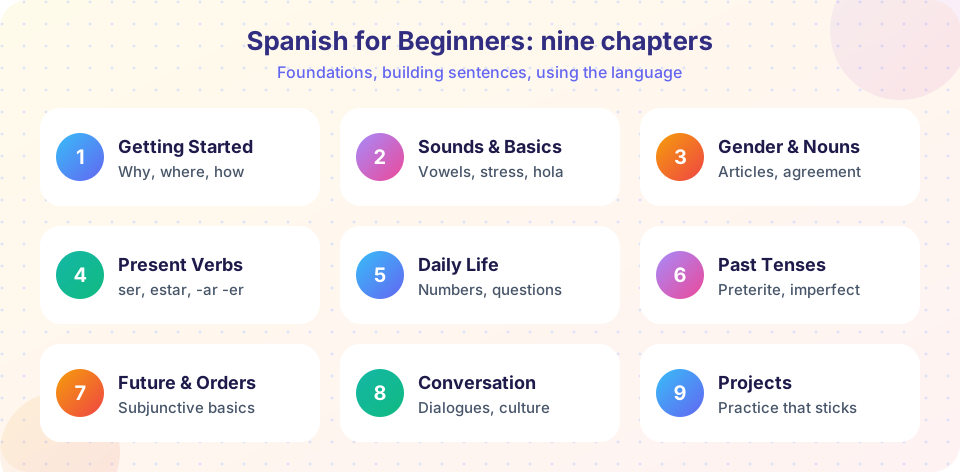
What you will learn
- Who this course is for and what you need before you start.
- How the nine chapters fit together and what each one adds.
- A realistic study plan you can measure in minutes per day.
- Which habits help most when learning a language as an adult or teenager.
Key terms
Target language: the language you are learning (here, Spanish).
Input: Spanish you read or hear. You need a lot of it.
Output: Spanish you speak or write. It exposes gaps that input hides.
Spaced repetition: reviewing material at growing gaps (a day, three days, a week) so it moves into long-term memory.
Cognate: a word that looks alike and means the same in two languages, such as animal or hospital.
Who this course is for
This course suits you if you are about 11 or older, speak English, and have never studied Spanish or studied it long ago and forgot most of it. You do not need to know grammar terms in advance. When we say noun (a person, place, thing or idea), verb (an action or state), adjective (a word that describes a noun) or subject (who does the action), we explain it the first time.
You also do not need a special talent. Adults often assume children learn languages effortlessly and adults cannot. The research picture is more balanced: young children are excellent at absorbing accents, but teenagers and adults learn grammar and vocabulary faster at the start, because they can reason about patterns and already know how language works. What you need is time, regularity and a little courage.
The nine chapters
The course is built in three stages. Each chapter ends with a review lesson and a quiz, so you always know whether to move on.
Stage 1: foundations (chapters 1 to 4). In Getting Started you learn why Spanish is worth learning, where it is spoken, and how to study. In Sounds, Greetings and Basics you learn the alphabet, the five pure vowels, stress rules and your first real conversations. In Nouns, Articles and Adjectives you meet gender (every Spanish noun is masculine or feminine) and agreement. In Present Tense Verbs you learn the two verbs for "to be", ser and estar, and how regular and irregular verbs behave.
Stage 2: building sentences (chapters 5 and 6). Daily Life and Questions covers numbers, time, food, family, and how to ask for things. Past Tenses introduces the two main ways to talk about yesterday, the preterite and the imperfect.
Stage 3: using the language (chapters 7 to 9). Future, Commands and Subjunctive Basics lets you plan, give instructions and express wishes. Conversation and Culture puts everything into dialogues and customs. Projects and Practice gives you tasks to finish and prove your progress.
Stage 1: foundations
- Getting started
- Sounds and greetings
Build the sentence
- Nouns and adjectives
- Present verbs
Use it every day
- Daily life
- Past tenses
Go further
- Future and commands
- Conversation
Prove it
- Projects
How a lesson works
Every content lesson follows the same skeleton so you always know where you are: What you will learn, Key terms, the teaching sections with worked examples, Common misconceptions, Try it (interactive exercises you run in your browser), Check your understanding (a quiz) and a Summary. The Spanish examples always come with an English translation. Where pronunciation matters, you will see the sound written in two ways: a plain English-style respelling in capital letters for the stressed part (for example OH-lah) and, for those who like precision, the International Phonetic Alphabet in slashes, such as /ˈo.la/.
No audio files come with the course. That is why we describe sounds carefully and why several exercises offer a Listen button that asks your browser to read the Spanish aloud. This feature depends on your device and may be unavailable in the preview; nothing in the course requires it. For real audio, pair each lesson with a short video or podcast from a native speaker.
A word on motivation
Language learning is a long game. The first weeks feel exciting because everything is new; the middle weeks can feel flat because progress is slow. That is normal. Keep a simple log of what you can do now that you could not do last week, such as "I can introduce myself", "I can order a coffee" or "I understood a song line". Reading it back on a hard day is more motivating than any pep talk.
Common misconceptions
"Spanish is just English with different words." The vocabulary overlaps a lot, but the grammar does not: nouns have gender, adjectives usually come after the noun, and verb endings change for every person. That is exactly why the chapters go in this order.
"I must lose my accent first." You do not. Clear, understandable Spanish with an English accent is perfectly fine. Understanding matters more than sounding native.
"I need to memorize every verb table." Tables help you see patterns, but you learn to use verbs by meeting them again and again in sentences.
A realistic study plan
How long does it take? The U.S. Foreign Service Institute has long grouped Spanish among the languages that are relatively quick for English speakers, with figures around 600 hours of guided study for professional working proficiency. Treat any such number as a rough guide, not a promise: people differ, and what counts is regular contact. To make the idea concrete, the first exercise below turns your free minutes into a timetable. The second is a set of flashcards with your first ten words. Both are small tools: the calculator simply applies the arithmetic you give it, and the flashcards simply show what we typed.
Try it
The planner uses my own rough estimate of study hours per chapter, so use it only for scheduling, not as a prediction of results.
Press Run (or Ctrl + Enter) to see the result here.
Program input · what you'd type while the program runs
Type the answers before you press Run, one per line. Each time the program reads a line (with input()), it gets the next line from this box.
Check your understanding
Quick check · 4 questions
of 4 answered You scored / 4 · perfect!
-
1. What is the most honest description of this course?
A website can teach and drill, but fluency needs real conversation and listening. -
2. In which chapter do you meet gender and agreement?
Chapter 3, Nouns, Articles and Adjectives, introduces masculine and feminine nouns and agreement. -
3. What is spaced repetition?
Reviews spread over days and weeks beat cramming. -
4. Which statement is true?
Understanding matters far more than sounding native.
Summary
- The course has nine chapters in three stages: foundations, building sentences, using the language.
- You need no grammar background; every term is explained the first time.
- Pronunciation is shown with respellings and IPA; no audio is included, so add real listening.
- Short daily sessions beat long irregular ones; plan in minutes per day.
- A course cannot replace speaking with people.
Track your progress
Create a free account to tick off lessons and pick up where you left off on any device.
of Spanish for Beginners lessons completed