Review Spanish present tense verbs: pronouns, ser and estar, regular -ar -er -ir verbs, stem changes, yo-go verbs and ir, with a recap table and a ten-question quiz.
You now have the engine of Spanish sentences. In this chapter you learned the subject pronouns and how often to drop them, the two verbs for "to be", the three regular families, and the irregular verbs that make up so much of everyday speech. Together with the noun phrases of Chapter 3, you can say a lot: who you are, where you are, what you do, what you want and where you are going.
Use this review to lock in the patterns. Study the one-page summary, run the table through your head, read the model paragraph aloud and take the quiz. If you score below eight out of ten, return to the lesson named in the explanation before starting Chapter 5.
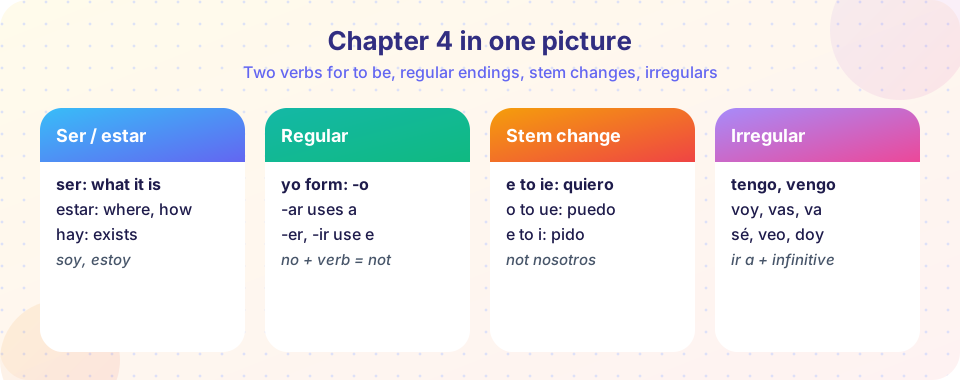
Chapter 4 on one page: two verbs for to be, three families, and the irregular core.
Read it aloud, then say it again with the English covered.
Me llamo Lucía y soy de Bogotá, pero vivo en Madrid. Trabajo en una oficina y estudio inglés por las noches. Mi hermano no vive aquí; está en Lima y trabaja en un banco. Los fines de semana quiero descansar, pero a veces salgo con mis amigos. Hoy tengo hambre y voy a comer en un restaurante pequeño.
My name is Lucía and I am from Bogotá, but I live in Madrid. I work in an office and study English in the evenings. My brother does not live here; he is in Lima and works in a bank. On weekends I want to rest, but sometimes I go out with my friends. Today I am hungry and I am going to eat in a small restaurant.
Count the verb types: soy (ser, origin), vivo, trabajo, estudio (regular), está (estar, location), quiero (stem change), salgo (yo-go), tengo (yo-go and stem change), voy (ir). Notice me llamo, whose full explanation (a reflexive verb) comes later; a veces (sometimes) is a frequency adverb; and voy a comer is ir a + infinitive.
The drill mixes the chapter, and the flashcards review the most frequent verbs in full sentences. Both use fixed lists, not adaptive tests.
Chapter 4 mixed drill
<style>:root{font-family:system-ui,-apple-system,"Segoe UI",sans-serif}body{margin:0;padding:16px;background:linear-gradient(135deg,#fffbeb,#fef2f2);color:#1e1b4b}button{border:0;border-radius:999px;padding:8px 16px;font:inherit;font-weight:600;cursor:pointer;background:#fff;color:#b45309;box-shadow:0 2px 8px rgba(180,83,9,.2)}button:hover{background:#fef3c7}.bar{display:flex;gap:8px;justify-content:center;align-items:center;margin-top:14px;flex-wrap:wrap}.muted{font-size:14px;color:#475569;text-align:center;margin-top:10px}.q{max-width:520px;margin:0 auto;background:#fff;border-radius:20px;padding:20px;box-shadow:0 10px 26px rgba(180,83,9,.15)}.prompt{font-size:22px;font-weight:700;margin:0 0 14px}.opts{display:grid;gap:8px}.opts button{text-align:left;border-radius:14px;background:#fffbeb;border:2px solid #fde68a;color:#1e1b4b}.opts button.ok{background:#d1fae5;border-color:#10b981}.opts button.no{background:#fee2e2;border-color:#ef4444}.fb{min-height:44px;margin-top:12px;font-size:15px;color:#334155}</style><divclass="q"><pclass="prompt"id="prompt"></p><divclass="opts"id="opts"></div><divclass="fb"id="fb"></div></div><divclass="bar"><buttonid="next">Next question</button></div><divclass="muted"id="score"></div><script>const items =[{"q":"Ella ___ de México. (origin)","options":["está","son","es"],"answer":3,"why":"Origin uses ser."},{"q":"¿Dónde ___ el baño? (location)","options":["está","es","son"],"answer":1,"why":"Location uses estar."},{"q":"Nosotros ___ en Madrid. (vivir)","options":["vivemos","vivimos","viven"],"answer":2,"why":"-ir verbs take -imos."},{"q":"Yo ___ la verdad. (decir)","options":["dico","dizo","digo"],"answer":3,"why":"Decir has the yo form digo."},{"q":"¿Tú ___ ir al cine? (querer)","options":["quieres","queres","quiero"],"answer":1,"why":"Querer changes e to ie: quieres."},{"q":"How do you say 'I do not speak German'?","options":["Hablo no alemán.","No hablo alemán.","No yo hablo alemán."],"answer":2,"why":"No goes before the verb."},{"q":"Vamos ___ comer. (We are going to eat.)","options":["de","en","a"],"answer":3,"why":"Ir a + infinitive: vamos a comer."},{"q":"Hace ___ hoy. (It is hot today.)","options":["calor","caliente","calurosa"],"answer":1,"why":"Weather with hacer uses a noun: hace calor."}];let k =0, right =0, tried =0, done =false;const$=(id)=> document.getElementById(id);functionshow(){const it = items[k];
done =false;$("prompt").textContent = it.q;$("fb").textContent ="";$("opts").innerHTML ="";
it.options.forEach((o, n)=>{const b = document.createElement("button");
b.textContent = o;
b.onclick=()=>pick(b, n);$("opts").appendChild(b);});$("score").textContent ="Score: "+ right +" / "+ tried;}functionpick(b, n){if(done)return;
done =true; tried++;const it = items[k], bs =$("opts").children;if(n === it.answer -1){ right++; b.className ="ok";$("fb").textContent ="Correct. "+ it.why;}else{ b.className ="no"; bs[it.answer -1].className ="ok";$("fb").textContent ="Not quite. "+ it.why;}$("score").textContent ="Score: "+ right +" / "+ tried;}$("next").onclick=()=>{ k =(k +1)% items.length;show();};show();</script>
Chapter 4 sentences
<style>:root{font-family:system-ui,-apple-system,"Segoe UI",sans-serif}body{margin:0;padding:16px;background:linear-gradient(135deg,#fffbeb,#fef2f2);color:#1e1b4b}button{border:0;border-radius:999px;padding:8px 16px;font:inherit;font-weight:600;cursor:pointer;background:#fff;color:#b45309;box-shadow:0 2px 8px rgba(180,83,9,.2)}button:hover{background:#fef3c7}.bar{display:flex;gap:8px;justify-content:center;align-items:center;margin-top:14px;flex-wrap:wrap}.muted{font-size:14px;color:#475569;text-align:center;margin-top:10px}.card{max-width:440px;margin:0 auto;border-radius:22px;padding:26px 20px;min-height:150px;display:flex;flex-direction:column;align-items:center;justify-content:center;text-align:center;cursor:pointer;color:#fff;background:linear-gradient(135deg,#f59e0b,#ef4444);box-shadow:0 12px 28px rgba(239,68,68,.25)}.card.back{background:linear-gradient(135deg,#6366f1,#a78bfa)}.big{font-size:32px;font-weight:700}.small{font-size:15px;opacity:.92;margin-top:8px}</style><divclass="card"id="card"tabindex="0"role="button"aria-label="Flip the card"></div><divclass="bar"><buttonid="prev">Previous</button><buttonid="flip">Flip</button><buttonid="next">Next</button><buttonid="say">Listen</button><buttonid="shuf">Shuffle</button></div><divclass="muted"id="info"></div><script>const cards =[["Soy estudiante.","I am a student.","ser"],["Estoy en casa.","I am at home.","estar"],["Hablamos español.","We speak Spanish.","-ar"],["Comes mucho.","You eat a lot.","-er"],["Viven en Lima.","They live in Lima.","-ir"],["Quiero un café.","I want a coffee.","e to ie"],["Tengo hambre.","I am hungry.","tener"],["Voy a trabajar.","I am going to work.","ir a"]];let i =0, back =false;const$=(id)=> document.getElementById(id);functionshow(){const c = cards[i];$("card").className ="card"+(back ?" back":"");$("card").innerHTML = back
?'<div class="big">'+ c[1]+'</div>'+(c[2]?'<div class="small">'+ c[2]+'</div>':''):'<div class="big">'+ c[0]+'</div><div class="small">Click to flip</div>';$("info").textContent ="Card "+(i +1)+" of "+ cards.length;}functiongo(d){ i =(i + d + cards.length)% cards.length; back =false;show();}$("card").onclick =$("flip").onclick=()=>{ back =!back;show();};$("prev").onclick=()=>go(-1);$("next").onclick=()=>go(1);$("shuf").onclick=()=>{ cards.sort(()=> Math.random()-0.5); i =0; back =false;show();};$("say").onclick=()=>{try{const u =newSpeechSynthesisUtterance(cards[i][0].replace(/<[^>]*>/g,""));
u.lang ="es-ES";
speechSynthesis.speak(u);}catch(e){$("info").textContent ="Speech is not available in this preview.";}};show();</script>