


















Lesson 29 of 51 · Past Tenses
The Spanish preterite: regular forms
Learn the Spanish preterite for regular -ar, -er and -ir verbs, spelling changes, stem-changing -ir verbs, time words, and practice with a conjugator.
The preterite is the main tense for telling a story: it reports things that happened and were completed. Ayer hablé con mi madre. (Yesterday I spoke with my mother.) Llegamos a las ocho. (We arrived at eight.) Its forms are simple for regular verbs, but there are three spelling rules and a few stem changes that you should know.
What you will learn
- Conjugate regular -ar, -er and -ir verbs in the preterite.
- Apply the spelling changes of -car, -gar and -zar verbs and of leer and creer.
- Use the stem changes of -ir verbs in the third person.
- Recognize when to use the preterite and its time words.
Key terms
Pretérito (indefinido): the preterite, a simple past tense for completed actions. Terminación: an ending added to the verb stem. Cambio ortográfico: a spelling change that keeps a sound the same. Acento escrito: the written accent in forms like habló. Marcador temporal: a time word such as ayer or anoche.
The regular endings
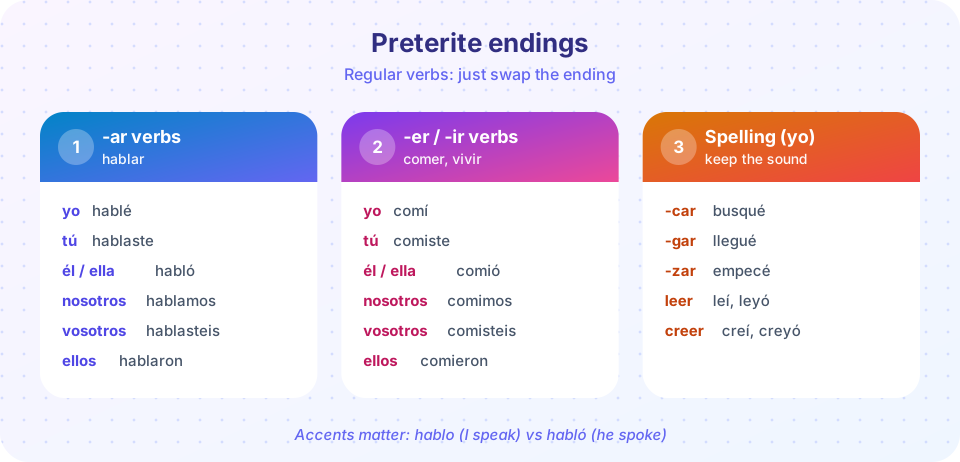
Remove -ar, -er or -ir and add the endings. Note that -er and -ir verbs share the same endings in the preterite.
| Person | -ar (hablar) | -er (comer) | -ir (vivir) |
|---|---|---|---|
| yo | hablé | comí | viví |
| tú | hablaste | comiste | viviste |
| él, ella, usted | habló | comió | vivió |
| nosotros | hablamos | comimos | vivimos |
| vosotros | hablasteis | comisteis | vivisteis |
| ellos, ellas, ustedes | hablaron | comieron | vivieron |
Two points deserve attention. First, the written accents on the yo and él forms (hablé, habló, comí, comió) are not decoration: they separate the preterite from other forms. Hablo (no accent) means "I speak" in the present, while habló means "he spoke". Second, the nosotros form of -ar and -ir verbs is the same in the present and the preterite: hablamos can mean "we speak" or "we spoke", and vivimos can mean "we live" or "we lived". Context tells you which one is meant, usually a time word: Ayer hablamos con el profesor.
Spelling changes in the yo form
Spanish keeps the sound of the last consonant of the stem. When a verb ending in -car, -gar or -zar takes the yo ending -é, the spelling must change. Otherwise the letters would be read differently:
- -car → -qué: buscar → busqué, tocar → toqué, explicar → expliqué, sacar → saqué.
- -gar → -gué: llegar → llegué, pagar → pagué, jugar → jugué, apagar → apagué.
- -zar → -cé: empezar → empecé, almorzar → almorcé, cruzar → crucé, comenzar → comencé.
Only the yo form changes: tú buscaste, él llegó, ellos empezaron are regular. Examples: Busqué las llaves. (I looked for my keys.) Llegué tarde. (I arrived late.) Empecé a estudiar a las cinco. (I began to study at five.)
Another spelling rule applies to -er and -ir verbs whose stem ends in a vowel, such as leer, creer, caer, oír. The unstressed i between two vowels becomes y in the third person: leyó, leyeron, creyó, creyeron, cayó, cayeron. The other forms keep an accent on the í: leí, leíste, leímos, leísteis. So leer is leí, leíste, leyó, leímos, leísteis, leyeron.
Stem changes in -ir verbs
Stem-changing -ar and -er verbs do not change in the preterite: pensar → pensé, pensó; volver → volví, volvió. But stem-changing -ir verbs change in the third person singular and plural only, with the vowel becoming weaker:
- e → i: pedir → pidió, pidieron; servir → sirvió; preferir → prefirió; sentir → sintió; repetir → repitió.
- o → u: dormir → durmió, durmieron; morir → murió, murieron.
The other four forms are regular: pedí, pediste, pedimos, pedisteis. A quick memory trick is the "boot" shape in the present (changes in all but nosotros and vosotros) versus the "two-person" shape in the preterite (only él and ellos). Example: Ella pidió una pizza y ellos durmieron hasta tarde. (She ordered a pizza and they slept until late.)
When to use the preterite
Use the preterite when you present an action as completed and seen as a whole. It often answers "what happened?" Typical uses:
- A single completed event: Ayer vi una película.
- A series of events in order: Me levanté, desayuné y salí de casa.
- An action with a stated limit or duration: Viví en Madrid dos años. (I lived in Madrid for two years, and it ended.)
- The beginning or end of something: La clase empezó a las nueve.
Time words that point to the preterite: ayer (yesterday), anoche (last night), anteayer (the day before yesterday), el lunes pasado (last Monday), la semana pasada, el año pasado, hace dos días (two days ago), de repente (suddenly), una vez (once), entonces (then), en 2019 and por fin (at last).
Common misconceptions
- "The preterite is only for short actions." It can describe long ones (Viví allí diez años) as long as they are presented as complete.
- "Every verb with a stem change changes in the preterite." Only -ir verbs do, and only in the third person.
- "The accent doesn't matter." Hablo / habló, compro / compró are different tenses.
- "Yo llegé is fine." It is llegué. The u keeps the hard g sound.
Worked examples
Example 1. Translate: "Last week I paid the bill and started a new book." Pick the verbs: pagar and empezar, both with spelling changes in the yo form. La semana pasada pagué la cuenta y empecé un libro nuevo. The time phrase la semana pasada confirms that we need the preterite.
Example 2. Ask someone about last night: ¿Qué comiste anoche? (What did you eat last night?) ¿Dónde trabajaste ayer? (Where did you work yesterday?) ¿A qué hora llegaron ustedes? (What time did you all arrive?) Answers repeat the verb with yo or nosotros: Comí pasta. Trabajé en casa. Llegamos a las nueve.
Example 3. Negative sentences: No hablé con nadie. (I did not speak to anyone.) Nunca viví en el extranjero. (I never lived abroad.) The object pronoun goes before the verb: Lo compré ayer. La vi en la fiesta. Te llamé anoche.
Telling a sequence
Stories need connecting words. Combine the preterite with primero (first), luego or después (then), más tarde (later), finalmente or por fin (finally) and antes de (before): Primero abrí la puerta. Luego entré y encendí la luz. Después cerré con llave. (First I opened the door. Then I went in and turned on the light. Afterwards I locked up.) Each verb ends before the next begins, which is exactly the picture the preterite paints.
In much of Latin America people prefer the preterite even for things that happened today: Hoy comí temprano. In Spain the present perfect often appears: Hoy he comido temprano. Both are correct. You will meet the perfect in a later lesson.
Try it
The conjugator below builds preterite forms with the rules from this lesson, including spelling changes, y-verbs and -ir stem changes. Add your own verbs to the list at the bottom (only regular patterns).
Press Run (or Ctrl + Enter) to see the result here.
Program input · what you'd type while the program runs
Type the answers before you press Run, one per line. Each time the program reads a line (with input()), it gets the next line from this box.
Next, type the correct preterite forms. The checker accepts accents only exactly as written, but tells you when only an accent is missing.
Check your understanding
Quick check · 5 questions
of 5 answered You scored / 5 · perfect!
-
1. What is the yo preterite of "llegar"?
The u is added to keep the hard g sound: llegué. -
2. Which form means "she spoke"?
The accent on the o marks the preterite third person: habló. -
3. What is the preterite of "dormir" for ellos?
Stem-changing -ir verbs change in the third person: durmieron. -
4. Which form of "leer" is correct for ella?
The i becomes y between two vowels: leyó. -
5. "Hablamos" can be present or preterite. What helps you decide?
Nosotros forms of -ar verbs are identical in both tenses; time words tell you which one is meant.
Summary
- Regular preterite: -ar → é, aste, ó, amos, asteis, aron; -er/-ir → í, iste, ió, imos, isteis, ieron.
- Spelling: -car → qué, -gar → gué, -zar → cé in the yo form; i becomes y in leyó, creyó.
- -ir stem changes (e→i, o→u) appear only in third person singular and plural.
- Use the preterite for completed events, sequences and bounded durations, with words like ayer and anoche.
Track your progress
Create a free account to tick off lessons and pick up where you left off on any device.
of Spanish for Beginners lessons completed