


















Lesson 3 of 51 · Getting Started
Spanish Around the World
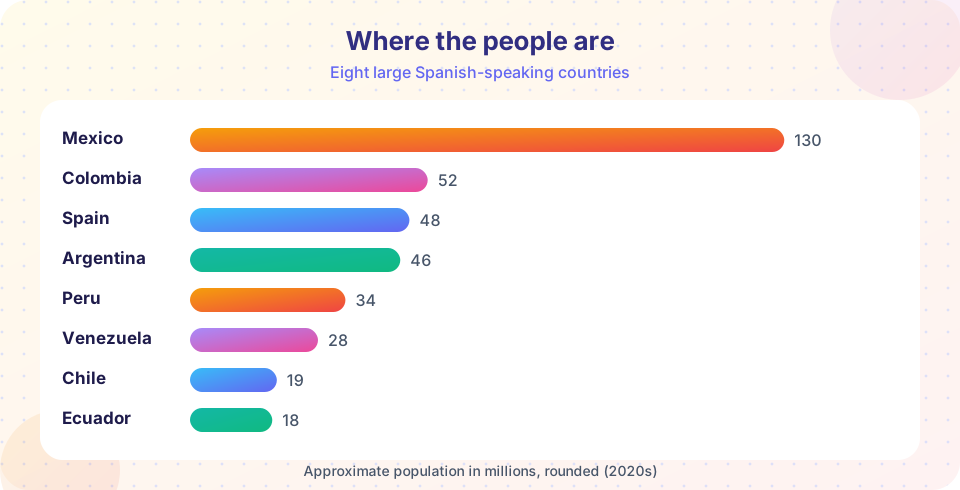
Learn where Spanish is spoken, how it grew from Latin, and how Spain and Latin America differ in pronouns, pronunciation and vocabulary, with a rounded population chart.
Spanish is not one fixed thing. It is a family of closely related varieties spoken across Europe, the Americas, Africa and parts of Asia, with a shared grammar core and many small differences in sound and vocabulary. Knowing the map early prevents two common beginner worries: "Which Spanish should I learn?" and "Why did the person from Argentina say it differently from my course?"
The short answer to the first question is this: learn the standard core in this course, which everybody understands, and then tune your ear to the region you care about. The second answer is the rest of this lesson.
What you will learn
- How many people speak Spanish and where, with hedged numbers.
- Where Spanish came from and why it looks like Latin.
- The main differences between Spain and Latin America.
- How to choose a variety to focus on without worrying.
Key terms
Native speaker: someone who grew up speaking the language at home.
Seseo: pronouncing the letters c (before e, i) and z like s, as in most of Latin America and the Canary Islands.
Voseo: using vos instead of tú for "you" (singular, informal), as in Argentina, Uruguay and parts of Central America.
Vosotros: the informal "you all" used in most of Spain; Latin America uses ustedes for all "you all".
How many speakers, and where
Spanish is the official language of 20 sovereign countries: Spain, Equatorial Guinea (in Africa) and 18 countries in the Americas: Mexico, Guatemala, Honduras, El Salvador, Nicaragua, Costa Rica, Panama, Cuba, the Dominican Republic, Colombia, Venezuela, Ecuador, Peru, Bolivia, Paraguay, Chile, Argentina and Uruguay. Puerto Rico, a United States territory, uses it widely too. Brazil speaks Portuguese, and Belize speaks English, even though both are in the region.
Estimates from the Instituto Cervantes put the number of native speakers at roughly 500 million, and the number of people with at least some command of Spanish at over 600 million. Only Mandarin Chinese has more native speakers. These figures change every year, so take them as orders of magnitude, not exact counts.
The United States deserves a note: tens of millions of people there speak Spanish at home, which makes the U.S. one of the largest Spanish-speaking communities in the world even though Spanish is not an official federal language. You can practice without leaving your own city in many places.
Where Spanish came from
Spanish began as a spoken Latin dialect in the north of the Iberian Peninsula, in the region called Castile. That is why Spanish is also called castellano (Castilian), and in many countries people use that word. Over centuries the language was shaped by contact with other peoples. Arabic, spoken in much of the peninsula from the 8th century, left thousands of words: aceite (oil), azúcar (sugar), almohada (pillow), ojalá (I hope so). From the end of the 15th century, Spanish spread to the Americas and the Philippines, where it absorbed words from indigenous languages: chocolate and tomate from Nahuatl, canoa from Taíno, puma from Quechua. Spanish returned some of these to English.
From this history comes a practical rule: if a Spanish word looks similar to an English word, it often shares a Latin source. Latin nox, noctis gave Spanish noche; Latin aqua gave agua.
Spain and Latin America: the main differences
Pronouns: vosotros, ustedes and vos
English has one you. Spanish has several, depending on number and formality, and it also varies by region:
| Meaning | Spain | Most of Latin America | Parts of Latin America |
|---|---|---|---|
| you (informal, one person) | tú | tú | vos (Argentina, Uruguay, Paraguay, parts of Central America) |
| you (formal, one person) | usted | usted | usted |
| you all (informal) | vosotros / vosotras | ustedes | ustedes |
| you all (formal) | ustedes | ustedes | ustedes |
You will learn all the forms in Chapters 2 and 4. The good news: if you use tú, usted and ustedes, you are understood everywhere.
Pronunciation
Three differences matter most. First, in most of Spain, c before e or i, and z, are pronounced like English th in thin: gracias sounds like GRAH-thyahs. In Latin America and the Canary Islands the same letters are pronounced like s: GRAH-syahs. Second, ll and y are pronounced like a y or a zh-like sound in different regions; in much of Argentina and Uruguay it is like the s in measure or sh. Third, in the Caribbean, Andalusia and elsewhere, a syllable-final s is often weakened or dropped, so ¿cómo estás? may sound like ¿cómo etá?.
Vocabulary
| English | Spain | Latin America (common) |
|---|---|---|
| computer | ordenador | computadora / computador |
| cell phone | móvil | celular |
| juice | zumo | jugo |
| potato | patata | papa |
| car | coche | carro / auto |
The differences are real but limited. A traveler from Madrid and one from Mexico City talk to each other without trouble.
Other languages in the Spanish-speaking world
Spanish is rarely the only language. In Spain, Catalan, Galician and Basque are co-official in their regions, and many people grow up bilingual. In Latin America, hundreds of indigenous languages are spoken: Guaraní is co-official with Spanish in Paraguay and spoken by most Paraguayans, Quechua is official in parts of Peru, and Nahuatl and Maya languages are spoken by millions in Mexico and Central America. This matters for learners because you will hear loanwords, place names and food names from these languages, and because bilingual speakers may transfer rhythm and sounds into their Spanish.
It also helps to remember that Spanish is a living language with online communities. Films, series, music and videos from Spain, Mexico, Colombia, Argentina and many other countries are widely available, and each country has its own humor, slang and accent. Start with whatever you enjoy; motivation matters more than the perfect accent.
Common misconceptions
"Spanish in Spain is the correct one." It is the historical home of the language, but no variety is more correct. Mexico has by far the most native speakers.
"Latin Americans all speak the same." The Spanish of Buenos Aires, Bogotá, Mexico City and Havana differ clearly in accent, slang and some grammar.
"Castilian and Spanish are different languages." They are two names for the same language; castellano also distinguishes it from other languages of Spain such as Catalan, Galician and Basque.
Which variety should you choose?
Pick the one you will hear most: the country you plan to visit, the community where you live, or the music and shows you like. Do not agonize. Ninety-five percent of what you learn is shared. If you have no preference, a neutral Latin American accent with ustedes is the most widely understood choice because there are more speakers in the Americas than in Spain.
Try it
The first drill asks which word is typical of Spain; the second exercise is a small Python helper showing how the pronoun choice depends on region. It simply looks up a table we typed; it is not a language model.
Press Run (or Ctrl + Enter) to see the result here.
Program input · what you'd type while the program runs
Type the answers before you press Run, one per line. Each time the program reads a line (with input()), it gets the next line from this box.
Check your understanding
Quick check · 5 questions
of 5 answered You scored / 5 · perfect!
-
1. Roughly how many native speakers does Spanish have?
Estimates put native speakers at roughly 500 million, with over 600 million people speaking it to some degree. -
2. In most of Spain, how are the letters z and c (before e or i) pronounced?
This sound is common in Spain; Latin America and the Canary Islands pronounce them like s (seseo). -
3. Which word means 'you all (informal)' in most of Latin America?
Latin America uses ustedes for all groups; vosotros is mostly used in Spain. -
4. Which country has Spanish as an official language?
Equatorial Guinea in Africa is the only African country with Spanish as an official language. -
5. Which is NOT a reason for Spanish vocabulary differences?
All Spanish countries use the same alphabet; history and contact with other languages caused vocabulary differences.
Summary
- Spanish is official in 20 sovereign countries and has about half a billion native speakers.
- It grew out of Latin in Castile, with Arabic and indigenous-language loans.
- Main differences: pronouns (vosotros, vos), the pronunciation of z and c, and everyday vocabulary.
- Learn the shared core; tune to your target region later.
- No variety is more correct than another.
Next: Study Habits That Work
Track your progress
Create a free account to tick off lessons and pick up where you left off on any device.
of Spanish for Beginners lessons completed