Chapter 1 overview: why Spanish is worth learning, where it is spoken, how to study it, and what each lesson of the chapter covers before you open your first word.
Every language course starts with the same question: why bother? If you can answer it clearly, you will keep going when the verb tables get tough. Spanish gives a lot of reasons. It is spoken by hundreds of millions of people on several continents, it opens doors to music, literature, film and travel, it is a useful professional skill in many countries, and for an English speaker it is among the most approachable foreign languages, because a large share of English vocabulary comes from Latin, often through French, and Spanish descended from Latin too.
This chapter is short on purpose. You will not memorize a lot; you will build the mental frame that makes the next eight chapters easier. You will see where Spanish lives, how its regional varieties differ, and how to build a study routine that fits real life.
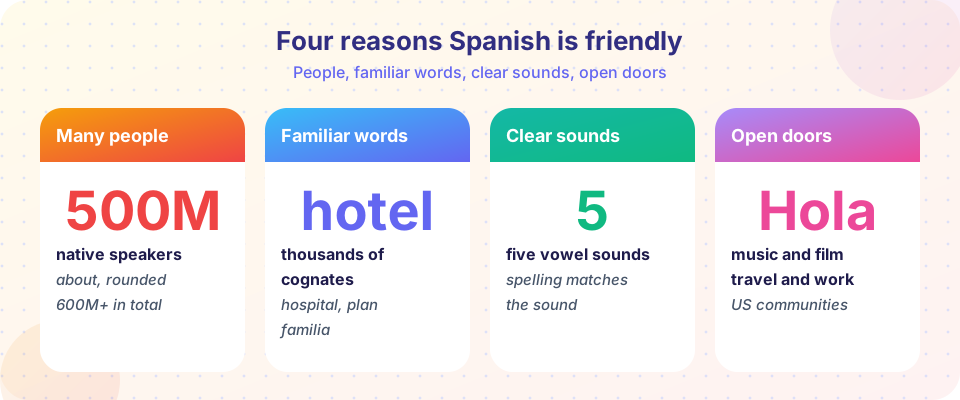
Four reasons Spanish is a friendly first foreign language for English speakers.
First, the sound system is small and regular. Spanish has five vowel sounds, and each one is always pronounced the same way. English has far more vowel sounds and spells them chaotically (think of though, through, tough, cough). In Spanish, if you can read the letters you can say the word. You will see this in Chapter 2.
Second, the vocabulary is familiar. English borrowed thousands of words from Latin, directly or through French. Spanish descended from Latin. So nación, natural, importante, familia, doctor, hospital, chocolate, banana and plan are instantly recognizable. Spanish also gave English words like patio, canyon, tornado, mosquito and burrito.
Third, the word order is similar. "I eat bread" is Yo como pan: subject, verb, object, the same order as English. Differences exist (adjectives usually follow nouns, and you often skip the subject pronoun), but the basic skeleton is familiar.
The challenges are real too, and we will not hide them. Nouns have gender, verbs change form for every person and tense, and a few sounds (the rolled rr, the soft d in nada) take practice. Chapters 3 and 4 spend patient time on exactly those.
"I will confuse it with other languages." Beginners sometimes worry about mixing Spanish with French or Italian. A little mixing is normal and fades as each language gets its own habits.
"Spanish is only for travel." It is also widely used online, in science, business, and in communities across the United States, where it is the most-spoken language after English.
"There is one correct Spanish." There are many correct varieties. The grammar in this course is understood everywhere; we flag differences where they matter.
The first drill checks a surprising claim: you already understand a lot of Spanish. The second shows the other side, false friends that trick beginners.
Can you guess the meaning?
<style>:root{font-family:system-ui,-apple-system,"Segoe UI",sans-serif}body{margin:0;padding:16px;background:linear-gradient(135deg,#fffbeb,#fef2f2);color:#1e1b4b}button{border:0;border-radius:999px;padding:8px 16px;font:inherit;font-weight:600;cursor:pointer;background:#fff;color:#b45309;box-shadow:0 2px 8px rgba(180,83,9,.2)}button:hover{background:#fef3c7}.bar{display:flex;gap:8px;justify-content:center;align-items:center;margin-top:14px;flex-wrap:wrap}.muted{font-size:14px;color:#475569;text-align:center;margin-top:10px}.q{max-width:520px;margin:0 auto;background:#fff;border-radius:20px;padding:20px;box-shadow:0 10px 26px rgba(180,83,9,.15)}.prompt{font-size:22px;font-weight:700;margin:0 0 14px}.opts{display:grid;gap:8px}.opts button{text-align:left;border-radius:14px;background:#fffbeb;border:2px solid #fde68a;color:#1e1b4b}.opts button.ok{background:#d1fae5;border-color:#10b981}.opts button.no{background:#fee2e2;border-color:#ef4444}.fb{min-height:44px;margin-top:12px;font-size:15px;color:#334155}</style><divclass="q"><pclass="prompt"id="prompt"></p><divclass="opts"id="opts"></div><divclass="fb"id="fb"></div></div><divclass="bar"><buttonid="next">Next question</button></div><divclass="muted"id="score"></div><script>const items =[{"q":"What does 'importante' mean?","options":["imported","important","impotent"],"answer":2,"why":"A true cognate: importante means important."},{"q":"What does 'hospital' mean?","options":["a hotel","a guest","a hospital"],"answer":3,"why":"Same word, same meaning, different pronunciation: /os.piˈtal/."},{"q":"What does 'familia' mean?","options":["family","famine","fame"],"answer":1,"why":"La familia is the family."},{"q":"What does 'restaurante' mean?","options":["a rest area","restaurant","a bakery"],"answer":2,"why":"El restaurante is a restaurant, with the e at the end."},{"q":"What does 'nación' mean?","options":["a nationality form","a notion","a nation"],"answer":3,"why":"Words ending in -tion in English often end in -ción in Spanish: nación, acción, información."}];let k =0, right =0, tried =0, done =false;const$=(id)=> document.getElementById(id);functionshow(){const it = items[k];
done =false;$("prompt").textContent = it.q;$("fb").textContent ="";$("opts").innerHTML ="";
it.options.forEach((o, n)=>{const b = document.createElement("button");
b.textContent = o;
b.onclick=()=>pick(b, n);$("opts").appendChild(b);});$("score").textContent ="Score: "+ right +" / "+ tried;}functionpick(b, n){if(done)return;
done =true; tried++;const it = items[k], bs =$("opts").children;if(n === it.answer -1){ right++; b.className ="ok";$("fb").textContent ="Correct. "+ it.why;}else{ b.className ="no"; bs[it.answer -1].className ="ok";$("fb").textContent ="Not quite. "+ it.why;}$("score").textContent ="Score: "+ right +" / "+ tried;}$("next").onclick=()=>{ k =(k +1)% items.length;show();};show();</script>
False friends to watch out for
<style>:root{font-family:system-ui,-apple-system,"Segoe UI",sans-serif}body{margin:0;padding:16px;background:linear-gradient(135deg,#fffbeb,#fef2f2);color:#1e1b4b}button{border:0;border-radius:999px;padding:8px 16px;font:inherit;font-weight:600;cursor:pointer;background:#fff;color:#b45309;box-shadow:0 2px 8px rgba(180,83,9,.2)}button:hover{background:#fef3c7}.bar{display:flex;gap:8px;justify-content:center;align-items:center;margin-top:14px;flex-wrap:wrap}.muted{font-size:14px;color:#475569;text-align:center;margin-top:10px}.card{max-width:440px;margin:0 auto;border-radius:22px;padding:26px 20px;min-height:150px;display:flex;flex-direction:column;align-items:center;justify-content:center;text-align:center;cursor:pointer;color:#fff;background:linear-gradient(135deg,#f59e0b,#ef4444);box-shadow:0 12px 28px rgba(239,68,68,.25)}.card.back{background:linear-gradient(135deg,#6366f1,#a78bfa)}.big{font-size:32px;font-weight:700}.small{font-size:15px;opacity:.92;margin-top:8px}</style><divclass="card"id="card"tabindex="0"role="button"aria-label="Flip the card"></div><divclass="bar"><buttonid="prev">Previous</button><buttonid="flip">Flip</button><buttonid="next">Next</button><buttonid="say">Listen</button><buttonid="shuf">Shuffle</button></div><divclass="muted"id="info"></div><script>const cards =[["embarazada","pregnant (not embarrassed)","embarrassed is avergonzado or apenado"],["éxito","success (not exit)","exit is salida"],["librería","bookstore (not library)","library is biblioteca"],["actualmente","currently (not actually)","actually is en realidad"],["constipado","having a cold (not constipated)","in parts of Latin America it can mean constipated, so check the region"],["carpeta","folder (not carpet)","carpet is alfombra"],["sensible","sensitive (not sensible)","sensible is sensato"]];let i =0, back =false;const$=(id)=> document.getElementById(id);functionshow(){const c = cards[i];$("card").className ="card"+(back ?" back":"");$("card").innerHTML = back
?'<div class="big">'+ c[1]+'</div>'+(c[2]?'<div class="small">'+ c[2]+'</div>':''):'<div class="big">'+ c[0]+'</div><div class="small">Click to flip</div>';$("info").textContent ="Card "+(i +1)+" of "+ cards.length;}functiongo(d){ i =(i + d + cards.length)% cards.length; back =false;show();}$("card").onclick =$("flip").onclick=()=>{ back =!back;show();};$("prev").onclick=()=>go(-1);$("next").onclick=()=>go(1);$("shuf").onclick=()=>{ cards.sort(()=> Math.random()-0.5); i =0; back =false;show();};$("say").onclick=()=>{try{const u =newSpeechSynthesisUtterance(cards[i][0].replace(/<[^>]*>/g,""));
u.lang ="es-ES";
speechSynthesis.speak(u);}catch(e){$("info").textContent ="Speech is not available in this preview.";}};show();</script>