


















Lesson 20 of 51 · Present Tense Verbs
Irregular Verbs in the Present
Learn the irregular present tense in Spanish: stem-changing verbs, yo-go verbs, ir, tener, hacer, decir, plus tener and hacer expressions, with a conjugator and drills.
Some of the most useful Spanish verbs break the regular patterns: tener (to have), hacer (to do, make), ir (to go), querer (to want), poder (to be able) and decir (to say). They are frequent because they carry basic ideas of life: possession, action, movement, desire and speech. So you meet them constantly, and the repetition helps you learn them.
The good news is that the irregularities are not random. They fall into a few families with simple rules: stem-changing verbs, yo-go verbs, verbs with a special first-person form, and a small set of really irregular verbs. This lesson sorts them into those families so you learn rules, not isolated forms.
What you will learn
- The three stem-change patterns (e → ie, o → ue, e → i) and the boot shape.
- Yo-go verbs and verbs with a special yo form.
- The fully irregular verbs ir, tener, hacer and decir.
- Everyday expressions with tener and hacer.
Key terms
Stem-changing verb: a verb whose stem vowel changes when the stress falls on the stem.
Boot verb: a nickname for stem-changing verbs; the forms that change form a boot shape in a conjugation table.
Yo-go verb: a verb whose yo form ends in -go (tengo, hago, pongo).
Irregular yo: any verb with a special first-person singular form (sé, veo, conozco).
Stem-changing verbs
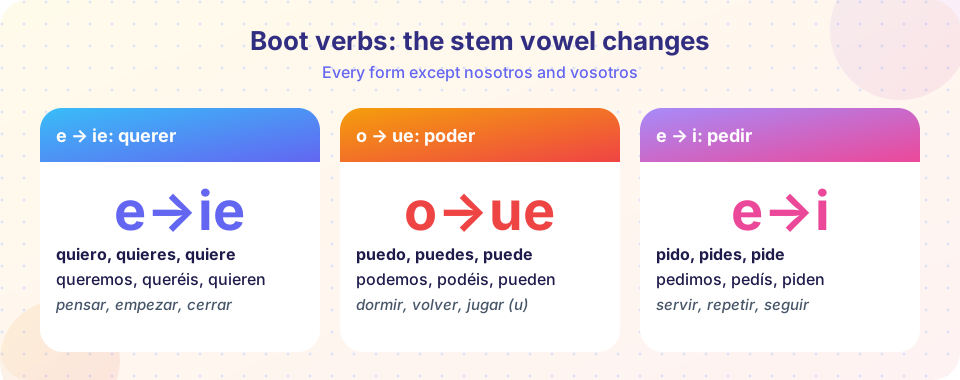
In many verbs, the vowel in the stem changes when it is stressed. Because the stress falls on the stem in the singular and ellos forms but on the ending in nosotros and vosotros, those last two forms keep the original vowel. Draw a line around the four changing forms and you get the shape of a boot, hence the name.
e → ie. querer (to want): quiero, quieres, quiere, queremos, queréis, quieren. Other verbs: pensar (to think), empezar (to begin), preferir (to prefer), cerrar (to close), entender (to understand), perder (to lose).
o → ue. poder (to be able to): puedo, puedes, puede, podemos, podéis, pueden. Others: dormir (to sleep), volver (to return), encontrar (to find), costar (to cost), contar (to count, tell), almorzar (to have lunch). Jugar (to play) changes u → ue: juego, juegas, juega, jugamos, jugáis, juegan.
e → i (only -ir verbs). pedir (to ask for): pido, pides, pide, pedimos, pedís, piden. Others: servir (to serve), repetir (to repeat), seguir (to follow, continue; sigo).
Examples: Quiero un café. (I want a coffee.) ¿Puedes ayudarme? (Can you help me?) Duermo ocho horas. (I sleep eight hours.) Pedimos la cuenta. (We ask for the bill.) Empieza a las nueve. (It starts at nine.)
You do not need a special rule for each verb; the dictionary or textbook marks them, for example querer (ie). Treat the verbs in this lesson as the core set.
Yo-go verbs
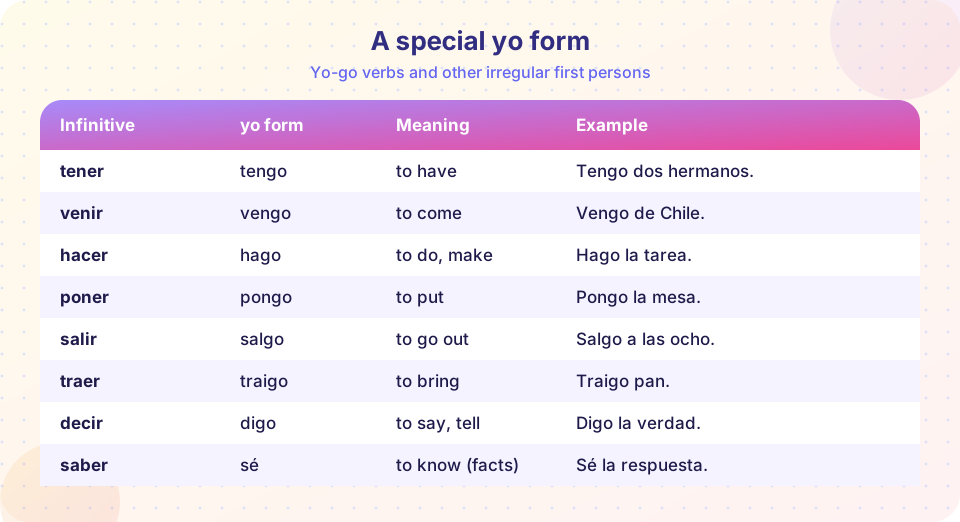
A group of verbs ends in -go in the yo form and is otherwise regular, or stem-changing, as in tener and venir:
| Verb | Full conjugation |
|---|---|
| tener (to have) | tengo, tienes, tiene, tenemos, tenéis, tienen |
| venir (to come) | vengo, vienes, viene, venimos, venís, vienen |
| hacer (to do, make) | hago, haces, hace, hacemos, hacéis, hacen |
| poner (to put) | pongo, pones, pone, ponemos, ponéis, ponen |
| salir (to go out) | salgo, sales, sale, salimos, salís, salen |
| decir (to say) | digo, dices, dice, decimos, decís, dicen |
Notice that tener, venir and decir combine a stem change with the -go (or -igo) yo. A few more verbs only change the yo form: saber (to know a fact: sé), ver (to see: veo), dar (to give: doy) and conocer (to be familiar with, to know a person or place: conozco). Saber and conocer both mean "to know", but saber is for facts and skills (Sé la respuesta, Sé nadar) and conocer for people and places (Conozco a Ana, Conozco Madrid).
Fully irregular: ir
The verb ir (to go) has its own set of forms: voy, vas, va, vamos, vais, van. It is almost always followed by a and a place or an infinitive:
- Voy a la escuela. I go to school. Vamos al cine. We go to the cinema.
- Voy a estudiar. I am going to study. This ir a + infinitive pattern is the standard way to talk about the near future, and you will use it constantly.
- ¿Adónde vas? Where are you going?
Tener and hacer expressions
Spanish uses tener (to have) for many states that English expresses with to be:
| Spanish | English |
|---|---|
| Tengo hambre. | I am hungry. |
| Tengo sed. | I am thirsty. |
| Tengo frío / calor. | I am cold / hot. |
| Tengo sueño. | I am sleepy. |
| Tengo miedo. | I am afraid. |
| Tengo prisa. | I am in a hurry. |
| Tengo razón. | I am right. |
| Tengo veinte años. | I am twenty years old. |
And hacer (to do, make) is used for the weather: Hace frío (It is cold), Hace calor (It is hot), Hace sol (It is sunny), Hace viento (It is windy). For rain and snow, use other verbs: Llueve (It rains), Nieva (It snows). Do not say Estoy veinte años or Soy hambre: with tener the noun stays a noun, so you use mucho/mucha to intensify: Tengo mucha hambre (I am very hungry), not muy hambre.
Putting it together
A short conversation with five irregular verbs:
| Spanish | English |
|---|---|
| ¿Qué quieres hacer hoy? | What do you want to do today? |
| Quiero ir al parque. ¿Puedes venir? | I want to go to the park. Can you come? |
| Sí, pero primero tengo que trabajar. | Yes, but first I have to work. |
| Está bien. Salgo a las cinco. | Fine. I leave at five. |
| Perfecto. Nos vemos allí. | Perfect. See you there. |
Notice two patterns. Querer, poder and tener que all combine with an infinitive: quiero ir, puedes venir, tengo que trabajar (I have to work). That is one of the biggest shortcuts in Spanish: conjugate the first verb, leave the second one in the infinitive.
Learning irregular verbs without tears
Irregular verbs look scary in a table but are easy in use, because you meet them in short repeated phrases. Learn them in chunks rather than as full conjugations: quiero un café, quiero ir, ¿quieres venir?; puedo ayudar, ¿puedes repetir?; tengo hambre, tengo que irme, tengo veinte años. Each chunk teaches one or two forms in a useful context. After a few weeks of speaking, the full table follows naturally.
One more trick: say the forms to a rhythm. The boot pattern has a natural beat: quiero, quieres, quiere, queremos, queréis, quieren. The nosotros form is the only one in the middle that sounds different, which is exactly why it feels like a "boot".
Common misconceptions
"The stem changes in every form." Not in nosotros and vosotros: queremos, podemos.
"Tengo 20 años is the same as I am 20 years." Age uses tener in Spanish (I have 20 years), never ser or estar.
"Saber and conocer are interchangeable." Use saber for facts and skills, conocer for people, places and being familiar with something.
"Hacer only means to do." It also means to make, and it is the weather verb.
Try it
The conjugator below applies stem changes, yo-go forms and ir. It uses rules and small tables, so it works for the verbs in this lesson but not for every Spanish verb. Then a drill and flashcards.
Press Run (or Ctrl + Enter) to see the result here.
Program input · what you'd type while the program runs
Type the answers before you press Run, one per line. Each time the program reads a line (with input()), it gets the next line from this box.
Check your understanding
Quick check · 5 questions
of 5 answered You scored / 5 · perfect!
-
1. What is the yo form of 'poder'?
O changes to ue in the stressed stem: puedo. -
2. Which form of 'querer' does NOT change its stem?
Nosotros and vosotros keep the original vowel. -
3. How do you say 'We are going to study'?
Ir a + infinitive expresses the near future. -
4. Which verb means 'to know a person'?
Conocer is for people, places and familiarity; saber is for facts and skills. -
5. How do you say 'I have to work'?
Tener que + infinitive means to have to.
Summary
- Stem-changing verbs change e → ie, o → ue or e → i in every form except nosotros and vosotros.
- Yo-go verbs: tengo, vengo, hago, pongo, salgo, digo; also special yo forms: sé, veo, doy, conozco.
- Ir is fully irregular: voy, vas, va, vamos, vais, van; ir a + infinitive is the near future.
- Tener expresses hunger, thirst, age and more; hacer expresses weather.
- Use querer, poder and tener que with an infinitive.
Next: Chapter 4 Review
Track your progress
Create a free account to tick off lessons and pick up where you left off on any device.
of Spanish for Beginners lessons completed