Learn how Spanish varies across Spain and Latin America: tú, vos, vosotros and ustedes, pronunciation, regional vocabulary and how to cope with accents.
Spanish is the official language of about twenty countries, from Spain to Argentina, and it is spoken by nearly half a billion native speakers. Like English, it has regional varieties. A Mexican, a Spaniard, an Argentine and a Colombian all understand each other, but they use some different words, pronounce certain sounds differently and even choose different pronouns. This lesson gives you a map of the main differences so that you are not surprised when you meet them.
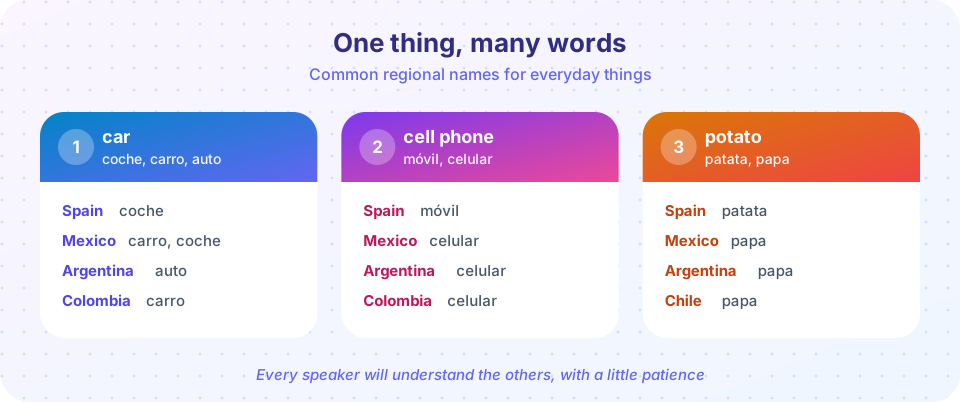
The same object has different everyday names in different countries.
Variedad regional: a regional variety of the language.
Voseo: using vos instead of (or alongside) tú.
Seseo / distinción: pronouncing z and c like s (seseo) or like English th (distinción).
Yeísmo: pronouncing ll and y the same way.
Regionalismo: a word or phrase typical of one region.
All Spanish speakers share a core of grammar and vocabulary. The language academies of Spain and Latin America (the Association of Academies of the Spanish Language) publish a common dictionary and grammar. Some people call the language español and others castellano, especially in Argentina, Chile and Spain, where castellano distinguishes Spanish from regional languages such as Catalan, Galician and Basque. In Latin America, Spanish also shares the stage with languages such as Quechua (official in Peru), Guaraní (official in Paraguay), Nahuatl and many Mayan languages, which have given Spanish words like chocolate, tomate and aguacate. In the United States, Spanish is spoken by tens of millions of people and has its own mixtures with English.
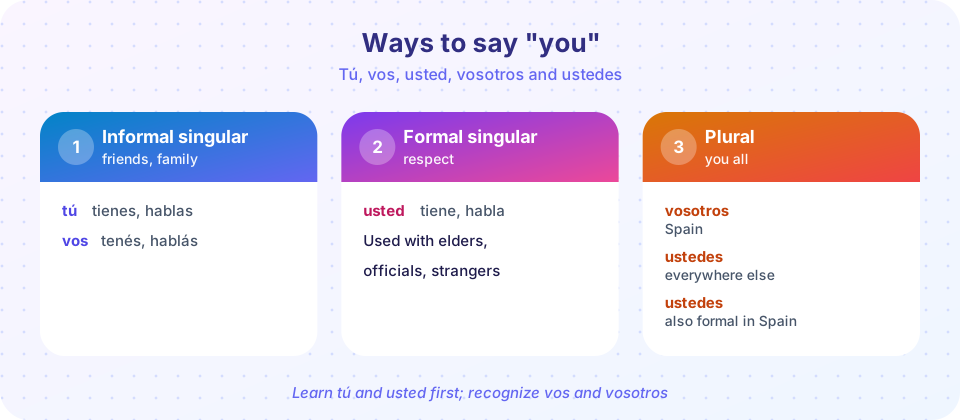
This is the biggest grammatical difference you will notice.
tú is the informal singular "you" in Spain, Mexico and many countries. Forms: tienes, hablas, vives.
usted is the formal singular "you" everywhere: tiene, habla, vive. It is also used instead of tú among friends in some regions, for example in parts of Colombia and Costa Rica.
vos replaces or coexists with tú in Argentina, Uruguay, Paraguay, much of Central America and in parts of countries such as Colombia, Venezuela, Ecuador and Chile. The present forms stress the last syllable: vos tenés, vos hablás, vos vivís, vos sos. Informal commands also differ: hablá, comé, vení, decime. If you learn tú first, people understand you everywhere.
vosotros is the informal plural in Spain: tenéis, habláis, vivís. In Latin America it is not used. Latin Americans say ustedes for every plural "you", formal or informal. In Spain, ustedes is the formal plural.
Pronouns for "you" across the Spanish-speaking world.
A safe beginner strategy: use tú with children, friends and peers, usted with strangers, older people and in formal situations, and ustedes for groups, except in Spain with friends, where you would recognize and understand vosotros. If someone says Tutéame or Háblame de tú (Use tú with me), switch.
Seseo and distinción. In most of Spain, z and c before e/i sound like the th in "think" (cinco is "THEEN-ko"), a feature called distinción. In Latin America, the Canary Islands and parts of southern Spain, they sound like s (cinco is "SEEN-ko"), called seseo. Both are standard.
Yeísmo. Most speakers pronounce ll and y the same (calle, playa). In Argentina and Uruguay they are often pronounced like the sh in "measure" or "show", so calle sounds like "CA-zhe" or "CA-she".
Weak final s. In the Caribbean, in Andalusia and in parts of South America (including Chile and coastal areas) the s at the end of a syllable is often weakened or dropped: ¿cómo estás? can sound like "¿cómo etá?".
Intonation and speed. Each region has its own melody. Some varieties sound fast, others sing; the vowels remain remarkably stable, which is why Spanish is considered easy to understand compared with other languages.
The word coger is neutral in Spain (coger el autobús) but has a vulgar meaning in parts of Latin America, such as Mexico and Argentina, so tomar is safer. Other regional words give color to conversation: guay (cool, Spain), chévere (cool, Colombia, Venezuela and the Caribbean), padre (cool, Mexico), bacán (cool, Chile and Peru). The diminutive -ito/-ita is used almost everywhere, with differences: ahorita (right now) is common in Mexico and several other countries, where it can mean anything from "right now" to "in a little while". Do not worry about learning all of this; you will learn more as you listen to speakers from different places.
In Spain the present perfect is used more for recent events (Hoy he comido), while Latin America often prefers the preterite (Hoy comí). The vosotros forms exist only in Spain. The use of vos with its own verb forms is a Latin American phenomenon. Pronouns such as lo/la/le are used with slightly different habits in different places, a topic for later study.
Common misconceptions
"Latin American Spanish is wrong or simplified." Both varieties are standard and correct; they differ, they do not compete.
"Spain's Spanish is the only proper Spanish." No academy treats one variety as superior.
"Vos is bad grammar." In many countries it is the normal informal pronoun.
"You must learn every regionalism." Learn one standard variety, and recognize others when you hear them.
Pick a region and see the common words. Click another region to compare.
Regional word explorer
<style>*{box-sizing:border-box}body{margin:0;padding:14px;font-family:system-ui,-apple-system,'Segoe UI',sans-serif;background:linear-gradient(135deg,#faf5ff,#eff6ff);color:#1e1b4b}.card{background:#fff;border-radius:18px;box-shadow:0 8px 22px rgba(67,56,202,.16);padding:16px;max-width:560px;margin:0 auto}button{font:inherit;font-weight:600;border:0;border-radius:999px;padding:8px 16px;margin:4px 4px 0 0;color:#fff;background:linear-gradient(135deg,#6366f1,#ec4899);cursor:pointer}button.alt{background:#eef2ff;color:#3730a3}input{font:inherit;padding:6px 10px;border:2px solid #c7d2fe;border-radius:10px;width:150px}.small{font-size:.85rem;color:#475569}</style><style>.pill{display:inline-block;padding:6px 14px;margin:3px;border-radius:999px;background:#eef2ff;color:#3730a3;font-weight:600;cursor:pointer;border:2px solid transparent}.pill.on{background:linear-gradient(135deg,#6366f1,#ec4899);color:#fff}table{width:100%;border-collapse:collapse;margin-top:10px}td,th{padding:6px 8px;text-align:left;border-bottom:1px solid #e0e7ff;font-size:.95rem}th{color:#4338ca}td.es{font-weight:700;color:#be185d}</style><divclass="card"style="max-width:640px"><divid="pills"></div><table><thead><tr><th>English</th><thid="rh">Spanish</th></tr></thead><tbodyid="rows"></tbody></table><pclass="small">These are common words, not the only ones. Every region also has other words, and speakers understand each other.</p></div><script>var regions=['Spain','Mexico','Argentina','Colombia','Chile'];var data=[['car',['coche','carro / coche','auto','carro','auto']],['computer',['ordenador','computadora','computadora','computador','computador']],['cell phone',['móvil','celular','celular','celular','celular']],['juice',['zumo','jugo','jugo','jugo','jugo']],['potato',['patata','papa','papa','papa','papa']],['peach',['melocotón','durazno','durazno','durazno','durazno']],['to drive',['conducir','manejar','manejar','manejar','manejar']],['city bus',['autobús','camión / autobús','colectivo','bus','micro']],['you (plural)',['vosotros','ustedes','ustedes','ustedes','ustedes']],['you (informal)',['tú','tú','vos','tú / vos (regional)','tú']]];var cur=0;functionrender(){var p=document.getElementById('pills');p.innerHTML='';regions.forEach(function(r,i){var b=document.createElement('span');b.className='pill'+(i===cur?' on':'');b.textContent=r;b.onclick=function(){cur=i;render();};p.appendChild(b);});
document.getElementById('rh').textContent='Spanish in '+regions[cur];var tb=document.getElementById('rows');tb.innerHTML='';data.forEach(function(d){var tr=document.createElement('tr');var a=document.createElement('td');a.textContent=d[0];var c=document.createElement('td');c.className='es';c.textContent=d[1][cur];tr.appendChild(a);tr.appendChild(c);tb.appendChild(tr);});}render();</script>
Check which pronoun fits.
Which pronoun would you use?
<style>*{box-sizing:border-box}body{margin:0;padding:14px;font-family:system-ui,-apple-system,'Segoe UI',sans-serif;background:linear-gradient(135deg,#faf5ff,#eff6ff);color:#1e1b4b}.card{background:#fff;border-radius:18px;box-shadow:0 8px 22px rgba(67,56,202,.16);padding:16px;max-width:560px;margin:0 auto}button{font:inherit;font-weight:600;border:0;border-radius:999px;padding:8px 16px;margin:4px 4px 0 0;color:#fff;background:linear-gradient(135deg,#6366f1,#ec4899);cursor:pointer}button.alt{background:#eef2ff;color:#3730a3}input{font:inherit;padding:6px 10px;border:2px solid #c7d2fe;border-radius:10px;width:150px}.small{font-size:.85rem;color:#475569}</style><style>.q{margin:0 0 14px;padding:10px 12px;border-radius:12px;background:#f8fafc}.q .s{font-weight:700;margin-bottom:6px}.q .e{font-size:.85rem;color:#475569;font-style:italic}.q button{background:#eef2ff;color:#3730a3}.q button.right{background:#16a34a;color:#fff}.q button.wrong{background:#dc2626;color:#fff}.fb{font-size:.9rem;margin-top:6px}</style><divclass="card"><divid="box"></div><pid="score"class="small"></p></div><script>var items=[{"s":"Talking to your friends in Madrid (informal plural).","o":["vosotros","ustedes"],"a":0,"x":"In Spain, vosotros is the informal plural.","en":""},{"s":"Talking to your friends in Mexico City (informal plural).","o":["vosotros","ustedes"],"a":1,"x":"In Latin America ustedes is the plural for everyone.","en":""},{"s":"Talking to an older stranger in Bogotá.","o":["usted","vos"],"a":0,"x":"Usted is the safe formal choice.","en":""},{"s":"Talking informally with a friend in Buenos Aires.","o":["vos","vosotros"],"a":0,"x":"Vos is the usual informal singular in Argentina.","en":""},{"s":"Talking to a child in Spain.","o":["tú","usted"],"a":0,"x":"Tú is natural with children.","en":""}];var good=0,done=0;var box=document.getElementById('box');
items.forEach(function(it,k){var d=document.createElement('div');d.className='q';var s=document.createElement('div');s.className='s';s.textContent=it.s;d.appendChild(s);var e=document.createElement('div');e.className='e';e.textContent=it.en;d.appendChild(e);var fb=document.createElement('div');fb.className='fb';
it.o.forEach(function(o,j){var b=document.createElement('button');b.textContent=o;b.onclick=function(){if(d.dataset.done)return;d.dataset.done='1';done++;if(j===it.a){good++;b.className='right';fb.textContent='Correct. '+it.x;}else{b.className='wrong';fb.textContent='Not quite. '+it.x;}document.getElementById('score').textContent='Score: '+good+' / '+done;};d.appendChild(b);});
d.appendChild(fb);box.appendChild(d);});</script>
Match the Spain word to the Latin American word.
Spain and Latin America
<style>*{box-sizing:border-box}body{margin:0;padding:14px;font-family:system-ui,-apple-system,'Segoe UI',sans-serif;background:linear-gradient(135deg,#faf5ff,#eff6ff);color:#1e1b4b}.card{background:#fff;border-radius:18px;box-shadow:0 8px 22px rgba(67,56,202,.16);padding:16px;max-width:560px;margin:0 auto}button{font:inherit;font-weight:600;border:0;border-radius:999px;padding:8px 16px;margin:4px 4px 0 0;color:#fff;background:linear-gradient(135deg,#6366f1,#ec4899);cursor:pointer}button.alt{background:#eef2ff;color:#3730a3}input{font:inherit;padding:6px 10px;border:2px solid #c7d2fe;border-radius:10px;width:150px}.small{font-size:.85rem;color:#475569}</style><style>.cols{display:flex;gap:12px}.col{flex:1;display:flex;flex-direction:column;gap:8px}.t{padding:10px;border-radius:12px;background:#eef2ff;cursor:pointer;text-align:center;font-weight:600;border:2px solid transparent}.t.sel{border-color:#6366f1;background:#e0e7ff}.t.done{background:#dcfce7;cursor:default}.t.bad{background:#fee2e2}</style><divclass="card"><pclass="small">Click a Spanish word, then its English meaning.</p><divclass="cols"><divclass="col"id="L"></div><divclass="col"id="R"></div></div><pid="msg"class="small"></p><buttonid="again"class="alt">New round</button></div><script>var pairs=[["coche","carro / auto"],["móvil","celular"],["zumo","jugo"],["patata","papa"],["ordenador","computadora"],["conducir","manejar"]];var sel=null,done=0;functionshuffle(a){return a.map(function(x){return[Math.random(),x];}).sort(function(p,q){return p[0]-q[0];}).map(function(p){return p[1];});}functionbuild(){done=0;sel=null;document.getElementById('msg').textContent='';varL=document.getElementById('L'),R=document.getElementById('R');L.innerHTML='';R.innerHTML='';shuffle(pairs.map(function(p,i){return[p[0],i];})).forEach(function(p){var d=document.createElement('div');d.className='t';d.textContent=p[0];d.dataset.i=p[1];d.onclick=function(){if(d.classList.contains('done'))return;Array.prototype.forEach.call(L.children,function(c){c.classList.remove('sel');});d.classList.add('sel');sel=d;};L.appendChild(d);});shuffle(pairs.map(function(p,i){return[p[1],i];})).forEach(function(p){var d=document.createElement('div');d.className='t';d.textContent=p[0];d.dataset.i=p[1];d.onclick=function(){if(!sel||d.classList.contains('done'))return;if(sel.dataset.i===d.dataset.i){sel.className='t done';d.className='t done';sel=null;done++;if(done===pairs.length)document.getElementById('msg').textContent='All matched. Well done!';}else{d.classList.add('bad');setTimeout(function(){d.classList.remove('bad');},500);}};R.appendChild(d);});}
document.getElementById('again').onclick=build;build();</script>