A glossary of Spanish grammar terms and key vocabulary from chapters 5 to 8, with English meanings, examples, flashcards and a matching game for review.
This glossary gathers the grammar terms and key vocabulary that appear in chapters 5 to 8. Use it as a reference when a lesson mentions a term you have forgotten, and as a review tool: read a row, cover the right-hand side and try to recall it. The first table lists grammar terms in alphabetical order (English term, Spanish term and a short explanation). The second lists core vocabulary by topic.
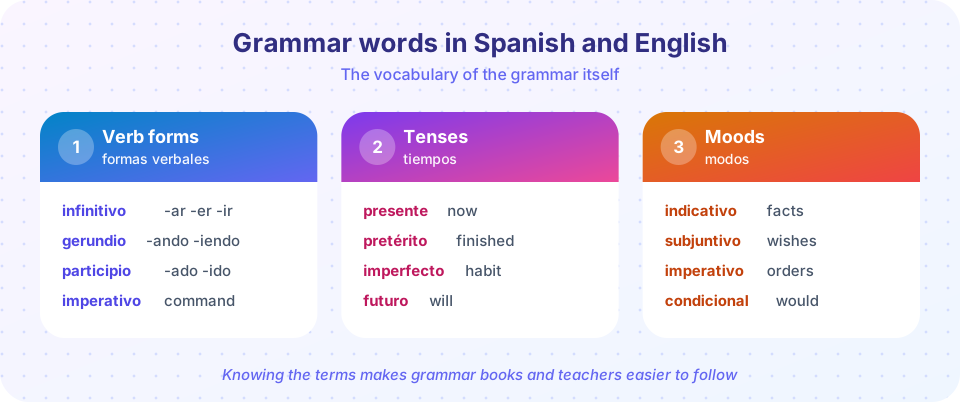
Grammar terms grouped as verb forms, tenses and moods.
Start with the grammar terms. Many Spanish textbooks, dictionaries and online grammar guides use the Spanish names (pretérito, subjuntivo, gerundio), so it is useful to recognize both. Then use the vocabulary tables with the flashcards below. When you meet a new word in a dialogue, add it to your own phrasebook (see the project lesson) rather than just reading it here.
Glosario: an alphabetical list of terms with explanations.
Término: a word with a specific meaning.
Definición: an explanation of a meaning.
Ejemplo: a sample sentence.
<style>*{box-sizing:border-box}body{margin:0;padding:14px;font-family:system-ui,-apple-system,'Segoe UI',sans-serif;background:linear-gradient(135deg,#faf5ff,#eff6ff);color:#1e1b4b}.card{background:#fff;border-radius:18px;box-shadow:0 8px 22px rgba(67,56,202,.16);padding:16px;max-width:560px;margin:0 auto}button{font:inherit;font-weight:600;border:0;border-radius:999px;padding:8px 16px;margin:4px 4px 0 0;color:#fff;background:linear-gradient(135deg,#6366f1,#ec4899);cursor:pointer}button.alt{background:#eef2ff;color:#3730a3}input{font:inherit;padding:6px 10px;border:2px solid #c7d2fe;border-radius:10px;width:150px}.small{font-size:.85rem;color:#475569}</style><style>.fc{height:150px;border-radius:18px;display:flex;flex-direction:column;align-items:center;justify-content:center;font-size:1.7rem;font-weight:700;color:#fff;cursor:pointer;text-align:center;padding:10px;background:linear-gradient(135deg,#6366f1,#a78bfa)}.fc.back{background:linear-gradient(135deg,#ec4899,#f59e0b)}</style><divclass="card"><divclass="small"id="cnt"></div><divclass="fc"id="fc"tabindex="0"role="button"aria-label="Flashcard, press to flip"></div><pclass="small">Click the card to flip it. Try to answer before you flip.</p><buttonid="prev"class="alt">Previous</button><buttonid="next">Next</button><buttonid="shuf"class="alt">Shuffle</button><buttonid="say"class="alt">Listen</button></div><script>var cards=[["el pretérito","the preterite (completed past)"],["el imperfecto","the imperfect (habits, scenery)"],["el subjuntivo","the subjunctive (wishes, doubts)"],["el imperativo","the imperative (commands)"],["el participio","the past participle"],["el gerundio","the gerund (-ando, -iendo)"],["la concordancia","agreement"],["la raíz","the stem"]];var i=0,front=true,fc=document.getElementById('fc');functionshow(){var c=cards[i];fc.className='fc'+(front?'':' back');fc.textContent=front?c[0]:c[1];document.getElementById('cnt').textContent='Card '+(i+1)+' of '+cards.length+(front?' (Spanish)':' (English)');}
fc.onclick=function(){front=!front;show();};
fc.onkeydown=function(e){if(e.key==='Enter'||e.key===' '){front=!front;show();}};
document.getElementById('next').onclick=function(){i=(i+1)%cards.length;front=true;show();};
document.getElementById('prev').onclick=function(){i=(i-1+cards.length)%cards.length;front=true;show();};
document.getElementById('shuf').onclick=function(){cards.sort(function(){return Math.random()-0.5;});i=0;front=true;show();};
document.getElementById('say').onclick=function(){try{var u=newSpeechSynthesisUtterance(cards[i][0]);u.lang='es-ES';speechSynthesis.speak(u);}catch(e){document.getElementById('cnt').textContent='Speech is not available here.';}};show();</script>
Match the Spanish term with its English meaning.
Glossary match
<style>*{box-sizing:border-box}body{margin:0;padding:14px;font-family:system-ui,-apple-system,'Segoe UI',sans-serif;background:linear-gradient(135deg,#faf5ff,#eff6ff);color:#1e1b4b}.card{background:#fff;border-radius:18px;box-shadow:0 8px 22px rgba(67,56,202,.16);padding:16px;max-width:560px;margin:0 auto}button{font:inherit;font-weight:600;border:0;border-radius:999px;padding:8px 16px;margin:4px 4px 0 0;color:#fff;background:linear-gradient(135deg,#6366f1,#ec4899);cursor:pointer}button.alt{background:#eef2ff;color:#3730a3}input{font:inherit;padding:6px 10px;border:2px solid #c7d2fe;border-radius:10px;width:150px}.small{font-size:.85rem;color:#475569}</style><style>.cols{display:flex;gap:12px}.col{flex:1;display:flex;flex-direction:column;gap:8px}.t{padding:10px;border-radius:12px;background:#eef2ff;cursor:pointer;text-align:center;font-weight:600;border:2px solid transparent}.t.sel{border-color:#6366f1;background:#e0e7ff}.t.done{background:#dcfce7;cursor:default}.t.bad{background:#fee2e2}</style><divclass="card"><pclass="small">Click a Spanish word, then its English meaning.</p><divclass="cols"><divclass="col"id="L"></div><divclass="col"id="R"></div></div><pid="msg"class="small"></p><buttonid="again"class="alt">New round</button></div><script>var pairs=[["infinitivo","base form of a verb"],["gerundio","-ando / -iendo form"],["participio","-ado / -ido form"],["tilde","written accent mark"],["raíz","stem"],["concordancia","agreement"]];var sel=null,done=0;functionshuffle(a){return a.map(function(x){return[Math.random(),x];}).sort(function(p,q){return p[0]-q[0];}).map(function(p){return p[1];});}functionbuild(){done=0;sel=null;document.getElementById('msg').textContent='';varL=document.getElementById('L'),R=document.getElementById('R');L.innerHTML='';R.innerHTML='';shuffle(pairs.map(function(p,i){return[p[0],i];})).forEach(function(p){var d=document.createElement('div');d.className='t';d.textContent=p[0];d.dataset.i=p[1];d.onclick=function(){if(d.classList.contains('done'))return;Array.prototype.forEach.call(L.children,function(c){c.classList.remove('sel');});d.classList.add('sel');sel=d;};L.appendChild(d);});shuffle(pairs.map(function(p,i){return[p[1],i];})).forEach(function(p){var d=document.createElement('div');d.className='t';d.textContent=p[0];d.dataset.i=p[1];d.onclick=function(){if(!sel||d.classList.contains('done'))return;if(sel.dataset.i===d.dataset.i){sel.className='t done';d.className='t done';sel=null;done++;if(done===pairs.length)document.getElementById('msg').textContent='All matched. Well done!';}else{d.classList.add('bad');setTimeout(function(){d.classList.remove('bad');},500);}};R.appendChild(d);});}
document.getElementById('again').onclick=build;build();</script>
Fill in the missing term.
Glossary gap fill
<style>*{box-sizing:border-box}body{margin:0;padding:14px;font-family:system-ui,-apple-system,'Segoe UI',sans-serif;background:linear-gradient(135deg,#faf5ff,#eff6ff);color:#1e1b4b}.card{background:#fff;border-radius:18px;box-shadow:0 8px 22px rgba(67,56,202,.16);padding:16px;max-width:560px;margin:0 auto}button{font:inherit;font-weight:600;border:0;border-radius:999px;padding:8px 16px;margin:4px 4px 0 0;color:#fff;background:linear-gradient(135deg,#6366f1,#ec4899);cursor:pointer}button.alt{background:#eef2ff;color:#3730a3}input{font:inherit;padding:6px 10px;border:2px solid #c7d2fe;border-radius:10px;width:150px}.small{font-size:.85rem;color:#475569}</style><style>.row{margin:0 0 12px;padding:10px 12px;border-radius:12px;background:#f8fafc}.ok{background:#dcfce7}.no{background:#fee2e2}.near{background:#fef9c3}.en{font-size:.85rem;color:#475569;font-style:italic}</style><divclass="card"><divid="list"></div><buttonid="chk">Check answers</button><buttonid="rst"class="alt">Clear</button><pid="score"class="small"></p></div><script>var items=[{"s":"El ___ de \"hablar\" es hablando. (gerund)","a":["gerundio"],"en":"The gerund of hablar is hablando."},{"s":"\"Hablé\" es un ejemplo de ___. (the tense)","a":["pretérito"],"en":"Hablé is an example of the preterite."},{"s":"El ___ de \"hablar\" es habl-. (stem)","a":["raíz"],"en":"The stem of hablar is habl-."},{"s":"\"Hablado\" es un ___. (participle)","a":["participio"],"en":"Hablado is a participle."}];functionstrip(t){return t.normalize('NFD').replace(/[\u0300-\u036f]/g,'');}var list=document.getElementById('list');
items.forEach(function(it,k){var d=document.createElement('div');d.className='row';var p=it.s.split('___');d.appendChild(document.createTextNode(p[0]));var inp=document.createElement('input');inp.id='f'+k;inp.setAttribute('aria-label','answer '+(k+1));d.appendChild(inp);d.appendChild(document.createTextNode(p[1]||''));var e=document.createElement('div');e.className='en';e.textContent=it.en;d.appendChild(e);var m=document.createElement('div');m.className='small';m.id='m'+k;d.appendChild(m);d.id='r'+k;list.appendChild(d);});
document.getElementById('chk').onclick=function(){var good=0;items.forEach(function(it,k){var v=document.getElementById('f'+k).value.trim().toLowerCase();var r=document.getElementById('r'+k),m=document.getElementById('m'+k);var ex=it.a.indexOf(v)>=0;var near=!ex&&it.a.some(function(a){returnstrip(a)===strip(v)&&v!=='';});if(ex){good++;r.className='row ok';m.textContent='Correct';}elseif(near){r.className='row near';m.textContent='Almost: check the accent. Answer: '+it.a[0];}else{r.className='row no';m.textContent=v?'Not quite. Answer: '+it.a[0]:'Answer: '+it.a[0];}});document.getElementById('score').textContent='Score: '+good+' / '+items.length;};
document.getElementById('rst').onclick=function(){items.forEach(function(it,k){document.getElementById('f'+k).value='';document.getElementById('r'+k).className='row';document.getElementById('m'+k).textContent='';});document.getElementById('score').textContent='';};</script>
"A glossary is for memorizing." It is for reference; learn words in sentences and dialogues.
"Grammar terms do not matter." They help you search, read explanations and talk with teachers.
"Spanish and English terms are the same." Many are similar (gerundio, participio), but some differ (pretérito indefinido for the English "simple past").