


















Lesson 24 of 51 · Daily Life and Questions
Numbers, time and dates in Spanish
Count to a million in Spanish, tell time with y, menos, cuarto and media, and say days, months and dates, with a number converter and a clock to practice.
Numbers appear everywhere in daily life: prices, phone numbers, bus times, birthdays. The good news is that Spanish numbers follow a clear pattern, and once you know the numbers to thirty and the hundreds you can build almost anything. This lesson teaches the numbers, the clock, the days of the week, the months and how to say a full date.
What you will learn
- Count from 0 to 1,000,000 and beyond, including the agreement rules.
- Tell the time with es la una / son las..., y, menos, cuarto and media.
- Say the days, months, dates and years.
- Ask ¿Qué hora es?, ¿A qué hora...? and ¿Qué día es hoy?
Key terms
Cardinal number: a counting number (uno, dos, tres). Ordinal number: a number showing order (primero, segundo). Apócope: a shortened form, uno becomes un before a masculine noun. Hora: hour or time of day. Fecha: date.
Zero to twenty-nine
| 0 cero | 1 uno | 2 dos | 3 tres | 4 cuatro |
|---|---|---|---|---|
| 5 cinco | 6 seis | 7 siete | 8 ocho | 9 nueve |
| 10 diez | 11 once | 12 doce | 13 trece | 14 catorce |
| 15 quince | 16 dieciséis | 17 diecisiete | 18 dieciocho | 19 diecinueve |
| 20 veinte | 21 veintiuno | 22 veintidós | 23 veintitrés | 24 veinticuatro |
| 25 veinticinco | 26 veintiséis | 27 veintisiete | 28 veintiocho | 29 veintinueve |
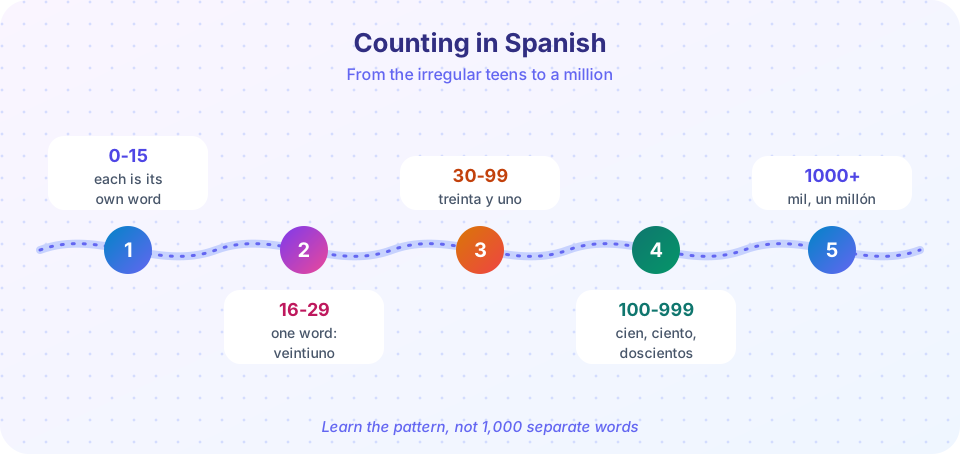
Numbers 16 to 29 are written as a single word, which is the modern spelling (dieciséis, not diez y seis). Notice the accents on dieciséis, veintidós, veintitrés and veintiséis. The numbers 1 to 15 must simply be memorized: once, doce, trece, catorce and quince share an ending but are otherwise irregular.
Thirty and above
From thirty on, Spanish builds numbers in three separate words joined by y (and): the tens, then y, then the unit.
- 30 treinta, 31 treinta y uno, 32 treinta y dos
- 40 cuarenta, 50 cincuenta, 60 sesenta, 70 setenta, 80 ochenta, 90 noventa
- 45 cuarenta y cinco, 68 sesenta y ocho, 99 noventa y nueve
The word y appears only between the tens and the units. It never goes after cien or mil: 105 is ciento cinco, not ciento y cinco.
Hundreds and thousands
- 100 is cien on its own or before a noun (cien personas), but ciento when anything follows: 101 ciento uno, 150 ciento cincuenta.
- 200 doscientos, 300 trescientos, 400 cuatrocientos, 500 quinientos, 600 seiscientos, 700 setecientos, 800 ochocientos, 900 novecientos. The bold ones are irregular: 500, 700 and 900 do not look like 5, 7 and 9 plus cientos.
- 1,000 is mil (never un mil); 2,000 dos mil; 100,000 cien mil; 2,026 dos mil veintiséis.
- 1,000,000 is un millón and it takes de before a noun: un millón de euros, dos millones de personas.
When numbers agree
The hundreds from 200 to 900 agree in gender with the noun: doscientos libros but doscientas casas. Uno shortens to un before a masculine noun (un libro) and becomes una before a feminine noun (una casa). The same happens inside a larger number: veintiún años, treinta y una personas, ciento un mil (not common). Counting aloud without a noun still uses uno: uno, dos, tres.
In writing, Spain and much of Europe use a comma for decimals and a period (or a space) for thousands: 1.000,50. Mexico, parts of Central America and the Caribbean often follow the English style: 1,000.50. When a price matters, check the local style.
Telling the time
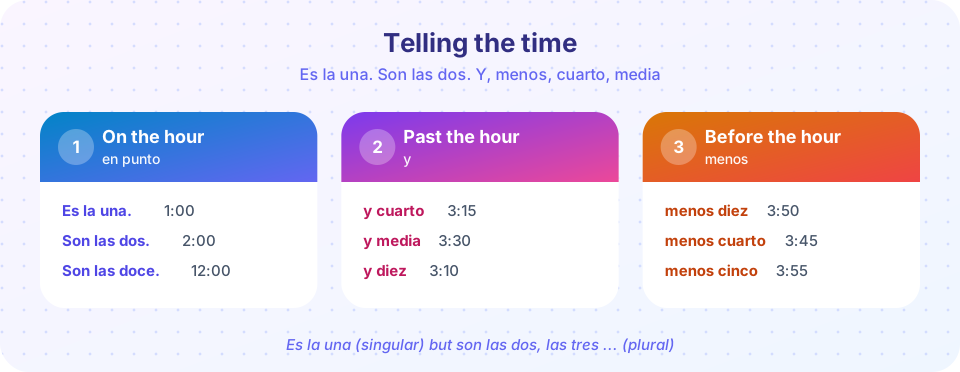
Ask: ¿Qué hora es? (What time is it?) Answer with es for one o'clock only and son for every other hour, because the hour word is a plural noun (las dos horas):
- Es la una. It is one o'clock.
- Son las dos. Son las cuatro. Son las doce.
- Es mediodía. It is noon. Es medianoche. It is midnight.
To add minutes, use y (and); to subtract, use menos (less). Fifteen minutes is cuarto (quarter) and thirty is media (half):
- 3:10 Son las tres y diez.
- 3:15 Son las tres y cuarto.
- 3:30 Son las tres y media.
- 3:45 Son las cuatro menos cuarto. (a quarter to four)
- 3:55 Son las cuatro menos cinco.
To say at a time, use a la / a las: ¿A qué hora empieza la clase? A las nueve. To distinguish morning from evening, add de la mañana (until noon), de la tarde (afternoon and early evening) or de la noche (night): Son las ocho de la noche. Spain and much of Latin America also use the 24-hour clock for schedules (el tren sale a las 18:30).
Days, months and dates
The days are lunes, martes, miércoles, jueves, viernes, sábado, domingo. Spanish week calendars start on Monday. Days and months are not capitalized in running text. To say "on Monday" use el: El lunes tengo clase. For "on Mondays" (every Monday) use los: Los lunes tengo clase. Ask ¿Qué día es hoy? and answer Hoy es martes.
The months are enero, febrero, marzo, abril, mayo, junio, julio, agosto, septiembre, octubre, noviembre, diciembre. Setiembre is an accepted variant of septiembre.
The date pattern is el + number + de + month (+ de + year): Hoy es el cinco de mayo. Spanish always puts the day first in numerals: 05/03 is 5 March. The first of the month uses primero in many places: el primero de mayo, but el dos de mayo. Years are read as whole numbers: 1999 is mil novecientos noventa y nueve and 2026 is dos mil veintiséis. Ask a date with ¿Cuál es la fecha de hoy? or ¿A cuántos estamos?
Common misconceptions
- "Cien and ciento are the same." Cien means exactly 100 or comes before a noun; ciento is used before another number (ciento diez).
- "Son la una is fine." Only es la una is correct for one o'clock.
- "Month names are capitalized." In Spanish they are lowercase: en mayo, el martes.
- "Dos mil is wrong without un." Spanish says mil, never un mil.
Try it
This converter applies the rules above to any number below one million. Run it and compare the output with the patterns in the lesson.
Press Run (or Ctrl + Enter) to see the result here.
Program input · what you'd type while the program runs
Type the answers before you press Run, one per line. Each time the program reads a line (with input()), it gets the next line from this box.
The clock below shows the Spanish for any time you pick. Move the sliders and read the sentence aloud.
Finally, practice numbers, days and dates by typing the missing words.
Ordinals and phone numbers
Ordinal numbers say the position in a list: primero (first), segundo, tercero, cuarto, quinto, and so on. They agree like adjectives (la segunda puerta), and primero and tercero lose the final -o before a masculine noun: el primer día, el tercer piso. In everyday speech people usually switch to cardinal numbers after ten: el piso once.
Phone numbers are normally read in small groups, not one digit at a time. In Spain a nine-digit number such as 612 345 678 is often said in groups of two or three: seis doce, treinta y cuatro, cincuenta y seis, setenta y ocho. Habits differ by country, so listen carefully the first time and ask ¿Puede repetir, por favor? (Can you repeat, please?) whenever you need to.
Check your understanding
Quick check · 5 questions
of 5 answered You scored / 5 · perfect!
-
1. How do you say 1:00?
One o'clock is singular: es la una. -
2. Which is correct for 500?
Quinientos is irregular: 500, 700 and 900 are quinientos, setecientos, novecientos. -
3. How do you say 3:45 in a typical way?
Past the half hour Spanish usually says the next hour menos the minutes that remain. -
4. What is "21 years"?
Uno shortens to un before a masculine noun: veintiún años. -
5. Which day follows jueves?
The order is lunes, martes, miércoles, jueves, viernes, sábado, domingo.
Summary
- 0 to 15 are irregular words; 16 to 29 are one word; from 30 you join tens and units with y.
- Cien stands alone, ciento is used before other numbers; mil needs no un.
- Hundreds agree with nouns; uno becomes un/una.
- Use es la una but son las... for other hours; y, menos, cuarto and media handle minutes.
- Days and months are lowercase; dates use el + number + de + month.
Track your progress
Create a free account to tick off lessons and pick up where you left off on any device.
of Spanish for Beginners lessons completed