


















Lesson 50 of 51 · Projects and Practice
Cheat sheet: Spanish beginner quick reference
A one-page Spanish quick reference for chapters 5 to 8: question words, numbers, time, gustar, reflexives, past tenses, future, subjunctive and commands.
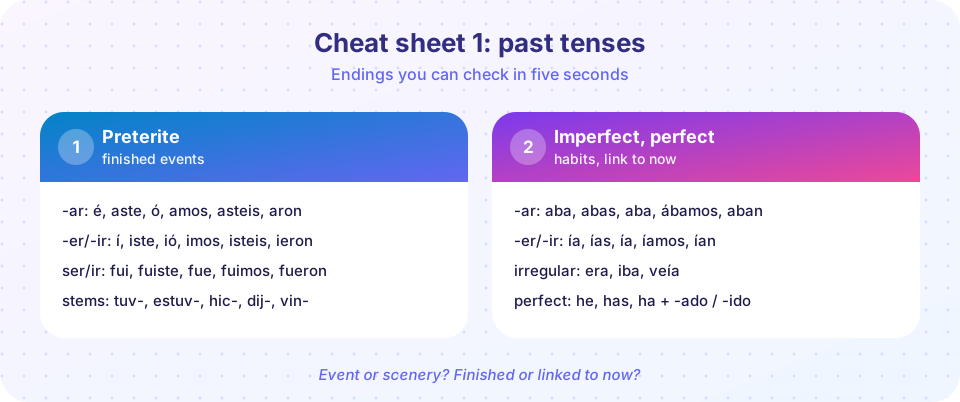
This page is your one-page recap of chapters 5 to 8. Use it before a conversation, a test or a trip. It collects the formulas that learners most often need and forget. Each section has a big picture and a compact table. Read the pictures first, then use the tables when you need details.
Key terms
Terminación: ending added to a stem. Raíz irregular: an irregular stem such as tendr-. Disparador (trigger): an expression that requires the subjunctive. Registro: formal (usted) or informal (tú) level.
Past tenses at a glance
| Tense | When to use | Forms for hablar / comer |
|---|---|---|
| Preterite | finished events, sequences, exact times | hablé, hablaste, habló, hablamos, hablasteis, hablaron / comí, comiste, comió, comimos, comisteis, comieron |
| Imperfect | habits, scenery, age, time, actions in progress | hablaba, hablabas, hablaba, hablábamos, hablabais, hablaban / comía, comías, comía, comíamos, comíais, comían |
| Present perfect | experiences, recent events, unfinished periods | he hablado, has hablado, ha hablado, hemos hablado, habéis hablado, han hablado |
Irregular preterite: ser/ir fui; dar di; ver vi; estar estuve; tener tuve; poder pude; poner puse; saber supe; querer quise; venir vine; hacer hice, hizo; decir dije, dijeron. Irregular imperfect: ser era, ir iba, ver veía. Irregular participles: abierto, dicho, escrito, hecho, muerto, puesto, resuelto, roto, visto, vuelto. Spelling in the preterite yo: busqué, llegué, empecé.
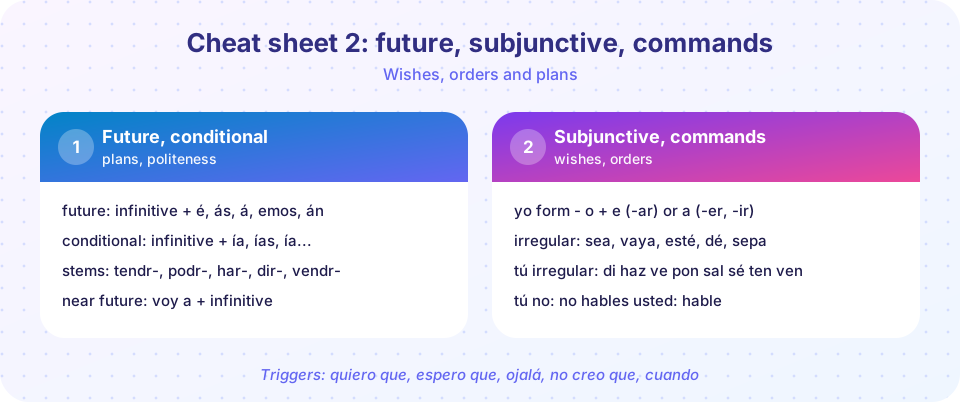
Future, subjunctive and commands
| Topic | Formula | Example |
|---|---|---|
| Near future | ir a + infinitive | Voy a estudiar. |
| Future | infinitive + é, ás, á, emos, éis, án | Estudiaré. |
| Irregular future stems | tendr-, podr-, har-, dir-, vendr-, saldr-, querr-, sabr- | Haré la cena. |
| Conditional | infinitive + ía, ías, ía, íamos, íais, ían | Me gustaría venir. |
| Present subjunctive | yo form − o + e (-ar) or a (-er, -ir) | Quiero que vengas. |
| Irregular subjunctive | sea, vaya, esté, dé, sepa, haya | Espero que estés bien. |
| Subjunctive triggers | quiero que, espero que, es importante que, dudo que, no creo que, ojalá, cuando (future), para que | Ojalá llueva. |
| Tú command (yes) | él form; di, haz, ve, pon, sal, sé, ten, ven | Haz la tarea. |
| Tú command (no) | no + subjunctive | No hables. |
| Usted command | subjunctive usted | Hable más despacio. |
| Nosotros command | subjunctive nosotros or vamos a | Comamos. |
| Pronouns | attach to affirmative, precede negative | Dímelo. No me lo digas. |
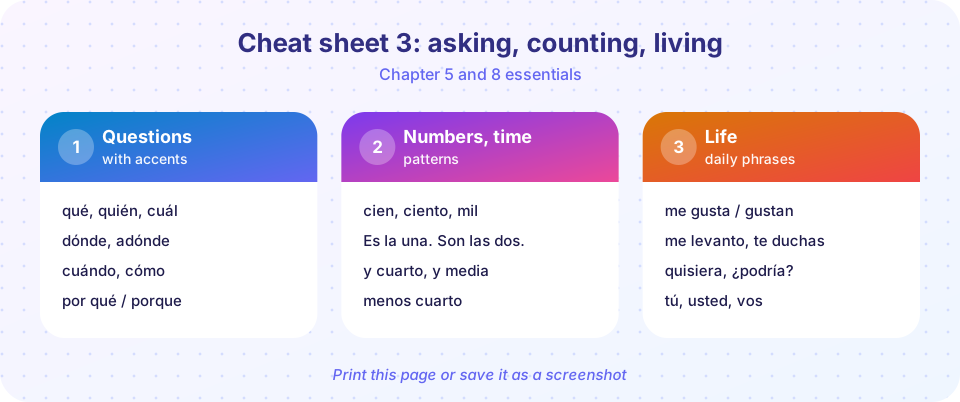
Asking, counting and daily life
- Question words: qué, quién(es), cuál(es), dónde, adónde, de dónde, cuándo, cómo, cuánto/a/os/as, por qué. Prepositions go before: ¿Con quién hablas? Por qué asks, porque answers.
- Numbers: 16-29 one word (dieciséis, veintiuno); 30+ with y (treinta y uno); cien / ciento; 500 quinientos, 700 setecientos, 900 novecientos; mil (never un mil); un millón de.
- Time: Es la una. Son las dos y cuarto. Son las tres y media. Son las cuatro menos diez. Days and months are lowercase. Date: el cinco de mayo.
- Gustar: me gusta (one thing, infinitive), me gustan (several); a mí, a ti, a Ana le. Also encantar, doler (me duele, me duelen).
- Reflexives: me, te, se, nos, os, se; me lavo las manos; stem changes except nosotros and vosotros.
- Restaurant: Quisiera..., Para mí..., La cuenta, por favor. Shopping: ¿Cuánto cuesta / cuestan?
- Politeness: tú (friends), usted (strangers), por favor, perdone, ¿podría...?
- Survival: ¿Puede repetir, por favor? Más despacio, por favor. No entiendo. ¿Cómo se dice...?
Ten model sentences
Each sentence uses a different pattern from the chapters. Read them aloud, then change one word.
- ¿Con quién hablaste ayer? (question word with a preposition, preterite)
- Son las ocho menos cuarto y todavía no me he levantado. (time, present perfect, reflexive)
- Me gustaría una mesa para dos, por favor. (conditional, politeness)
- Cuando era niño, íbamos a la playa todos los veranos. (imperfect habit)
- Estaba leyendo cuando sonó el teléfono. (progressive and preterite)
- Mañana tendré tiempo; voy a llamarte. (irregular future, ir a)
- Espero que vengas y que traigas a tu hermana. (subjunctive after esperar que)
- Dímelo ahora, pero no se lo digas a nadie. (commands with pronouns)
- Perdone, ¿puede repetir más despacio? (polite repair phrase)
- Me duelen los pies, así que me voy a sentar. (doler, reflexive near future)
If you can explain why each verb has the form it has, you have understood the core of this course.
How to use the cheat sheet well
A cheat sheet is not meant to replace study; it is meant to support retrieval. Try this routine: look at a card for ten seconds, cover it and write what you remember, then check. Do the same with one block per day. In a real conversation you will not consult a table, so the sheet must live in your memory. Use it just before a conversation as a warm-up, and after a conversation to check the forms you doubted. Add your own notes in the margins of a printed copy: the verbs you confuse, the phrases you like and the questions you were asked.
Try it
Test yourself with the formulas. Type the missing form.
Common misconceptions
- "The cheat sheet is enough." It helps you recall; real fluency needs practice.
- "Memorize everything at once." Pick one block per day and use it in sentences.
- "The sheet covers all of Spanish." It covers the core forms of chapters 5 to 8 only.
Check your understanding
Quick check · 5 questions
of 5 answered You scored / 5 · perfect!
-
1. What is the future stem of "tener"?
Tener has the irregular stem tendr-. -
2. What is the subjunctive trigger in "Quiero que vengas"?
A wish with a change of subject triggers the subjunctive. -
3. Which is the negative tú command of "hablar"?
Negative tú commands use the subjunctive tú form. -
4. What is the imperfect of "ver" for yo?
Ver is irregular in the imperfect: veía. -
5. What time is 3:45 in Spanish?
Past the half hour: next hour menos cuarto.
Summary
- Past: preterite for events, imperfect for scenery and habits, perfect for a link to now.
- Future: ir a, simple future with irregular stems, conditional for politeness.
- Subjunctive after wishes, doubts and feelings; commands use subjunctive forms except affirmative tú.
- Basics: question words with accents, number patterns, time formulas, gustar, reflexives.
- Use the sheet for recall, and use Spanish for real.
Next: Further study
Track your progress
Create a free account to tick off lessons and pick up where you left off on any device.
of Spanish for Beginners lessons completed