


















Lesson 19 of 51 · Present Tense Verbs
Regular Verbs in the Present
Learn the Spanish present tense of regular -ar, -er and -ir verbs, how to make negatives and questions, useful verbs and adverbs, with a conjugator and drills.
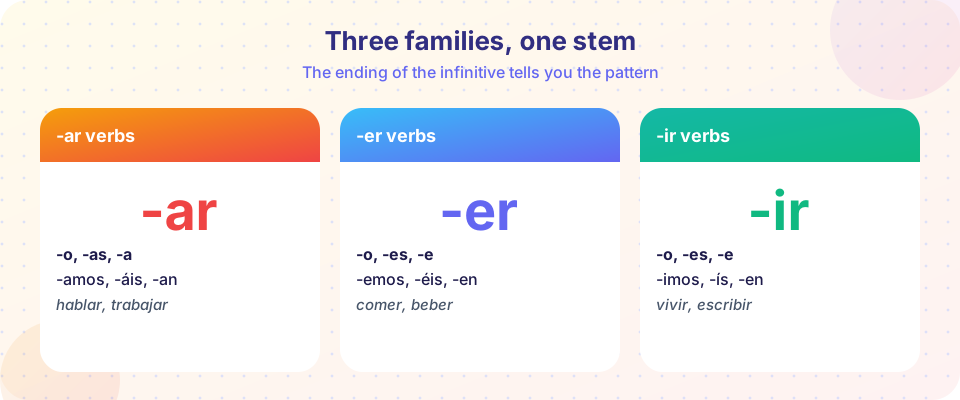
Most Spanish verbs are regular: once you know the pattern for a family, you can conjugate hundreds of verbs you have never seen. There are only three patterns, one for each infinitive ending -ar, -er and -ir, and the -er and -ir patterns are almost identical. That means you only need to learn about eighteen endings, and you already know most of the sound of them from the greetings: hablo, habla, vives, comemos.
In this lesson you learn those endings, how to say that you do not do something, how to ask questions, and a core vocabulary of everyday regular verbs. By the end you will be able to say what you and others do, work, study, eat, live, read and write, and to ask the same questions back.
What you will learn
- How to conjugate regular -ar, -er and -ir verbs in the present tense.
- How to form negative sentences and yes/no questions.
- Fifteen high-frequency regular verbs.
- Adverbs that say how often something happens.
Key terms
Stem: the infinitive without -ar, -er or -ir (habl-, com-, viv-).
Ending: the part added to the stem that shows the person (-o, -as, -a, ...).
Conjugate: to list or produce the forms of a verb for each person.
Yes/no question: a question that can be answered sí or no.
The three patterns
Take the stem and add the ending that fits the person:
| Person | hablar (-ar) | comer (-er) | vivir (-ir) |
|---|---|---|---|
| yo | hablo | como | vivo |
| tú | hablas | comes | vives |
| él / ella / usted | habla | come | vive |
| nosotros | hablamos | comemos | vivimos |
| vosotros | habláis | coméis | vivís |
| ellos / ustedes | hablan | comen | viven |
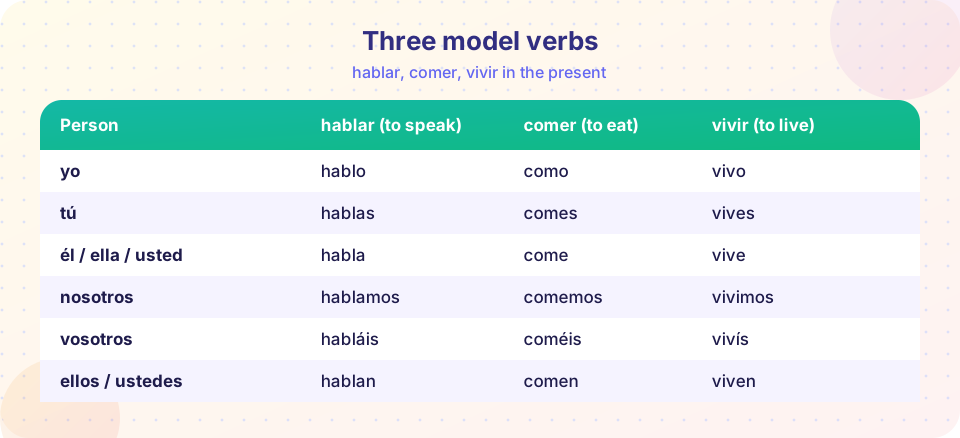
Observe three useful facts:
- The yo form always ends in -o for all three families.
- -er and -ir share their endings except for nosotros (-emos versus -imos) and vosotros (-éis versus -ís).
- The -ar family uses a where the others use e. The -ar family goes -o, -as, -a, -amos, -áis, -an; the -er family goes -o, -es, -e, -emos, -éis, -en. If you can remember that -ar uses a and -er/-ir use e, you hold half the system.
The stress is on the stem in the singular and ellos forms (HA-blo, HA-blas, HA-bla, HA-blan) and on the ending for nosotros and vosotros (ha-BLA-mos, ha-BLÁIS), which is why the vosotros form carries an accent.
Useful regular verbs
| -ar | -er | -ir |
|---|---|---|
| hablar (to speak) | comer (to eat) | vivir (to live) |
| trabajar (to work) | beber (to drink) | escribir (to write) |
| estudiar (to study) | aprender (to learn) | abrir (to open) |
| comprar (to buy) | leer (to read) | recibir (to receive) |
| escuchar (to listen) | correr (to run) | subir (to go up, to climb) |
| mirar (to look at) | vender (to sell) | decidir (to decide) |
| bailar (to dance) | comprender (to understand) | compartir (to share) |
Leer looks regular and is regular in the present (leo, lees, lee, leemos, leéis, leen), although it has irregularities in the past.
Examples: Trabajo en un banco. (I work in a bank.) Estudias español. (You study Spanish.) Ella escribe correos. (She writes emails.) Comemos pasta los sábados. (We eat pasta on Saturdays.) Ellos viven en Lima. (They live in Lima.)
Say it, do not translate it
English needs helper words: I do not speak, Do you speak? Spanish does not. The negative and the question are built from the same verb form.
Negatives: put no directly before the verb. Hablo español. (I speak Spanish.) No hablo francés. (I do not speak French.) No trabajamos los domingos. (We do not work on Sundays.) There is no word for do or does.
Questions: raise your voice at the end and add the opening mark, or put the subject after the verb. ¿Hablas inglés? (Do you speak English?) ¿Vive Ana aquí? (Does Ana live here?) The two orders ¿Ana vive aquí? and ¿Vive Ana aquí? both work.
Answers: Sí, hablo inglés. / No, no hablo inglés. The double no is correct: the first answers the question, the second negates the verb. Spanish also allows double negatives inside a sentence: No como nada (I do not eat anything), literally "I do not eat nothing".
How often?
Adverbs of frequency are often placed right before the verb:
- siempre (always): Siempre desayuno a las ocho.
- a menudo, con frecuencia (often).
- a veces (sometimes): A veces corro en el parque.
- casi nunca (almost never).
- nunca (never): Nunca bebo café. When nunca comes before the verb you do not need no; after the verb it needs no: No bebo café nunca.
- todos los días (every day), los lunes (on Mondays).
A first conversation
Read both parts aloud, then cover the English.
| Spanish | English |
|---|---|
| ¿Dónde vives? | Where do you live? |
| Vivo en Madrid. ¿Y tú? | I live in Madrid. And you? |
| Vivo en Lima. ¿Trabajas? | I live in Lima. Do you work? |
| Sí, trabajo en un banco. | Yes, I work in a bank. |
| ¿Hablas inglés? | Do you speak English? |
| Sí, hablo inglés y un poco de francés. | Yes, I speak English and a little French. |
Longer sentences
Once you can conjugate a verb you can attach everything else to it. Many verbs need a preposition: trabajar en (to work at or in), trabajar para (to work for), vivir en (to live in), hablar con (to talk with), hablar de (to talk about), escuchar and mirar take no preposition in Spanish (escucho música, miro la tele, where English says "listen to" and "look at").
When the direct object is a specific person, Spanish adds the little word a, called the personal a: Veo a Ana (I see Ana), Escucho a mi madre (I listen to my mother), but Veo la casa, with no a, because a house is not a person. You will meet this construction constantly.
Finally, a regional note. In Argentina, Uruguay and parts of Central America, the informal singular you is vos with its own forms: vos hablás, vos comés, vos vivís. They are easy to recognise because the stress falls on the final syllable. Everyone who uses vos understands tú too, so you can safely learn tú first.
Common misconceptions
"I need yo before every verb." The ending already says who is acting: Hablo is enough.
"I use do or does in questions." There is no helper verb: ¿Hablas inglés?, not ¿Haces hablar inglés?
"-er and -ir have the same endings in all forms." Almost: nosotros and vosotros differ (comemos versus vivimos).
"Usted takes -as." Usted takes the él ending: usted habla.
Try it
The first tool conjugates any regular verb. It applies the rules, so irregular verbs such as tener or hacer will come out wrong (the next lesson covers them). Then a drill and flashcards.
Press Run (or Ctrl + Enter) to see the result here.
Program input · what you'd type while the program runs
Type the answers before you press Run, one per line. Each time the program reads a line (with input()), it gets the next line from this box.
Check your understanding
Quick check · 5 questions
of 5 answered You scored / 5 · perfect!
-
1. What is the yo form of 'comer'?
Every regular verb ends in -o in the yo form. -
2. How do you say 'We live in Lima'?
-ir verbs take -imos for nosotros. -
3. Which is the correct negative?
No goes directly before the verb. -
4. Which verb form goes with 'usted'?
Usted takes the same form as él and ella. -
5. What does '¿Vive Ana aquí?' mean?
Inverting the subject makes a yes/no question.
Summary
- Regular verbs have three patterns: -ar (-o, -as, -a, -amos, -áis, -an), -er (-o, -es, -e, -emos, -éis, -en), -ir (-o, -es, -e, -imos, -ís, -en).
- The yo form always ends in -o; usted takes the él/ella ending.
- Negatives use no before the verb; questions use intonation or inversion, with no helper verb.
- Frequency adverbs: siempre, a menudo, a veces, nunca.
- Irregular verbs follow in the next lesson.
Track your progress
Create a free account to tick off lessons and pick up where you left off on any device.
of Spanish for Beginners lessons completed