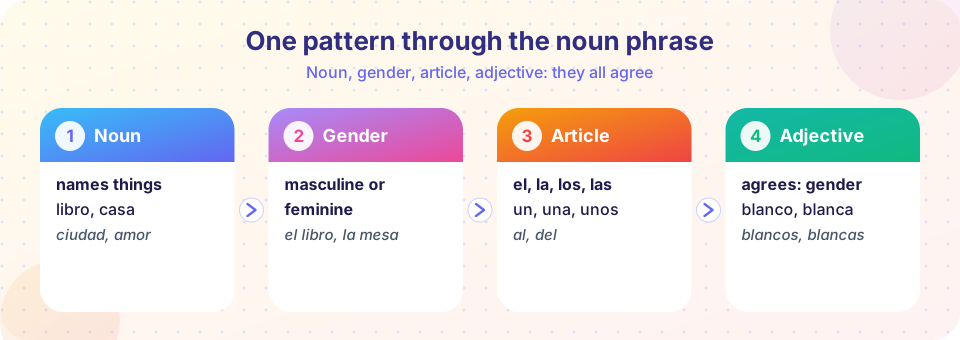
Chapter 3 overview: how Spanish nouns have gender and number, how articles and adjectives agree with them, and what each lesson of the chapter teaches.
English nouns are simple: a book, the book, two books. Spanish nouns carry more information. Every noun is masculine or feminine, and it is either singular or plural. The little words around the noun, the articles (the, a) and the adjectives (red, tall), change their endings to match. This matching is called agreement, and it is the most important new idea in this chapter.
It sounds like extra work, and at first it is. But agreement also makes Spanish sentences self-checking: when you read las casas blancas, the endings -as repeat three times, so you immediately know the group is feminine plural. Once the pattern is in your ear, you will find it more elegant than strange.
Nouns, gender, articles, adjectives: one pattern repeated through the phrase.
Gender in Spanish is a grammar label, not a statement about the object. A table is feminine (la mesa) and a book is masculine (el libro) for no reason except history and habit. For people and animals, gender usually follows biology (el niño, the boy; la niña, the girl), but for things, it does not. The same object can have different genders in different languages: the sun is el sol (masculine) in Spanish and die Sonne (feminine) in German.
The good news is that the endings of nouns give strong hints. Most nouns ending in -o are masculine and most ending in -a are feminine, and several suffixes are always one gender. You will learn these patterns in the next lesson, along with the main exceptions.
Las casas blancas son bonitas. The white houses are pretty.
Every word is feminine plural: las (the, feminine plural), casas (houses), blancas (white), bonitas (pretty). Change the noun to el coche (masculine singular) and everything changes: El coche blanco es bonito. The pattern is always the same: look at the noun, then make the other words match.
"I can guess gender from meaning." For people yes, for things rarely. Learn each noun with its article: el libro, la mesa, not just libro and mesa.
"Gender mistakes make me unintelligible." Native speakers understand a wrong article easily. Mistakes show you are learning; correct ones come with practice.
"Feminine means weak or small." Gender is purely grammatical: la fuerza (strength) is feminine, el cuchillo (knife) is masculine.
Learn every noun with its article. Write la mesa, not mesa. Your memory will store the gender with the word.
Notice endings. Words in -ción, -dad and -tud are feminine; words in -or and -aje are usually masculine.
Say whole phrases aloud.La casa blanca sounds right because the -a sounds repeat; the habit of hearing agreement is faster than rules.
Accept exceptions without fear.El día looks feminine but is masculine; la mano looks masculine but is feminine. A handful of very common words break the pattern; you will meet them often and they will stick.
A short drill tests the idea of agreement, and flashcards give you the first ten nouns with their articles. The drill is a fixed list, not an adaptive test.
Spot the agreement
<style>:root{font-family:system-ui,-apple-system,"Segoe UI",sans-serif}body{margin:0;padding:16px;background:linear-gradient(135deg,#fffbeb,#fef2f2);color:#1e1b4b}button{border:0;border-radius:999px;padding:8px 16px;font:inherit;font-weight:600;cursor:pointer;background:#fff;color:#b45309;box-shadow:0 2px 8px rgba(180,83,9,.2)}button:hover{background:#fef3c7}.bar{display:flex;gap:8px;justify-content:center;align-items:center;margin-top:14px;flex-wrap:wrap}.muted{font-size:14px;color:#475569;text-align:center;margin-top:10px}.q{max-width:520px;margin:0 auto;background:#fff;border-radius:20px;padding:20px;box-shadow:0 10px 26px rgba(180,83,9,.15)}.prompt{font-size:22px;font-weight:700;margin:0 0 14px}.opts{display:grid;gap:8px}.opts button{text-align:left;border-radius:14px;background:#fffbeb;border:2px solid #fde68a;color:#1e1b4b}.opts button.ok{background:#d1fae5;border-color:#10b981}.opts button.no{background:#fee2e2;border-color:#ef4444}.fb{min-height:44px;margin-top:12px;font-size:15px;color:#334155}</style><divclass="q"><pclass="prompt"id="prompt"></p><divclass="opts"id="opts"></div><divclass="fb"id="fb"></div></div><divclass="bar"><buttonid="next">Next question</button></div><divclass="muted"id="score"></div><script>const items =[{"q":"Which phrase agrees correctly?","options":["la casa blanco","el casa blanca","la casa blanca"],"answer":3,"why":"Casa is feminine, so article and adjective are feminine: la casa blanca."},{"q":"Which phrase agrees correctly?","options":["los libros rojos","los libros rojas","las libros rojos"],"answer":1,"why":"Libros is masculine plural, so los and rojos."},{"q":"What is the gender of 'mesa'?","options":["masculine","feminine"],"answer":2,"why":"La mesa; it ends in -a."},{"q":"What is the gender of 'libro'?","options":["masculine","feminine"],"answer":1,"why":"El libro; it ends in -o."},{"q":"Is gender in Spanish about biology for objects?","options":["Yes","No, it is a grammar label"],"answer":2,"why":"For things, gender is grammatical, not biological."}];let k =0, right =0, tried =0, done =false;const$=(id)=> document.getElementById(id);functionshow(){const it = items[k];
done =false;$("prompt").textContent = it.q;$("fb").textContent ="";$("opts").innerHTML ="";
it.options.forEach((o, n)=>{const b = document.createElement("button");
b.textContent = o;
b.onclick=()=>pick(b, n);$("opts").appendChild(b);});$("score").textContent ="Score: "+ right +" / "+ tried;}functionpick(b, n){if(done)return;
done =true; tried++;const it = items[k], bs =$("opts").children;if(n === it.answer -1){ right++; b.className ="ok";$("fb").textContent ="Correct. "+ it.why;}else{ b.className ="no"; bs[it.answer -1].className ="ok";$("fb").textContent ="Not quite. "+ it.why;}$("score").textContent ="Score: "+ right +" / "+ tried;}$("next").onclick=()=>{ k =(k +1)% items.length;show();};show();</script>
Ten nouns with their articles
<style>:root{font-family:system-ui,-apple-system,"Segoe UI",sans-serif}body{margin:0;padding:16px;background:linear-gradient(135deg,#fffbeb,#fef2f2);color:#1e1b4b}button{border:0;border-radius:999px;padding:8px 16px;font:inherit;font-weight:600;cursor:pointer;background:#fff;color:#b45309;box-shadow:0 2px 8px rgba(180,83,9,.2)}button:hover{background:#fef3c7}.bar{display:flex;gap:8px;justify-content:center;align-items:center;margin-top:14px;flex-wrap:wrap}.muted{font-size:14px;color:#475569;text-align:center;margin-top:10px}.card{max-width:440px;margin:0 auto;border-radius:22px;padding:26px 20px;min-height:150px;display:flex;flex-direction:column;align-items:center;justify-content:center;text-align:center;cursor:pointer;color:#fff;background:linear-gradient(135deg,#f59e0b,#ef4444);box-shadow:0 12px 28px rgba(239,68,68,.25)}.card.back{background:linear-gradient(135deg,#6366f1,#a78bfa)}.big{font-size:32px;font-weight:700}.small{font-size:15px;opacity:.92;margin-top:8px}</style><divclass="card"id="card"tabindex="0"role="button"aria-label="Flip the card"></div><divclass="bar"><buttonid="prev">Previous</button><buttonid="flip">Flip</button><buttonid="next">Next</button><buttonid="say">Listen</button><buttonid="shuf">Shuffle</button></div><divclass="muted"id="info"></div><script>const cards =[["el libro","the book","masculine, -o"],["la mesa","the table","feminine, -a"],["el coche","the car","masculine; -e is unpredictable"],["la casa","the house",""],["el día","the day","masculine despite -a"],["la mano","the hand","feminine despite -o"],["la ciudad","the city","feminine, -dad"],["el problema","the problem","masculine, -ma"],["la canción","the song","feminine, -ción"],["el amor","love","masculine, -or"]];let i =0, back =false;const$=(id)=> document.getElementById(id);functionshow(){const c = cards[i];$("card").className ="card"+(back ?" back":"");$("card").innerHTML = back
?'<div class="big">'+ c[1]+'</div>'+(c[2]?'<div class="small">'+ c[2]+'</div>':''):'<div class="big">'+ c[0]+'</div><div class="small">Click to flip</div>';$("info").textContent ="Card "+(i +1)+" of "+ cards.length;}functiongo(d){ i =(i + d + cards.length)% cards.length; back =false;show();}$("card").onclick =$("flip").onclick=()=>{ back =!back;show();};$("prev").onclick=()=>go(-1);$("next").onclick=()=>go(1);$("shuf").onclick=()=>{ cards.sort(()=> Math.random()-0.5); i =0; back =false;show();};$("say").onclick=()=>{try{const u =newSpeechSynthesisUtterance(cards[i][0].replace(/<[^>]*>/g,""));
u.lang ="es-ES";
speechSynthesis.speak(u);}catch(e){$("info").textContent ="Speech is not available in this preview.";}};show();</script>