


















Lesson 45 of 51 · Conversation and Culture
Chapter 8 review: Conversation and culture
Review Spanish travel dialogues, social formulas, regional variation and customs with a recap table, role-play prompts, a drill and a ten-question quiz.
Chapter 8 was about using Spanish with people: in airports and hotels, on the phone, at parties and across regions and customs. Review the picture, the recap table and the role-plays, then check yourself with the drill and the quiz.
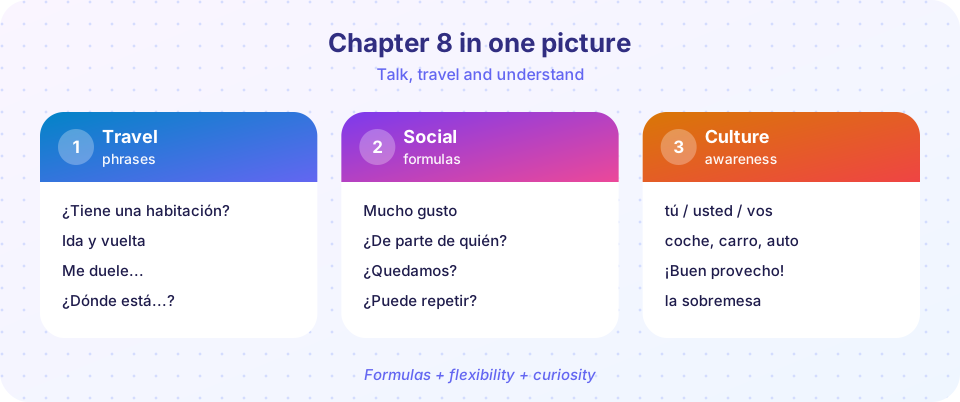
Recap table
| Lesson | Key ideas | Example |
|---|---|---|
| Travel dialogues | airport, hotel, train, doctor; doler works like gustar | Me duelen los pies. |
| Social conversation | introductions, phone calls, invitations, opinions, repair phrases | ¿De parte de quién? |
| Regional Spanish | tú, vos, usted, vosotros, ustedes; seseo; vocabulary | coche / carro / auto |
| Customs and etiquette | greetings, names, meals, festivals | ¡Buen provecho! |
Role-play practice
Act out each scene aloud, then compare with the model answer.
Scene 1: hotel. You arrive in Valencia and need a single room for two nights with breakfast. Model: Buenas tardes. ¿Tiene una habitación individual libre para dos noches? ¿Incluye el desayuno? ¿A qué hora es la salida?
Scene 2: phone. You call your friend Marta, but her brother answers. Model: Hola, buenas tardes. ¿Está Marta, por favor? De parte de Daniel. ¿Puede decirle que me llame? Gracias, hasta luego.
Scene 3: lost. You do not understand an answer. Model: Perdone, no entiendo. ¿Puede repetir más despacio, por favor? ¿Qué significa "andén"? ¿Cómo se dice "platform" en español?
Scene 4: culture. You are introduced to your friend's grandmother in Colombia. Model: Mucho gusto, señora. Es un placer conocerla. (Shake her hand, and if she offers a kiss on the cheek, accept it.)
Three habits to keep
- Memorize formulas. Short, tested phrases save you when your brain is tired.
- Choose the register. Usted for strangers, tú for friends, and follow the other person.
- Be curious about variation. When you hear a new word, ask ¿Cómo se dice aquí...? (How do you say it here?)
Why variety matters when you listen
A beginner often panics when a new speaker uses an unfamiliar word. The best strategy is to guess from context and ask. If a taxi driver in Santiago says Tome el micro, the context (a city, a transport question) tells you that a bus is meant. If a waiter in Madrid says ¿Quiere zumo?, you can see that he is holding a jug of orange juice. When context does not help, a short question solves the problem: ¿Qué es una guagua? ¿Cómo se dice "bus" aquí? Speakers love to explain their local words.
Another strategy is to listen to many accents: watch a Mexican series on Monday, a Spanish podcast on Tuesday, an Argentine interview on Wednesday. At first each accent will feel strange; after a few weeks your ear adjusts quickly. Choose one variety for your own pronunciation (the one you will use most), but do not be surprised when you meet others. Remember that regional differences are mostly in vocabulary, a few sounds and the pronouns, while grammar, spelling and the core vocabulary of about thousands of everyday words are shared.
Mixed practice
Worked examples
Example 1: choosing a register. You meet your Colombian host mother, an older woman. Which pronoun? Usted, until she says otherwise: ¿Cómo está usted? ¿Le puedo ayudar con las maletas? In Colombia, many families use usted even inside the family, so do not take it as cold.
Example 2: reading a menu abroad. In Spain you see zumo de naranja, patatas bravas, tortilla de patatas. In Mexico the same items might be jugo de naranja, papas a la francesa, and tortilla would be a flat bread. In Argentina you may find jugo, papas fritas, and milanesa. Knowing the variation prevents confusion.
Example 3: a polite refusal. A friend invites you to a late dinner, and you are tired. Muchas gracias por la invitación. Me encantaría, pero estoy muy cansado hoy. ¿Podemos quedar mañana? This answer includes thanks, regret, a reason and an alternative. It uses the conditional (encantaría), a present-tense reason and a question with poder.
Chapter review quiz
Quick check · 10 questions
of 10 answered You scored / 10 · perfect!
-
1. How do you say "My head hurts"?
One body part: duele. -
2. Where would you hear "¿De qué andén sale?"
Andén means platform. -
3. Which phrase is a polite way to decline?
Politeness: express regret and give a reason. -
4. What does "¿De parte de quién?" ask?
It asks the name of the caller on the phone. -
5. What is the plural informal "you" in Mexico?
Latin America uses ustedes. -
6. What is "seseo"?
Seseo is the pronunciation of z and c like s. -
7. Which verb is safest for "to take a bus" across countries?
Tomar is neutral. -
8. What does one say before eating?
Buen provecho wishes someone an enjoyable meal. -
9. How many surnames do most people have?
Father’s then mother’s first surname. -
10. Which statement about regional Spanish is true?
All varieties are standard and mutually intelligible.
Summary
- You can handle travel and social situations with formulas and polite requests.
- You know how to repair a conversation and ask for help.
- You recognize regional differences in pronouns, sounds and words.
- You know basic customs for greetings, names, meals and holidays.
Track your progress
Create a free account to tick off lessons and pick up where you left off on any device.
of Spanish for Beginners lessons completed