


















Lesson 10 of 51 · Sounds, Greetings and Basics
Greetings and Introductions
Learn hello, goodbye, how are you, what is your name and where are you from in Spanish, with formal and informal versions, cultural notes and two full dialogues.
Now you can put your sounds to work. Greetings are the first Spanish most people use, and they are more important than their length suggests: in Spanish-speaking cultures a proper hello is not optional. Walking into a shop, a taxi or a meeting without a buenos días can feel rude, and a friendly greeting often leads to a warmer, more helpful reply.
This lesson gives you the phrases to say hello and goodbye at the right time of day, to ask and answer "how are you?", to introduce yourself, and to say where you come from. You will also learn when to use the informal tú and the formal usted, a distinction English no longer makes but Spanish uses every day.
What you will learn
- Greetings and farewells for each time of day.
- How to ask and answer "How are you?" informally and formally.
- How to say your name and where you are from.
- Basic courtesy: please, thank you, excuse me, sorry.
Key terms
tú: informal "you" for one person (friends, family, children, peers).
usted: formal "you" for one person (strangers, older people, customers, officials). Abbreviated Ud. or Vd.
Saludo: a greeting. Despedida: a goodbye.
Register: how formal your speech is.
Hello and goodbye
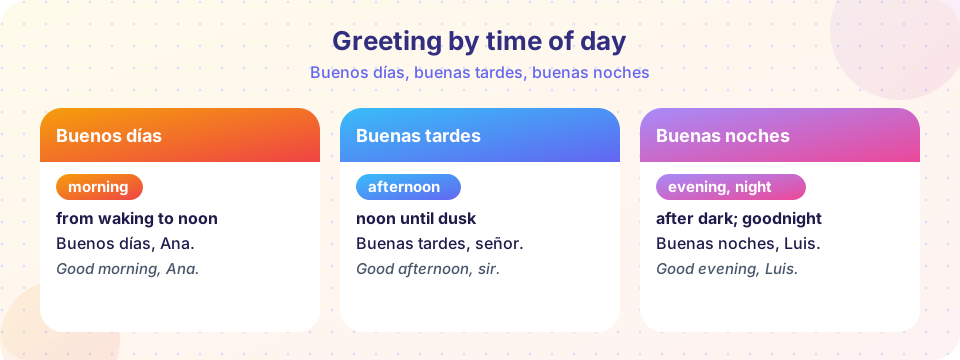
Hola (hello) works at any time and with anyone. For more polish, match the time of day:
- Buenos días (good morning), from waking up until about midday.
- Buenas tardes (good afternoon), from midday until dusk. In Spain, where lunch is late, tarde lasts until about 8 or 9 in the evening.
- Buenas noches (good evening or good night), after dark. It is also used when you go to bed.
Notice the grammar: all three are plural (literally "good days, good afternoons, good nights"), buenos is masculine (because día is masculine) while buenas is feminine (because tarde and noche are feminine). That is a first glimpse of gender agreement from Chapter 3.
To say goodbye, choose from:
| Spanish | English | When |
|---|---|---|
| Adiós | Goodbye | General, can sound final |
| Hasta luego | See you later | Very common |
| Hasta mañana | See you tomorrow | When you will meet tomorrow |
| Hasta pronto | See you soon | Friendly |
| Nos vemos | See you (around) | Informal |
| Chao / Chau | Bye | Informal, common in Latin America |
How are you?
Informal (tú): ¿Cómo estás? or ¿Qué tal? Formal (usted): ¿Cómo está usted? Casual regional versions include ¿Qué onda? (Mexico) and ¿Qué pasa? (Spain, informal).
You answer with a feeling plus a polite return question:
- Muy bien, gracias. ¿Y tú? Very well, thank you. And you?
- Bien, gracias. ¿Y usted? Fine, thank you. And you? (formal)
- Más o menos or así así: So-so.
- Regular: Not great, so-so.
- Mal or muy mal: Bad.
In many places a greeting is a ritual, not a request for a medical report, so a short bien, gracias is a normal reply. Among friends you can be more honest.
Introducing yourself
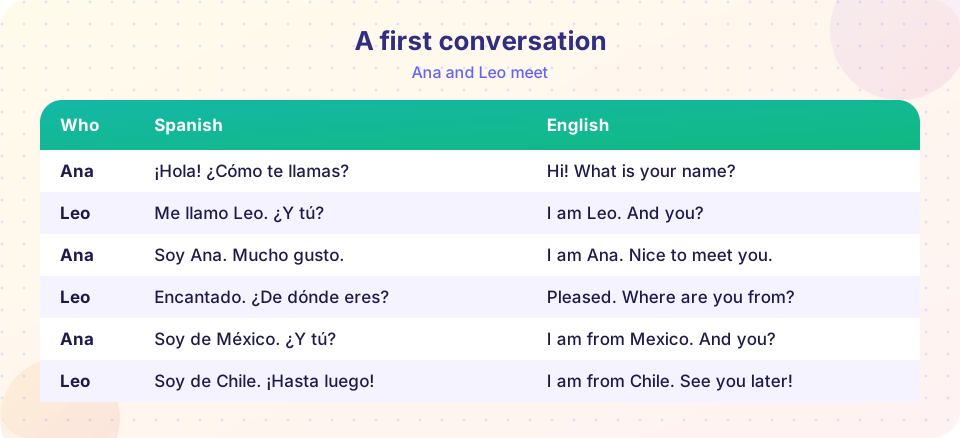
To ask a name: ¿Cómo te llamas? (informal) or ¿Cómo se llama usted? (formal). Literally, "How do you call yourself?" To answer: Me llamo Ana (My name is Ana, literally "I call myself Ana"), or just Soy Ana (I am Ana).
You can learn these as ready-made chunks now. The explanation of me llamo (a reflexive verb) comes in Chapter 4; the idea of soy (I am, from ser) is also explained there.
After names, say Mucho gusto (nice to meet you, literally "much pleasure"). A man can also say Encantado and a woman Encantada (delighted); both are forms of the same adjective, which agrees with the speaker. The other person answers Igualmente (likewise) or El gusto es mío (the pleasure is mine).
For origin, ask ¿De dónde eres? (informal) or ¿De dónde es usted? (formal) and answer Soy de Canadá, Soy de Estados Unidos, Soy de Inglaterra. For where you live, Vivo en Toronto.
Being polite
| Spanish | English | Use |
|---|---|---|
| Por favor | Please | Asking |
| Gracias / Muchas gracias | Thank you / Thank you very much | Thanking |
| De nada | You are welcome | Replying to thanks |
| Perdón | Sorry; excuse me | Apologizing or bumping into someone |
| Disculpe | Excuse me | Getting attention (formal); disculpa is informal |
| Lo siento | I am sorry | Expressing regret |
| Con permiso | Excuse me (to pass by) | Moving through a crowd |
Tú or usted?
Use tú with friends, classmates, family and children, and usted with older people, people you have just met in a formal setting, officials and customers. In Spain, tú has spread widely; in Colombia, Costa Rica and some other places, usted is used even within families. When in doubt, begin with usted. Most people will smile and say ¿Nos tuteamos? (Shall we use tú?), and from then on you can relax.
Culture note
Physical greetings vary. In Spain, two kisses (one on each cheek) are normal between friends, especially when at least one of them is a woman; in much of Latin America, one kiss on the right cheek is common, and in business or with strangers a handshake is the default. Men often shake hands or hug with a pat on the back. Watch what the other person does and follow their lead.
Greeting in real situations
Greetings follow small rituals. When you enter a shop, a café or a lift, say Buenos días or Buenas tardes to the people there, even if you do not know them; leaving silently can seem cold. When you answer the telephone, the usual openings vary by country: ¿Diga? or ¿Dígame? in Spain, Bueno in Mexico, Aló in many South American countries, and a plain ¿Hola? almost everywhere.
In writing, the opening matters too. A formal email begins with Estimado señor García: (Dear Mr. García) or Estimada señora López:; a friendly one begins Hola, Ana:. A formal closing is Atentamente or Cordialmente; a neutral one is Un saludo or Saludos; for a friend, Un abrazo (a hug) or Besos. These phrases are short, so you can learn them in a few minutes and use them for years.
A practical tip: when you are unsure whether to use tú or usted, listen to how the other person addresses you and copy it. If they say ¿Cómo está usted? answer in usted; if they say ¿Cómo estás? you can switch to tú.
Common misconceptions
"Adiós is the only goodbye." It is correct but can sound final. In daily life people more often say hasta luego, nos vemos or chao.
"Spanish speakers say buenas all day." Short buenas is a casual greeting that means whatever fits the time of day; it is not a complete rule.
"Usted is just old-fashioned." It is alive and well. In some countries it is the normal choice with everyone except close friends.
"I must say me llamo every time." Soy Ana is just as common and often shorter.
Try it
First a small Python tool that applies the typical time-of-day rule and builds an introduction. It simply applies the rules from this lesson, so real usage may differ by region. Then a drill and flashcards for practice.
Press Run (or Ctrl + Enter) to see the result here.
Program input · what you'd type while the program runs
Type the answers before you press Run, one per line. Each time the program reads a line (with input()), it gets the next line from this box.
Check your understanding
Quick check · 5 questions
of 5 answered You scored / 5 · perfect!
-
1. Which greeting do you use after dark?
Buenas noches is used in the evening and at night. -
2. How do you ask 'What is your name?' to a stranger formally?
Se llama usted is the formal form. -
3. What does 'Mucho gusto' mean?
It literally means much pleasure and is said when meeting someone. -
4. A man says he is delighted to meet someone. He says...
Encantado is the masculine form. -
5. Which is a casual way to say goodbye in Latin America?
Chao (or chau) is a casual goodbye.
Summary
- Match your greeting to the time of day: buenos días, buenas tardes, buenas noches.
- Ask how someone is with ¿Cómo estás? (informal) or ¿Cómo está usted? (formal).
- Introduce yourself with Me llamo... or Soy..., then Mucho gusto.
- Ask where someone is from with ¿De dónde eres? and answer Soy de...
- Use usted when in doubt; switch to tú when invited.
Next: Chapter 2 Review
Track your progress
Create a free account to tick off lessons and pick up where you left off on any device.
of Spanish for Beginners lessons completed