


















Lesson 7 of 51 · Sounds, Greetings and Basics
The Alphabet and the Five Vowels
Learn the 27 letters of the Spanish alphabet, their names, the five pure vowel sounds, and how diphthongs and hiatus work, with a vowel pad and a spelling helper.
The Spanish alphabet is the one you already know, with one extra letter and a few differences in names. The big change is not in the shapes but in the sounds: where English letters can be pronounced half a dozen ways, each Spanish vowel has exactly one sound. That single fact is the foundation of Spanish pronunciation. If you master the five vowels in this lesson and never let them slide into English habits, you will be understood in almost every Spanish-speaking country.
You will also learn to spell words aloud, which you need all the time: giving your name on the phone, spelling an email address, or asking someone to spell a word for you with the phrase ¿Cómo se escribe? (How is it written?).
What you will learn
- The 27 letters of the Spanish alphabet and their names.
- The five vowel sounds and how to keep them pure.
- How strong and weak vowels combine into diphthongs, and when they split (hiatus).
- How to spell a word aloud in Spanish.
Key terms
Vowel: a sound made with an open mouth and no blocking of the air: a, e, i, o, u.
Consonant: a sound that partly or fully blocks the air (p, s, l).
Diphthong: two vowels pronounced in one syllable (bue-no, two syllables, not three).
Hiatus: two vowels side by side that belong to separate syllables (le-er, pa-ís).
Strong vowels: a, e, o. Weak vowels: i, u.
The 27 letters
Since 2010 the Real Academia Española (the institution that sets standard spelling) counts 27 letters. Ch and ll, once separate letters in dictionaries, are now treated as two-letter combinations. The letter ñ is its own letter, placed after n. Here are all of them with their names and a respelling:
| Letter | Name | Say it | Letter | Name | Say it |
|---|---|---|---|---|---|
| a | a | ah | ñ | eñe | EH-nyeh |
| b | be | beh | o | o | oh |
| c | ce | seh (Spain: theh) | p | pe | peh |
| d | de | deh | q | cu | koo |
| e | e | eh | r | erre | EH-rreh |
| f | efe | EH-feh | s | ese | EH-seh |
| g | ge | heh | t | te | teh |
| h | hache | AH-cheh | u | u | oo |
| i | i | ee | v | uve | OO-beh |
| j | jota | HOH-tah | w | uve doble | OO-beh DOH-bleh |
| k | ka | kah | x | equis | EH-kees |
| l | ele | EH-leh | y | ye (also i griega) | yeh |
| m | eme | EH-meh | z | zeta | SEH-tah (Spain: THEH-tah) |
| n | ene | EH-neh |
Letter names vary a little by country. The letter v is uve in Spain and often ve in Latin America; w is doble ve, doble u or uve doble; and b and v are sometimes distinguished as be larga and ve corta when someone needs to avoid confusion. The letters k and w appear mainly in loanwords: kilo, whisky.
The five vowels
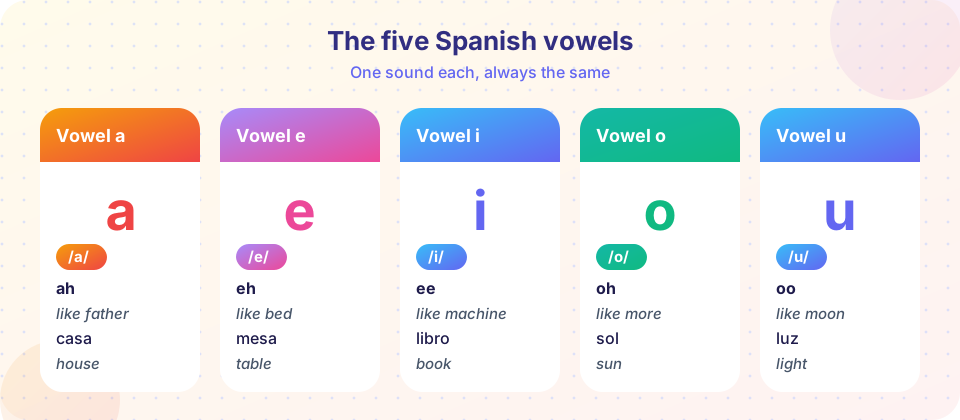
Learn these as sounds, not as spellings. Each is short, clean and does not glide.
| Vowel | IPA | Like English... | Examples |
|---|---|---|---|
| a | /a/ | the a in father, but shorter | casa (house), mano (hand) |
| e | /e/ | the e in bed, without the y-glide of day | mesa (table), leche (milk) |
| i | /i/ | the ee in machine, short | libro (book), vino (wine) |
| o | /o/ | the o in more, without the w-glide of go | sol (sun), foto (photo) |
| u | /u/ | the oo in moon, short | uva (grape), luz (light) |
Here is the trick that fixes most accents. Say English go slowly and notice that your lips close at the end into a small w: goh-w. Now say Spanish o and stop the lips from moving. Do the same with say (seh-y). If you keep the mouth still, the vowel is pure.
The vowels are also the same whether stressed or not. In English, the second a in banana turns into a lazy "uh". In Spanish it stays a full a: ba-NA-na.
Diphthongs and hiatus
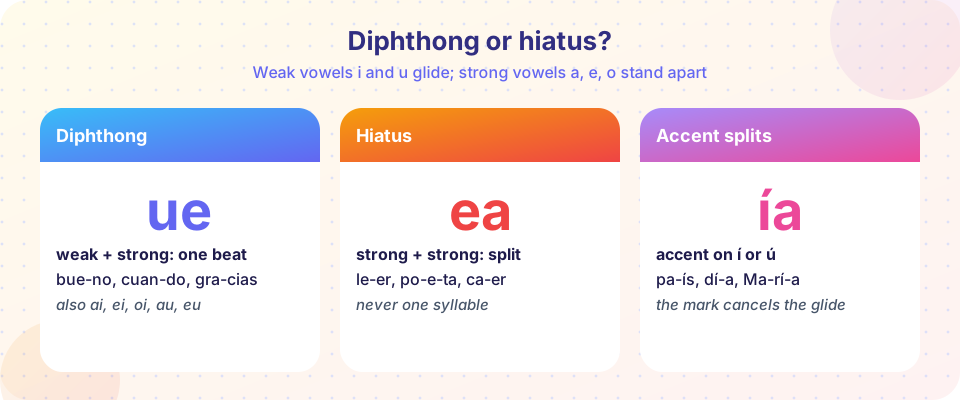
Spanish vowels fall into two groups. The strong vowels a, e, o are open and loud. The weak vowels i and u are closed and soft.
- Weak + strong, strong + weak or weak + weak in the same syllable make a diphthong: bue-no (good), cuan-do (when), gra-cias (thanks), ciu-dad (city), ai-re (air), rey (king), muy (very).
- Strong + strong never share a syllable. They form a hiatus: le-er (to read), po-e-ta (poet), ca-er (to fall).
- A weak vowel with a written accent keeps its own syllable: pa-ís (country), dí-a (day), Ma-rí-a. The accent is the signal that the diphthong is cancelled.
A useful phonetic detail: in a diphthong the weak vowel becomes a semivowel. The i in gracias sounds like a quick English y (/ˈɡɾa.sjas/), and the u in bueno like a quick w (/ˈbwe.no/).
Spelling a word aloud
When you give your name or email, say each letter by its name. Ana is a, ene, a. Pérez is pe, e con acento, erre, e, zeta; for é con acento people say e con tilde too. For an email, the at sign is arroba and the dot is punto: ana punto perez arroba correo punto com. It sounds odd the first time, so practice it.
Practicing the vowels
Your mouth shape decides the vowel. For a open the jaw wide and keep the tongue low and flat. For i raise the front of the tongue close to the roof of the mouth and spread the lips as if smiling. For u round and push the lips forward and raise the back of the tongue. The vowels e and o sit between them: e is a relaxed, half-open front vowel and o is a half-open rounded back vowel. Say i, e, a, o, u slowly in front of a mirror and watch the lips change; then say them again without any glide.
A useful drill is the vowel chain. Pair each vowel with a consonant and say them in order, slowly at first and then faster: mi, me, ma, mo, mu and si, se, sa, so, su. Next compare words that differ only by their vowel. Say mesa (table), misa (mass) and musa (muse) three times each; then paso (step), piso (floor, apartment) and peso (weight; also the name of several currencies); then casa (house), cosa (thing) and caso (case). If a listener can tell them apart, your vowels are pure.
Finally, record yourself reading the words once a day for a week. Many learners notice that, after a few days, the o stops sliding into ow and the e stops sliding into ay. That small change is the biggest single improvement you can make to your accent.
Common misconceptions
"Spanish e is like the e in me." No. Spanish e is /e/ like bed; the English ee sound is Spanish i. So me (to me) is meh, not mee.
"Spanish u is like you." It is simply oo, as in moon. The y sound appears only in diphthongs such as ciudad.
"Unstressed vowels disappear." In English they weaken; in Spanish they do not. Pronounce chocolate as cho-co-LA-te, with a clear final e.
Try it
First a vowel pad: click a vowel to see how to say it, with three example words. It uses a fixed table and, if your browser supports it, the Listen button reads a word aloud. Then a spelling helper in Python that turns any word into its letter names, and flashcards for the trickiest letter names.
Press Run (or Ctrl + Enter) to see the result here.
Program input · what you'd type while the program runs
Type the answers before you press Run, one per line. Each time the program reads a line (with input()), it gets the next line from this box.
Check your understanding
Quick check · 5 questions
of 5 answered You scored / 5 · perfect!
-
1. How many letters does the Spanish alphabet have today (RAE, since 2010)?
The 26 Latin letters plus ñ make 27; ch and ll are no longer separate letters. -
2. Which English word has the same vowel sound as Spanish i?
Spanish i is /i/, like the ee in machine. -
3. Which pair forms a hiatus, two separate syllables?
Two strong vowels, e and a, never form a diphthong: le-er. -
4. What does the accent do in 'país'?
A written accent on a weak vowel cancels the diphthong. -
5. How is the letter 'h' named?
H is hache; j is jota; g is ge.
Summary
- The Spanish alphabet has 27 letters, including ñ; letter names differ slightly by region.
- Five vowels, a e i o u, each with one clean sound and no glide.
- Weak vowels (i, u) combine with others into diphthongs; two strong vowels (a, e, o) split.
- An accent on a weak vowel keeps it in its own syllable.
- Spell with letter names: a, ene, a for Ana.
Track your progress
Create a free account to tick off lessons and pick up where you left off on any device.
of Spanish for Beginners lessons completed