


















Lesson 39 of 51 · Future, Commands and Subjunctive Basics
Chapter 7 review: Future, commands and subjunctive
Review the Spanish future, conditional, present subjunctive and commands with a recap table, common mistake fixes, a mixed drill and a ten-question quiz.
This chapter dealt with things that have not happened yet: plans, wishes and orders. Use this review to consolidate. Read the picture, scan the table, fix the mistakes and test yourself.
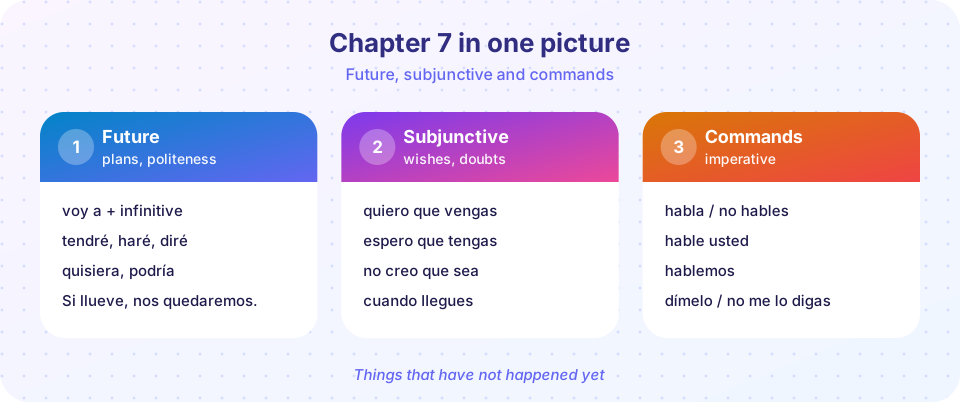
Recap table
| Lesson | Key ideas | Example |
|---|---|---|
| Future and conditional | present, ir a, simple future; irregular stems; -ía endings for polite requests | ¿Podrías ayudarme? |
| Subjunctive basics | yo form − o + opposite vowel; six irregulars; WEIRDO triggers; cuando + future | Quiero que vengas. |
| Commands | tú affirmative = él form; irregulars; negatives and usted via subjunctive; pronouns attached | Dímelo. No me lo digas. |
Four habits to keep
- Ask what kind of "not yet". A plan, a wish, a doubt or an order each has its own form.
- Same subject, infinitive. Quiero salir, but Quiero que salgas.
- Build negatives from the subjunctive. Habla but no hables; hable usted, no hablen.
- Attach pronouns to affirmative commands. Siéntate, dímelo; and add accents to keep the stress.
Fix the mistakes
| Sentence | Correction | Why |
|---|---|---|
| Voy a hablaré con ella. | Voy a hablar con ella. / Hablaré con ella. | Do not combine ir a with a conjugated verb. |
| Quiero que yo vaya. | Quiero ir. | The same subject takes the infinitive. |
| Creo que sea fácil. | Creo que es fácil. | Affirmative creer que takes the indicative. |
| Cuando llego mañana, te llamo. | Cuando llegue mañana, te llamo. | Future events after cuando take the subjunctive. |
| No haz eso. | No hagas eso. | Negative tú commands use the subjunctive. |
| Dime lo. | Dímelo. | Pronouns attach to affirmative commands, with an accent. |
| Tendrémos tiempo. | Tendremos tiempo. | The nosotros future form has no written accent. |
Worked examples
Example 1: plan and politeness. Translate: "Tomorrow I will go to the bank, and I would like you to come with me." Mañana iré al banco y me gustaría que vinieras conmigo. This uses the simple future (iré), the conditional (me gustaría) and the imperfect subjunctive (vinieras), which you meet later. For now the simpler version works: Mañana voy al banco. Quiero que vengas conmigo.
Example 2: advice. A friend feels tired. Te recomiendo que duermas más. Acuéstate temprano y no tomes café por la noche. Yo que tú iría al médico. Notice recommendation + que + subjunctive (duermas), two commands (acuéstate, no tomes) with the reflexive pronoun attached to the affirmative one, and the conditional (iría) for gentle advice.
Example 3: instructions. A host tells a guest: Pase usted, siéntese, por favor. ¿Le gustaría un café? Cuando quiera, dígame. This one sentence uses two formal commands (pase, siéntese), a conditional (gustaría), a subjunctive after cuando (quiera) and a command with a pronoun (dígame). If you can understand why each form appears, you have mastered the chapter.
Mixed practice
Chapter review quiz
Quick check · 10 questions
of 10 answered You scored / 10 · perfect!
-
1. How do you say "I am going to cook"?
Ir a + infinitive. -
2. What is the future of "hacer" for nosotros?
Hacer has the stem har-: haremos. -
3. Which is a polite request?
The conditional podría softens the request. -
4. What is the subjunctive of "tener" for tú?
Tengo becomes teng- + as: tengas. -
5. Which sentence needs the subjunctive?
Dudo que triggers the subjunctive. -
6. What is "Don't go alone" (tú)?
Negative tú command: no + subjunctive vayas. -
7. What is the affirmative tú command of "poner"?
Poner is irregular in the affirmative tú command: pon. -
8. How do you say "Give it to him"?
Le becomes se before lo, and the pronouns attach with an accent: dáselo. -
9. Which sentence is correct?
Quiero que requires the subjunctive: estudies. -
10. What does "Ojalá llueva" express?
Ojalá expresses a wish or hope and takes the subjunctive.
Summary
- The future can use the present, ir a or the simple future; the conditional gives politeness and advice.
- The present subjunctive follows wishes, doubts, emotions and cuando with future events, with a change of subject.
- Commands change by person; negatives and formal commands use subjunctive forms.
- Pronouns attach to affirmative commands and precede negative ones.
Track your progress
Create a free account to tick off lessons and pick up where you left off on any device.
of Spanish for Beginners lessons completed