


















Lesson 2 of 49 · Getting Started
What Is Oceanography?
Learn what oceanography studies, how its four branches (geological, chemical, physical, biological) work together and why the ocean matters to everyone.
Imagine you want to know why a fishing area suddenly collapses. A biologist counts the fish. A chemist checks the oxygen in the water. A physicist looks at the currents that bring food. A geologist studies the seafloor where young fish shelter. Each of them finds part of the answer, and none can find the whole answer alone. That is why oceanography is not one subject but four, braided together.
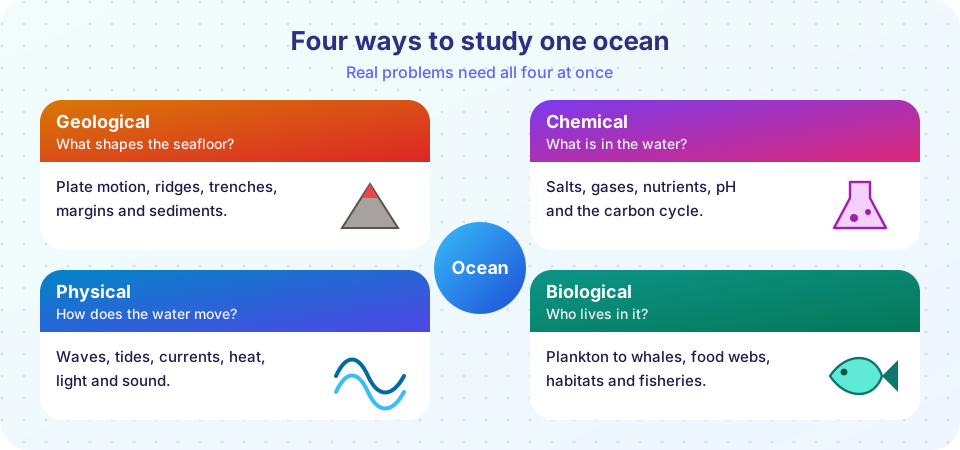
This lesson defines the field, introduces its four branches and shows how a single question, such as "why is this part of the ocean so rich in life?", passes through all of them.
What you will learn
- A working definition of oceanography and how it differs from marine biology
- The questions asked by geological, chemical, physical and biological oceanography
- Why oceanographers treat the ocean as a connected system
- Why the ocean matters for climate, food, trade and safety
Key terms
Oceanography: the study of the ocean's floor, water, motion and life (also called oceanology or marine science).
Marine biology: the study of organisms that live in the sea; one branch's neighbor, not the whole field.
Hydrosphere: all the water on Earth, including oceans, ice, lakes, rivers and groundwater.
Interdisciplinary: using several sciences at once to answer one question.
Hypothesis: a testable explanation that observations can support or contradict.
A definition that works
Oceanography is the scientific study of the ocean: its floor, its water, its motion and its life. The word comes from the Greek okeanos ("ocean") and graphein ("to write"), and early oceanography was mostly description: where the water is, how deep, how salty. Today it is a quantitative, interdisciplinary science that asks "why" and "what next" as well as "what".
People sometimes call it marine science, and the two terms overlap heavily. Marine biology is the part of the field that studies sea organisms, while oceanography includes biology but also geology, chemistry and physics. The sea's weather-like behavior, its salt, its mountains and its animals all belong.
The four branches
Geological oceanography
Geological oceanography (also called marine geology) studies the seafloor and the rocks beneath it. Its questions include: How are ocean basins formed? Why are there long mountain chains under the sea and deep trenches at the edges of continents? Where does sediment come from, and what does a core of mud say about past climates? The answers rest on plate tectonics, which you will meet in chapter 2.
Chemical oceanography
Chemical oceanography studies what is dissolved in the water and how elements cycle between sea, air, rock and living things. Key questions: Why is seawater salty, and why is the saltiness so constant? Where do nutrients such as nitrate and phosphate come from, and where do they go? How much carbon dioxide does the ocean take up, and what does that do to its acidity? Chapter 3 answers these.
Physical oceanography
Physical oceanography studies the ocean as a moving fluid: waves, tides, currents, temperature, density, light and sound. It asks: What drives the great current systems? How does heat travel from the tropics toward the poles? Why do some waves break and others travel across a whole ocean? Chapter 4 is its home ground.
Biological oceanography
Biological oceanography studies sea life and its relationships: how microscopic algae produce food, how food webs work, how animals migrate, what controls where life is abundant. Chapter 6 covers it.
| Branch | Studies | Typical tools | Example question |
|---|---|---|---|
| Geological | Seafloor, sediments, tectonics | Sonar, drilling, sediment cores | How old is the Atlantic basin? |
| Chemical | Salts, gases, nutrients, pH | Water bottles, sensors, lab analysis | How fast is the ocean getting more acidic? |
| Physical | Currents, waves, tides, heat | Floats, moorings, satellites, models | Why is the Gulf Stream so strong? |
| Biological | Organisms and ecosystems | Nets, cameras, genetic samples | What limits plankton growth? |
One question, four branches
Take the question: why is the ocean off the west coast of South America so full of fish?
- Physical: the winds blow along the coast and push surface water offshore. Cold water rises from below to replace it. This is called upwelling.
- Chemical: that deep water is rich in nutrients, because dead material from above has been sinking, decaying and releasing nitrate and phosphate for years.
- Biological: in the sunlit surface, microscopic algae use those nutrients to multiply quickly. Small fish eat them, larger animals eat the fish, and a huge fishery appears.
- Geological: a narrow continental shelf close to a steep margin lets the cold water rise near the coast, and sediment on the shelf holds records of past years when the upwelling weakened.
All four branches tell part of one story. That is what "interdisciplinary" means in practice, and it is why the rest of this course always connects the chapters.
Why the ocean matters
- Climate. Water holds heat very well. The top three meters of the ocean store about as much heat as the entire atmosphere. The ocean has absorbed the large majority of the extra heat caused by human activity and about a quarter to a third of the carbon dioxide we release.
- Food. Fish and seafood are an important protein source for billions of people, and marine algae and bacteria carry out roughly half of all photosynthesis on Earth, so they produce a large share of the oxygen we breathe.
- Transport and trade. Around 80% of world trade by volume travels by sea.
- Safety. Storms, tsunamis, sea-level rise and coastal erosion are ocean phenomena that affect hundreds of millions of people who live near coasts.
Common misconceptions
"Oceanography and marine biology are the same thing." Marine biology studies sea life. Oceanography includes it but also studies the seafloor, the water's chemistry and its motion.
"The ocean is too big to change." Its size is exactly why changes matter: it controls heat and carbon for the whole planet. And local effects like pollution and overfishing are already measurable.
"Scientists just go out on ships and look." Modern oceanography relies on instruments, satellites, autonomous robots and computer models. Ships are important, but a great deal of data arrives without anyone being at sea.
Try it
The first example shows how the four branches might share the questions in a real research project. Edit the list to match a topic you like, and see how the count changes.
Press Run (or Ctrl + Enter) to see the console output here.
No output.
The second example draws a simple "pie" of how much of each branch a project uses. It is a demonstration, not a survey of real research.
Press Run (or Ctrl + Enter) to see the result here.
Program input · what you'd type while the program runs
Type the answers before you press Run, one per line. Each time the program reads a line (with input()), it gets the next line from this box.
Check your understanding
Quick check · 5 questions
of 5 answered You scored / 5 · perfect!
-
1. Which statement best describes oceanography?
Oceanography covers the seafloor, the water, its motion and its life. -
2. Which branch studies waves, tides and currents?
Physical oceanography treats the ocean as a moving fluid with heat, density, light and sound. -
3. Why is a question like 'why do anchovies thrive off Peru?' interdisciplinary?
Upwelling (physical) brings nutrients (chemical) that feed algae and fish (biological). -
4. Which of these is a reason the ocean matters for climate?
The ocean's huge heat capacity and its carbon uptake make it central to Earth's climate. -
5. Roughly how much world trade by volume goes by sea?
Around 80% of world trade by volume is carried by ships.
Summary
- Oceanography studies the ocean's floor, water, motion and life; marine biology is one part of it.
- The four branches are geological, chemical, physical and biological oceanography.
- Real questions use several branches at once, which is why the ocean is studied as a system.
- The ocean matters for climate, food, trade and coastal safety.
Track your progress
Create a free account to tick off lessons and pick up where you left off on any device.
of Oceanography lessons completed