


















Lesson 3 of 49 · Getting Started
Ocean Scale and Key Numbers
Get a feel for the size of the ocean: its area, volume, depth zones, pressure and the five ocean basins, with worked calculations and a simple hypsometric curve.
Numbers about the ocean are so large that they can lose meaning. A volume of 1.33 billion cubic kilometers is hard to picture. This lesson gives you a small set of facts to remember and, more importantly, shows you how to work with them: how to turn area and depth into volume, how to turn depth into pressure and how to see why the ocean, huge as it is, is really a thin film on a large planet.
You will use these numbers again and again, so it is worth learning them well. We will round on purpose. In oceanography, a good estimate with the right units is more useful than a long string of digits.
What you will learn
- The area, volume and mean depth of the world ocean
- The names and rough sizes of the ocean basins
- How depth zones are named and how pressure grows with depth
- How to estimate volume and mass from area and depth
- Why the ocean is a "thin film" compared with Earth's radius
Key terms
World ocean: the single connected body of salt water that covers most of Earth; its named parts (Pacific, Atlantic and so on) are basins.
Mean depth: the average depth over the whole ocean, about 3,700 m.
Hypsometric curve: a graph of how much of Earth's surface lies at each height or depth.
Hydrostatic pressure: pressure caused by the weight of the water above, which rises steadily with depth.
Sea level: the average height of the ocean surface, used as the zero point for heights and depths.
The headline numbers
| Quantity | Value (rounded) |
|---|---|
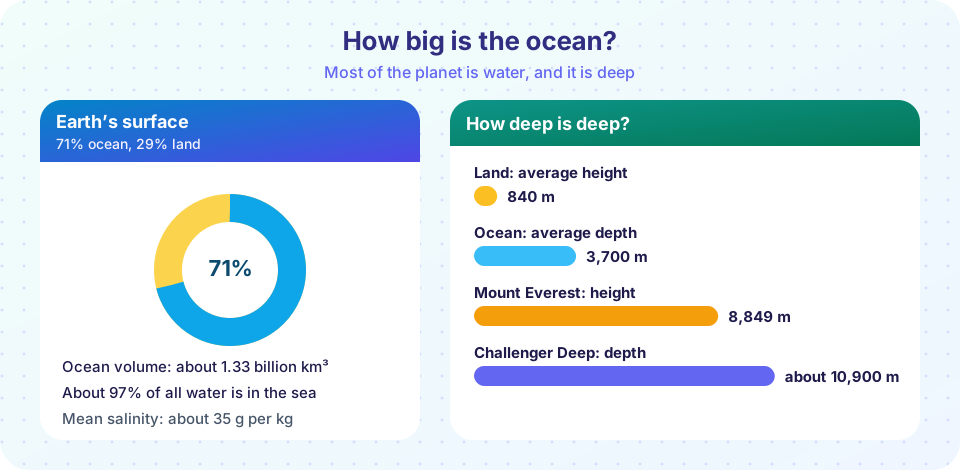
| Ocean area | about 361 million km² (71% of the surface) |
| Land area | about 149 million km² (29%) |
| Ocean volume | about 1.33 billion km³ |
| Mean depth | about 3,700 m |
| Greatest depth | about 10,900 m (Challenger Deep, Mariana Trench) |
| Highest land | 8,849 m (Mount Everest) |
| Mean salinity | about 35 g of salt per kg of seawater |
| Mean temperature | about 3.5 °C (most of the volume is cold, deep water) |
| Total mass | about 1.4 × 10²¹ kg |
Two things stand out. First, the ocean is deep: its average depth is more than four times the average height of the land. If you could bulldoze every mountain into the sea, the land would not even fill the ocean basins; it would leave a global ocean about 2.7 km deep. Second, the ocean is very cold on average. The warm layer you swim in is a thin skin on top of a huge cold interior.
The ocean basins
The world ocean is one connected body, but we divide it into named basins:
- Pacific Ocean, the largest by far, about 46% of the ocean area. It alone is larger than all the land on Earth put together.
- Atlantic Ocean, roughly 29% of the ocean area including its marginal seas, long and narrow, and growing wider.
- Indian Ocean, about 20% of the area, mostly in the Southern Hemisphere and bounded to the north by Asia.
- Southern Ocean, the water around Antarctica, which flows all the way around the planet and links the other basins. Its northern boundary is defined differently by different agencies.
- Arctic Ocean, the smallest and shallowest, mostly covered by sea ice.
Because the percentages depend on where boundaries are drawn (especially for the Southern Ocean and marginal seas), treat them as approximate. What matters is the pattern: the Pacific dominates, the Atlantic is the narrow connector, and the Southern Ocean joins everything.
There is also a hemisphere effect. About 61% of the Northern Hemisphere is ocean, compared with about 81% of the Southern Hemisphere, because most land lies in the north.
Depth zones and pressure
Oceanographers divide the water column into layers by depth. The names are a mixture of old conventions, but these are the common ones:
| Zone | Depth | What it is like |
|---|---|---|
| Epipelagic | 0 to 200 m | Sunlit, warm, most photosynthesis |
| Mesopelagic | 200 to 1,000 m | Dim twilight, no photosynthesis |
| Bathypelagic | 1,000 to 4,000 m | Dark, cold, about 2 to 4 °C |
| Abyssopelagic | 4,000 to 6,000 m | Dark, near freezing, the abyssal plains |
| Hadal | below 6,000 m | The trenches, extreme pressure |
Pressure increases with depth because of the weight of the water above you. The formula for hydrostatic pressure is:
p = p₀ + ρ g h
where p₀ is atmospheric pressure at the surface (about 101,325 Pa), ρ is the density of seawater (about 1,027 kg/m³), g is gravitational acceleration (9.81 m/s²) and h is depth in meters.
Worked example. What is the added pressure at 1,000 m?
ρ g h = 1,027 × 9.81 × 1,000 ≈ 1.01 × 10⁷ Pa
One atmosphere is about 1.01 × 10⁵ Pa, so this is about 100 atmospheres added to the air pressure, giving roughly 101 atmospheres in total. A handy rule: every 10 meters of seawater adds about one atmosphere. At the bottom of Challenger Deep, around 10,900 m, the pressure is about 1,100 atmospheres (the exact value depends on how density grows with depth, but 1,100 atmospheres is a good estimate).
From area and depth to volume and mass
To find the ocean's volume you can multiply area by mean depth:
V = A × d = 361 × 10⁶ km² × 3.7 km ≈ 1.34 × 10⁹ km³
This matches the accepted value (1.33 to 1.34 billion km³). To find the mass, convert to cubic meters (1 km³ = 10⁹ m³) and multiply by density:
m = ρ V = 1,027 kg/m³ × 1.34 × 10¹⁸ m³ ≈ 1.4 × 10²¹ kg
Notice the pattern: units first, then arithmetic. Always write the unit with each number and make sure they cancel properly before you multiply.
The ocean is a thin film
Earth's radius is about 6,371 km. The mean depth of the ocean is 3.7 km, which is 0.06% of the radius. If you shrank Earth to the size of a basketball (diameter about 24 cm), the average ocean would be a layer roughly 0.07 mm thick, about as thick as a sheet of paper. This is why a "thin" layer of water can behave in surprising ways: its horizontal extent (thousands of kilometers) is vastly larger than its vertical extent (a few kilometers), so currents and waves behave almost like they are in a two-dimensional sheet, and why a few kilometers of vertical distance can mean the difference between warm and freezing water.
Common misconceptions
"The Pacific is just the biggest ocean, nothing special." It contains roughly half the ocean's water and is larger than all the continents combined. Its behavior (El Niño, typhoons, the largest trenches) shapes the climate of the whole planet.
"The ocean is 'bottomless' in the deep parts." The deepest point, Challenger Deep, is about 10,900 m. That is deep, but finite and well measured. The greatest depths are small areas; most of the seafloor is 3,000 to 6,000 m deep.
"Pressure at depth is the same as at the surface but stronger in some mystical way." It is just the weight of the water above. The formula p = p₀ + ρ g h works, and every 10 m adds about 1 atmosphere.
Try it
The first example draws a simplified hypsometric curve. It is built from rounded points and is an illustration, not a measured data set, but it shows the real pattern: two peaks of area, one at sea-floor depth around 4 to 5 km, and one near sea level.
Press Run (or Ctrl + Enter) to see the result here.
Program input · what you'd type while the program runs
Type the answers before you press Run, one per line. Each time the program reads a line (with input()), it gets the next line from this box.
The second example is a pressure and scale calculator. Change the depth to see the pressure, and see how thin the ocean is on a scaled-down Earth.
Press Run (or Ctrl + Enter) to see the console output here.
No output.
Check your understanding
Quick check · 5 questions
of 5 answered You scored / 5 · perfect!
-
1. What is the approximate mean depth of the ocean?
The mean depth is about 3,700 m; the maximum, in Challenger Deep, is about 10,900 m. -
2. About how much does pressure increase for every 10 m of seawater depth?
Using ρ g h = 1,027 × 9.81 × 10 ≈ 1.0 × 10⁵ Pa, which is about one atmosphere. -
3. Which ocean basin is the largest?
The Pacific contains roughly half of the ocean's area and volume. -
4. Roughly how do you get the volume of the ocean from the numbers in this lesson?
Volume is area times mean depth: 361 million km² × 3.7 km is about 1.34 billion km³. -
5. Why is the ocean called a thin film?
A mean depth of 3.7 km is about 0.06% of the 6,371 km radius, so the ocean is thin compared with its horizontal size.
Summary
- The ocean covers 71% of Earth, holds about 1.33 billion km³ of water and has a mean depth near 3,700 m.
- The Pacific is about half the ocean; the Southern Ocean links the basins.
- Pressure adds about one atmosphere per 10 m of depth (
p = p₀ + ρ g h). - Volume is area times mean depth; mass is volume times density.
- The ocean is a thin film on a large planet, mostly cold and dark.
Track your progress
Create a free account to tick off lessons and pick up where you left off on any device.
of Oceanography lessons completed