


















Lesson 24 of 49 · Ocean-Atmosphere Interaction
Chapter 5 Overview: Ocean-Atmosphere Interaction
Overview of how the ocean and atmosphere trade heat, water and momentum: the heat budget, winds, El Niño, hurricanes and monsoons, with lesson links.
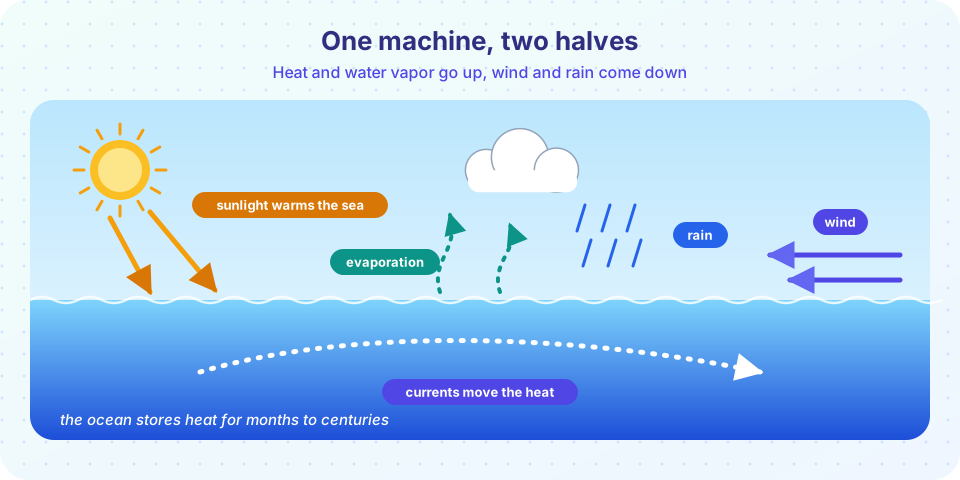
Weather and ocean currents are usually taught as separate subjects, but they are two halves of one machine. The Sun heats the tropical ocean; the ocean passes that heat to the air as water vapor; the air moves it poleward and drives winds; and the winds push the surface of the ocean, which then moves heat around the planet and changes the air above it. Round and round it goes. When you notice that a drought in Australia, a fishery collapse in Peru and a mild winter in Canada can share one cause, you are seeing this machine at work.
This chapter explains the main parts of the machine. You met the ocean's currents in chapter 4; here we put the atmosphere back into the picture and ask what the two exchange, how fast, and what happens when the exchange goes out of balance.
What you will learn
- What the ocean and atmosphere exchange: heat, water, momentum and gases
- Why the ocean is the climate system's heat store and the atmosphere its fast messenger
- The main phenomena you will meet in this chapter and the scales they live on
- How the lessons in this chapter fit together
Key terms
Air-sea flux: the rate at which heat, water or momentum crosses the sea surface, measured per square meter.
Latent heat: heat absorbed when water evaporates and released when vapor condenses into cloud.
Sea surface temperature (SST): the temperature of the top few meters of the ocean, the main thing the atmosphere "feels".
Teleconnection: a link between weather or climate in places thousands of kilometers apart.
Coupled system: two parts, here ocean and air, that each change the other.
Four things that cross the surface
The sea surface is a thin boundary with a great deal of traffic. Four quantities cross it constantly.
- Heat. Sunlight warms the surface; infrared radiation, evaporation and direct contact with cooler air cool it. The balance decides whether a patch of ocean warms or cools.
- Water. The ocean supplies most of the water vapor in the atmosphere. About 86% of all evaporation on Earth happens over the sea, and most rain falls back into it. The water that does fall on land comes from the sea first.
- Momentum. Wind drags on the surface and pushes it. This friction is the main driver of surface currents and waves (chapter 4).
- Gases. Oxygen, carbon dioxide and other gases dissolve into or escape from the sea surface. You looked at this in the chapter on seawater.
In this chapter the first three take center stage.
Why the ocean is the heat store
Water has an unusually high heat capacity, and the ocean has an enormous mass. A simple comparison makes the point. The whole atmosphere above one square meter has a mass of about 10,000 kg. The heat capacity of that column equals the heat capacity of only about the top 2.5 meters of seawater. The ocean as a whole is 3,700 meters deep on average. So, for climate purposes, the atmosphere is a small, fast, easily warmed layer sitting on a vast, slow, heavy reservoir.
Two consequences follow:
- The ocean remembers. A warm patch can persist for months and keep influencing the weather, which is why seasonal forecasts depend on SST.
- The ocean buffers change. Over the past half century the ocean has absorbed more than 90% of the extra heat trapped by greenhouse gases, so air temperatures have risen more slowly than they would have otherwise. You will see the numbers in the next lesson.
The map of phenomena
The topics of this chapter span several time scales and spatial sizes, just as the motions in chapter 4 did.
One coupled machine
Winds and heat
El Niño
Storms and monsoons
Why it matters
Everything in this chapter is a trade of heat, water or momentum.
What each lesson covers
| Lesson | Question it answers |
|---|---|
| Heat, Winds and Air-Sea Exchange | How much heat crosses the surface, and what shapes the global wind belts? |
| El Niño and the Southern Oscillation | Why does the tropical Pacific swing between warm and cool states every few years? |
| Hurricanes and Monsoons | How does warm ocean water fuel storms and drive seasonal rains? |
| Chapter 5 Review | Formulas, numbers and a ten-question quiz. |
Common misconceptions
"The atmosphere heats the ocean." On average the heating goes mostly the other way. Sunlight passes through air and is absorbed by the sea; the sea then warms the air from below.
"El Niño is a hurricane or a storm." It is a change in the ocean's temperature pattern and in the winds above it, lasting many months.
"The ocean absorbs heat evenly." Most of the Sun's heat enters in the tropics, and the ocean's surface layer both stores and exports it.
Try it
The first example checks the claim that the top 2.5 meters of the ocean hold as much heat capacity as the entire atmosphere. It uses only the density of seawater and standard values for heat capacities.
Press Run (or Ctrl + Enter) to see the console output here.
No output.
The second example is a small interactive picture of the coupled loop. Move the slider to change how warm the sea surface is and watch how the vapor supplied to the air changes. The relationship is the Magnus formula for saturation vapor pressure, a standard approximation. The picture is a demonstration, not a weather model.
Check your understanding
Quick check · 4 questions
of 4 answered You scored / 4 · perfect!
-
1. Roughly what share of global evaporation happens over the ocean?
The ocean covers 71% of the surface and is warm and wet, so it supplies about 86% of evaporation. -
2. The heat capacity of the whole atmosphere equals that of about how much seawater?
A column of air above 1 m² has a heat capacity of about 10 MJ/K, the same as roughly 2.5 m of seawater. -
3. Which of these is a teleconnection?
Teleconnections link weather in places far apart, usually through changes in the winds. -
4. Which statement about the ocean's role in warming is correct?
More than 90% of the added heat has gone into the ocean, which slows surface warming of the air.
Summary
- The ocean and atmosphere exchange heat, water, momentum and gases across the sea surface.
- The ocean holds far more heat than the air: the whole atmosphere has the heat capacity of about 2.5 m of seawater.
- About 86% of evaporation is from the sea, so ocean temperature controls how much water the air receives.
- El Niño, hurricanes and monsoons are all ocean-atmosphere partnerships, studied in the next lessons.
Track your progress
Create a free account to tick off lessons and pick up where you left off on any device.
of Oceanography lessons completed