


















Lesson 9 of 49 · The Ocean Basins
Ridges, Hotspots and Seamounts
Discover the volcanic landscape of the deep sea: mid-ocean ridges, black smokers, hotspot island chains like Hawaii, seamounts, guyots and Darwin's atoll theory.
Most of Earth's volcanic activity happens where nobody can see it. About 70% of the magma that reaches the surface each year erupts along the mid-ocean ridges, building new crust on the bottom of the sea. Another set of volcanoes sits far from any plate boundary, above hotspots, and builds chains of islands that tell the speed and direction of the plate above them.
This lesson covers both. You will see how a ridge builds the longest mountain chain on the planet, why scalding water gushes from the seafloor, how the Hawaiian Islands formed and how an island can sink and become a ring-shaped coral atoll.
What you will learn
- How fast- and slow-spreading ridges differ
- How hydrothermal vents and black smokers work
- How hotspots create island chains, and how to compute plate speed from them
- What seamounts and guyots are
- How Darwin explained coral atolls
Key terms
Mid-ocean ridge: an undersea mountain chain where plates diverge and new crust forms.
Hotspot: a place where a long-lived column of hot rock (a mantle plume) feeds volcanism, away from plate boundaries.
Seamount: an underwater volcano that rises at least 1,000 m above the seafloor.
Guyot: a flat-topped seamount whose summit was planed off by waves when it was at the surface.
Atoll: a ring-shaped coral reef enclosing a lagoon.
Mid-ocean ridges
The ridge system winds through all the oceans like the seam of a baseball, about 65,000 km long. The crest is typically 2,500 m below the surface, and the whole ridge stands 2,000 to 3,000 m above the neighboring plains. It is wide because new crust is hot and buoyant; as it ages and cools it sinks (lesson 220).
Ridges come in two flavors, depending on spreading speed:
| Slow-spreading | Fast-spreading | |
|---|---|---|
| Example | Mid-Atlantic Ridge | East Pacific Rise |
| Full spreading rate | about 2 to 5 cm/yr | about 8 to 16 cm/yr |
| Shape | Rugged, with a deep central rift valley | Smooth, broad, with a shallow axial high |
| Magma supply | Intermittent | Steady, with a magma chamber below |
Spreading is not perfectly continuous. Transform faults cut the ridge into segments and shift them sideways, leaving fracture zones.
Hydrothermal vents
Cold seawater seeps down into cracks in the young crust, gets heated by the magma and dissolves metals and sulfur from the rock. The hot fluid is buoyant and rushes back out. Where it meets near-freezing water, the dissolved minerals precipitate as dark clouds of tiny particles, forming black smokers, chimneys of sulfide and sulfate minerals. The fluid can be around 350 to 400 °C. It does not boil, because the pressure at 2,500 m is more than 250 times atmospheric.
These vents matter for three reasons:
- They are a significant part of the exchange of heat and chemicals between the crust and the ocean.
- They support life without sunlight. Bacteria use chemical energy from hydrogen sulfide (chemosynthesis), and animals such as giant tube worms, clams and shrimp host or eat those bacteria.
- Their mineral deposits are a target for exploration and a subject of debate about mining.
Hotspots and island chains
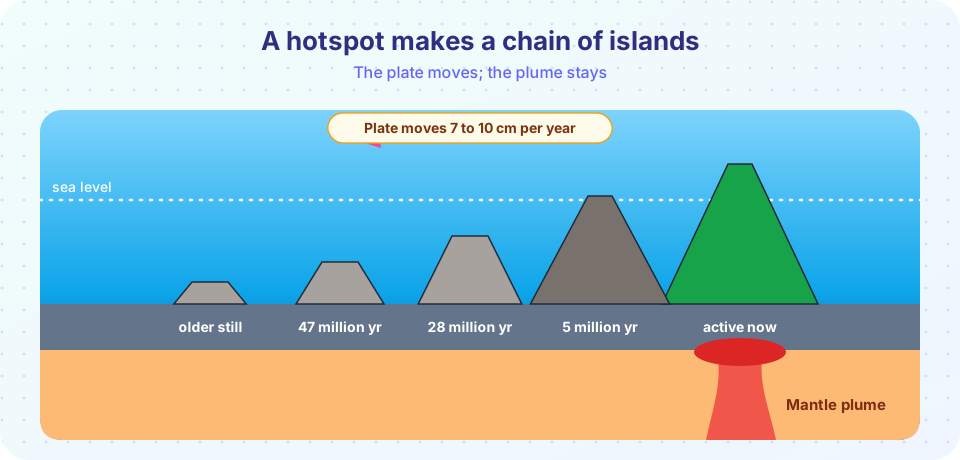
Some volcanoes are not at plate boundaries at all. The Hawaiian Islands lie in the middle of the Pacific plate, thousands of kilometers from the nearest boundary. The explanation proposed by J. Tuzo Wilson in 1963 is a hotspot: a stationary source of magma below a moving plate. As the plate moves over it, a volcano forms, grows and eventually is carried away from the source, and a new one forms behind it. The result is a chain of volcanoes of increasing age away from the active site.
Hawaii is the textbook case. The Big Island is still volcanically active (Kilauea and Mauna Loa), while Kauai, about 520 km to the northwest, is around 5 million years old, and Midway, roughly 2,400 km away, is around 28 million years old. Farther along, the chain turns toward the north in the Emperor Seamounts. The bend, dated to roughly 47 million years ago, records a change in the direction of the Pacific plate.
Worked example: plate speed from a hotspot chain
Midway is about 2,400 km from the Big Island and about 28 million years old. What is the average speed of the Pacific plate?
speed = distance / time = 2,400 km / 28 million years ≈ 86 km per million years
Convert: 1 km per million years is 1 mm per year, so the speed is about 86 mm/yr, or 8.6 cm per year. This agrees with the 7 to 10 cm per year measured by satellite positioning today, which is a beautiful cross-check.
Sinking islands: guyots and atolls
Volcanic islands do not last. They erode, and the plate under them cools and subsides as it moves away from the hotspot, so they slowly sink. When the summit is eroded flat at sea level and then sinks, it becomes a flat-topped guyot. Many seamounts, and guyots in the Emperor chain, are today 1,000 m or more under water.
In 1842, Charles Darwin used this idea to explain coral atolls. A young volcano is first surrounded by a fringing reef. As the island sinks, the corals grow upward to stay near the light, and the reef becomes a barrier reef with a lagoon between it and the island. When the island has disappeared completely, the reef is a ring around an empty lagoon: an atoll. Drilling on Enewetak and other atolls has confirmed that they sit on top of thick limestone over an old volcano.
Seamounts and abyssal hills
Satellites and sonar have found tens of thousands of seamounts over 1,000 m high. They are hotspots for life: they deflect currents, bring nutrients up and host cold-water corals, sponges and aggregations of fish. That also makes them targets for fishing and are central to marine protected area planning.
Most of the seafloor, however, is covered by smaller abyssal hills, only tens to hundreds of meters high, formed at spreading ridges. They are the most common landform on Earth. Where sediment is thick, it buries them and creates the flat abyssal plains.
Common misconceptions
"All volcanoes are at plate boundaries." Hawaii and Iceland-style hotspots show that some are not. (Iceland is a hotspot that sits on a ridge.)
"Hotspots move with the plates." The plume is relatively fixed; the plate moves over it. This is why the chain forms. (Some studies show that plumes drift slowly, but much more slowly than plates.)
"Black smoke from vents is burning." The black color is fine sulfide mineral particles. Nothing is on fire.
"Deep-sea vents are lifeless because there is no sunlight." Vents host dense communities that live on chemical energy.
Try it
The first example fits a straight line through illustrative ages and distances along the Hawaiian chain. The slope tells you the plate speed. The values are rounded approximations, used for teaching.
Press Run (or Ctrl + Enter) to see the result here.
Program input · what you'd type while the program runs
Type the answers before you press Run, one per line. Each time the program reads a line (with input()), it gets the next line from this box.
The second example is Darwin's atoll story. Drag the slider to let the volcanic island sink while the corals grow upward. It is a schematic model, not a measured record.
Check your understanding
Quick check · 5 questions
of 5 answered You scored / 5 · perfect!
-
1. How long is the global mid-ocean ridge system?
The ridge system winds through every ocean for about 65,000 km. -
2. What is chemosynthesis at a vent?
Bacteria at vents use chemical energy to make organic matter, supporting entire communities. -
3. Midway is about 2,400 km from the Big Island and 28 million years old. What is the approximate plate speed?
2,400 km / 28 Myr is about 86 km per Myr, which is 86 mm/yr, or 8.6 cm/yr. -
4. What is a guyot?
A guyot's summit was planed off by waves near sea level, then sank below the surface. -
5. Darwin's atoll theory says an atoll forms when...
As the island subsides, corals build upward and leave a ring reef around a lagoon.
Summary
- Mid-ocean ridges are volcanic mountain chains where crust is made; slow ridges are rugged with rift valleys, fast ridges are smooth.
- Hydrothermal vents release hot, mineral-rich water and support chemosynthetic life.
- Hotspots make chains of increasingly old volcanoes; the age and distance give the plate speed.
- Volcanoes sink with age, becoming guyots, and coral reefs on sinking islands become atolls.
Next: Seafloor Sediments
Track your progress
Create a free account to tick off lessons and pick up where you left off on any device.
of Oceanography lessons completed