


















Lesson 22 of 49 · Waves, Tides and Currents
Deep Ocean Circulation
Learn how density drives the deep ocean circulation: where deep water forms, the Atlantic overturning, bottom water, ventilation, turnover time and links to climate.
The wind-driven currents you met in the last lesson affect only the top kilometer or so. Below, the great bulk of the ocean, about 90% of its volume, moves by another mechanism and at a much slower pace. Water at the bottom of the Pacific can be a thousand years old. It last touched the atmosphere long before the Vikings sailed, and it will not be at the surface again for centuries.
This deep flow is called the overturning circulation, or thermohaline circulation, because it is driven largely by differences in temperature ("thermo") and salinity ("haline") that make water dense enough to sink. It is a slow conveyor belt that carries heat, carbon, oxygen and nutrients around the planet and matters for climate on time scales from decades to millennia.
What you will learn
- Where and why surface water becomes dense enough to sink
- The main deep water masses: NADW and AABW
- How the Atlantic overturning circulation is organized
- How to estimate turnover time and upwelling speed from transport
- Why the circulation matters for climate, carbon and oxygen
Key terms
Deep water formation: the process by which surface water becomes dense enough to sink to great depth.
Brine rejection: when seawater freezes, the ice excludes most of the salt, which makes the remaining water saltier and denser.
AMOC: the Atlantic Meridional Overturning Circulation, the north-south overturning loop in the Atlantic.
Ventilation: the supply of oxygen-rich surface water to the deep ocean.
Turnover time: the time for the flow to replace a volume of water; volume divided by flux.
Why water sinks
Chapter 3 showed that density rises when water gets colder or saltier. Deep water forms where surface water loses buoyancy:
- Cooling. Cold, dry winter air extracts heat from the sea surface. In the Labrador Sea and the Nordic Seas, surface water cools to about 2 or 3 °C and becomes dense.
- Evaporation. In the North Atlantic, evaporation exceeds rain, which leaves the water saltier than in the Pacific. That means the already salty water of the Gulf Stream, once cooled, is especially dense.
- Sea ice formation. As seawater freezes around Antarctica, the ice keeps a little salt, but most is pushed out into the water below (brine rejection). The cold, salty water that results is the densest in the ocean.
Deep water forms only in a few small places, mostly where intense cooling and sea ice happen: the Greenland, Iceland and Norwegian Seas, the Labrador Sea and the Weddell and Ross Seas around Antarctica. In the North Pacific, the surface is too fresh for water to sink to great depth. These few "chimneys" feed the whole deep ocean.
Worked example: brine rejection
Take 1 kg of seawater with salinity 34 g/kg. Suppose 10% of it freezes into ice with salinity 5. How salty is the remaining water? Conserve the salt:
34 × 1.0 = 5 × 0.10 + S × 0.90, so S = (34 − 0.5) / 0.90 = 37.2 g/kg
Freezing 10% of the water raised the salinity of the rest by more than 3 g/kg, which is a large density increase, and the water is already near the freezing point of about −1.9 °C.
The Atlantic overturning
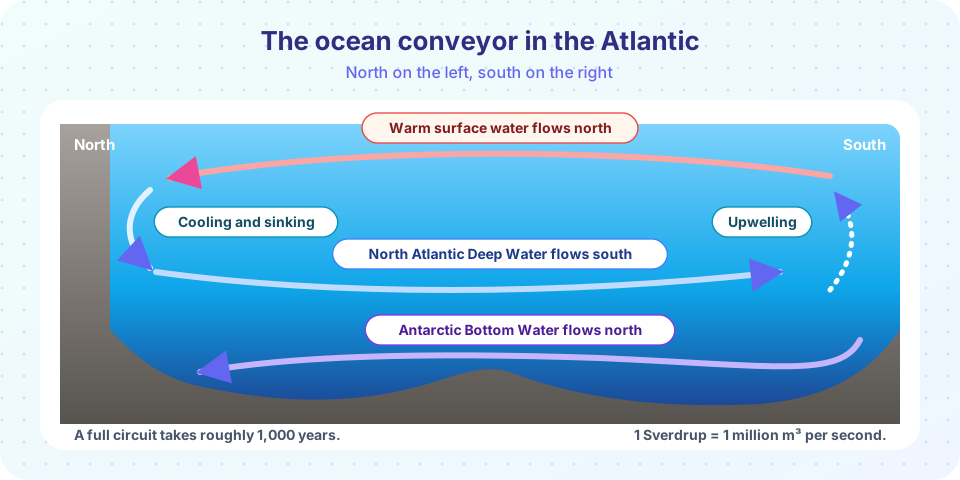
In the Atlantic the circulation forms a loop in the north-south plane (see the picture):
- Northward at the surface. Warm, salty water from the tropics flows north in the Gulf Stream and North Atlantic Current.
- Sinking in the north. It cools in the Labrador and Nordic Seas and sinks. Dense water also spills over the sills between Greenland, Iceland and Scotland and tumbles down the slope.
- North Atlantic Deep Water (NADW). The sinking water forms a layer flowing south at depths of roughly 1,500 to 4,000 m, mostly along the western boundary.
- Antarctic Bottom Water (AABW). Dense water formed on the Antarctic shelves, mainly in the Weddell and Ross Seas, flows north along the bottom, below the NADW.
- Upwelling. NADW eventually reaches the Southern Ocean, where strong westerly winds draw water upward to the surface around Antarctica. Some of it returns north as intermediate water or as bottom water; some is carried into the Indian and Pacific Oceans, where it slowly upwells through the thermocline and returns to the surface by a long route.
Measurements by the RAPID array of moorings at 26.5° N, running since 2004, show that the overturning there carries about 17 Sv northward in the upper layer, balanced by the same amount flowing southward below. This also transports heat northward, on the order of one petawatt (10¹⁵ W), which is a major part of the ocean's contribution to the climate of the North Atlantic region.
The "great ocean conveyor belt" is a useful picture, but real circulation is more complicated than a single loop: it has many branches, eddies, and varying strength, and it is driven by both density differences and by wind and tides.
How old is deep water?
Deep water carries a memory of when it was last at the surface. Its age is measured with tracers: radiocarbon (carbon-14, half-life 5,730 years) decays with time since the water left the surface, and human-made chemicals such as CFCs and tritium from bomb tests mark water that sank in recent decades. The oldest deep water, in the northern Pacific, has a radiocarbon age of well over 1,000 years.
Worked example: turnover time
The ocean volume is 1.34 × 10¹⁸ m³ and the deep overturning flux is about 30 Sv (30 × 10⁶ m³/s).
turnover time = V / Q = 1.34 × 10¹⁸ / 30 × 10⁶ = 4.5 × 10¹⁰ s ≈ 1,400 years
This is consistent with the observed ages (a few hundred to about 1,500 years).
Worked example: how fast does deep water rise?
The 30 Sv must eventually come back up through the thermocline. If this upwelling is spread across most of the ocean, about 3.6 × 10¹⁴ m² of area, the average vertical speed is
w = Q / A = 30 × 10⁶ / 3.6 × 10¹⁴ = 8.3 × 10⁻⁸ m/s ≈ 0.7 cm per day
That is an incredibly slow rise: about 2.6 m per year, which is nearly impossible to measure directly. It is the reason the deep water takes so long to return to the surface.
Why it matters
- Climate. The AMOC transports heat to the northern North Atlantic. Past climate records show that abrupt changes in the overturning coincided with sudden shifts in regional climate, such as during the Younger Dryas around 12,900 years ago. Melting of Greenland ice and increased rainfall could make the northern surface water fresher and less dense, which may weaken the AMOC. Climate assessments say the AMOC is very likely to weaken during the 21st century, while an abrupt collapse before 2100 is considered unlikely but is hard to rule out; observing and modeling it is an active field of research.
- Carbon. Sinking water carries dissolved carbon into the deep. Over centuries, the ocean's deep reservoir stores most of the carbon released by humans that the ocean takes up.
- Oxygen and nutrients. Deep water formation delivers oxygen to the deep. As the water ages, respiration uses up oxygen and releases nutrients, so old Pacific deep water is rich in nutrients and low in oxygen.
Common misconceptions
"The conveyor belt is a single river of water." It is a slow, broad, diffuse flow with many branches, mixing and eddies, not a defined stream.
"The thermohaline circulation could stop in a few years." Observations and models indicate changes over decades and longer; an abrupt shutdown is considered unlikely this century but not impossible.
"Deep water sinks everywhere." It sinks in a few small regions; the great majority of the ocean surface does not form deep water.
"Warm water rises because of the Gulf Stream." The Gulf Stream is mainly wind-driven. The overturning is density-driven, and the two are connected but different.
Try it
The first example estimates the radiocarbon "age" of water from the fraction of carbon-14 that remains relative to the surface, and shows how a turnover time follows from the flux. The fractions are illustrative.
Press Run (or Ctrl + Enter) to see the result here.
Program input · what you'd type while the program runs
Type the answers before you press Run, one per line. Each time the program reads a line (with input()), it gets the next line from this box.
The second example is a calculator for brine rejection and upwelling speed.
Press Run (or Ctrl + Enter) to see the console output here.
No output.
Check your understanding
Quick check · 5 questions
of 5 answered You scored / 5 · perfect!
-
1. Where does the densest ocean water form?
Cold, salty brine produced as sea ice forms on Antarctic shelves sinks to become Antarctic Bottom Water. -
2. What does brine rejection do?
Ice excludes most salt, so the water beneath becomes saltier and denser. -
3. Roughly how long is the turnover time of the ocean, given a 30 Sv deep flux?
V / Q = 1.34 × 10¹⁸ / 30 × 10⁶ = 4.5 × 10¹⁰ s, about 1,400 years. -
4. Which water mass flows south at mid-depth in the Atlantic?
NADW forms in the North Atlantic and flows south at roughly 1,500 to 4,000 m. -
5. Why might melting Greenland ice weaken the overturning?
Fresher surface water is less dense and sinks less readily.
Summary
- Deep water forms where surface water becomes dense by cooling, evaporation and sea ice formation, mainly in the North Atlantic and around Antarctica.
- The Atlantic overturning carries warm water north, NADW south at mid-depth and AABW north along the bottom, with about 17 Sv at 26.5° N.
- Turnover time is volume over flux (about 1,400 years for 30 Sv); the average upwelling speed is under 1 cm per day.
- The overturning circulation transports heat and carbon, supplies oxygen to the deep, and may weaken in a warming climate.
Next: Chapter 4 Review
Track your progress
Create a free account to tick off lessons and pick up where you left off on any device.
of Oceanography lessons completed