


















Lesson 35 of 49 · Human Impacts
Warming, Sea Level and Acidification
Learn how the ocean absorbs heat and carbon dioxide, why sea level rises by thermal expansion and melting ice, what pH 8.1 means, and how deoxygenation and marine heatwaves follow.
If you could measure only three things about the ocean to see whether it is changing, you would choose its temperature, its height and its acidity. All three have been measured for decades, and all three show a clear trend. The temperature and the height rise; the pH falls. What makes them valuable to a student is that each follows directly from physics and chemistry you already know: the heat capacity of water, the thermal expansion of a liquid and the equilibrium chemistry of carbon dioxide.
This lesson explains each trend, shows you the arithmetic that links them to the numbers in the news and ends with two related changes, falling oxygen and marine heatwaves.
What you will learn
- How much the ocean has warmed, and how heat storage connects to sea level
- How thermal expansion and melting ice each raise sea level, and how to convert ice mass to millimeters
- What ocean acidification is, why pH 8.1 is still slightly basic and why a 0.1 drop is large
- Why a warmer ocean holds less oxygen, and what a marine heatwave is
Key terms
Thermosteric sea level rise: the rise in sea level from expansion of water as it warms.
Eustatic (mass) sea level rise: the rise from adding water to the ocean, mostly from melting land ice.
pH: −log₁₀[H⁺], a logarithmic measure of acidity; each unit is a factor of ten.
Carbonate saturation state (Ω): a measure of whether water favors forming or dissolving shells and skeletons of calcium carbonate.
Marine heatwave: a period of at least five days with sea temperature above the 90th percentile of the local history.
Warming
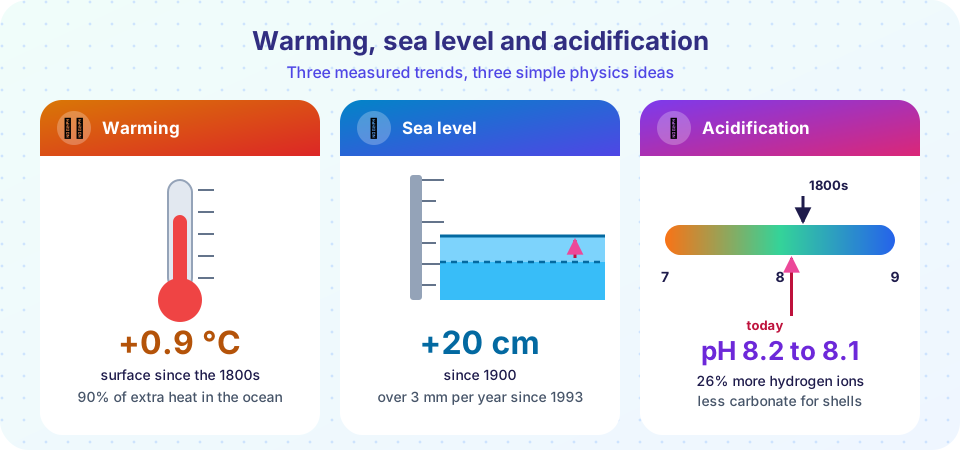
The surface of the global ocean is now about 0.9 °C warmer than in the late nineteenth century. That might seem small, but consider the amount of water: warming the whole ocean by even a fraction of a degree takes an enormous quantity of energy. The mass of the ocean is about 1.4 × 10²¹ kg, and the specific heat of sea water is about 3,990 J/(kg K). A uniform 0.01 °C rise would take:
1.4 × 10²¹ × 3,990 × 0.01 ≈ 5.6 × 10²² J
That is roughly 90 times the annual primary energy consumption of humanity (about 6 × 10²⁰ J). Measurements show that the upper 2,000 m has been gaining heat steadily, at a rate of roughly 0.5 to 1 watt per square meter averaged over the Earth's surface in recent decades. The warming is strongest at the surface and decreases with depth, but it has now been measured down to the deep ocean.
Why the ocean warms unevenly
Warming is not uniform. The Arctic is warming fastest, as bright ice melts and exposes dark water, which absorbs more sunlight. Parts of the North Atlantic have warmed more slowly, perhaps because of changes in the ocean circulation. Western boundary currents such as the Gulf Stream and the Kuroshio have warmed faster than the average and are moving poleward.
Sea level
Global mean sea level has risen about 20 cm since 1900. The rate has accelerated: the average since 1993, when satellite altimetry began (chapter 8), is more than 3 mm per year, and it is higher in the most recent years. There are two main causes, and they contribute comparable amounts.
Thermal expansion
Water expands when it warms. The thermal expansion coefficient α of sea water is about 2 × 10⁻⁴ per °C at typical ocean temperatures (smaller in cold water, larger in warm). A column of water of height h that warms by ΔT grows by Δh = α h ΔT. Warming the upper 700 m by 0.3 °C therefore raises the level by roughly
2 × 10⁻⁴ × 700 × 0.3 = 0.042 m = 4 cm.
There is a handy shortcut linking this to heat. A heat input per unit area E raises the water by Δh = α E / (ρ c_p). With ρ = 1,025 kg/m³ and c_p = 3,990 J/(kg K), a continuous 1 W/m² of ocean heat uptake for one year (3.16 × 10⁷ J/m²) gives about 1.5 mm of expansion. The observed thermosteric rise of about 1 to 1.5 mm per year is consistent with the measured heat uptake.
Adding water from land ice
The second cause is water that was stored as ice on land flowing into the sea. (Melting floating ice, such as sea ice, does not change sea level much, for the same reason that melting ice in a drink does not overflow it.) The ocean's surface area is 3.61 × 10¹⁴ m². To raise it by 1 mm you must add 3.61 × 10¹¹ m³ of water, which has a mass of 3.61 × 10¹⁴ kg, or 361 gigatonnes (Gt). So:
361 Gt of melted ice = 1 mm of sea level
Mountain glaciers have lost mass for many decades. The Greenland ice sheet has lost on the order of 200 to 300 Gt per year in recent decades (about 0.6 to 0.8 mm per year), and the Antarctic ice sheet, with some regions gaining and others losing, has also contributed. If all of Greenland's ice melted, sea level would rise by about 7 m, and for Antarctica by about 58 m, but this would take centuries to millennia. The future rate depends on the emissions pathway and on the behavior of ice sheets, where uncertainty is largest.
Sea level does not rise evenly. Local relative sea level also depends on land that is sinking (groundwater pumping, sediment compaction) or rising (rebound after ice sheets retreated), on ocean currents and on gravitational effects of melting ice. For coastal planning, local records matter as much as the global mean.
Acidification
When carbon dioxide dissolves in sea water, it reacts with water to form carbonic acid, which releases hydrogen ions (you studied this in chapter 3):
CO₂ + H₂O ⇌ H₂CO₃ ⇌ H⁺ + HCO₃⁻
The extra hydrogen ions then react with carbonate ions (CO₃²⁻) to form more bicarbonate, so the carbonate concentration falls. The average surface pH has dropped from about 8.2 before the industrial era to about 8.1 today.
Why call a fall to 8.1 "acidification" when sea water is still basic? Because the direction of change is toward acid, and because pH is logarithmic. A drop of 0.1 pH units corresponds to a factor of 10^0.1 = 1.26, so the hydrogen ion concentration has risen by about 26%. Under very high emissions the surface pH could fall by a further 0.3 units by 2100, which would mean a doubling of hydrogen ion concentration relative to now, from 8.1 to 7.8 (a factor of 10^0.3 ≈ 2).
The biological consequence is related to the saturation state Ω = [Ca²⁺][CO₃²⁻] / K_sp. When Ω is above 1 calcium carbonate tends to form, and below 1 it tends to dissolve. Many organisms build shells of aragonite or calcite: corals, oysters, mussels, pteropods (sea butterflies) and coccolithophores. Lower carbonate concentrations make building shells more costly, and in some cold polar waters and upwelling regions the water is already undersaturated with respect to aragonite for part of the year. Oyster hatcheries on the U.S. Pacific coast already adjust their water chemistry to protect larvae. The sensitivity varies a great deal among species, and some organisms may even benefit, so scientists study the whole community.
Less oxygen, more heatwaves
Deoxygenation. Gases are less soluble in warm water: fully saturated sea water at 25 °C holds about 40% less oxygen than at 0 °C. Surface warming also strengthens stratification, so less oxygen-rich surface water is carried down. Observations show a loss of roughly 2% of the ocean's oxygen since 1960, and the oxygen minimum zones (chapter 3) are expanding. Low oxygen squeezes fish and other animals into thinner layers near the surface.
Marine heatwaves. The same background warming makes extremely hot spells more likely. A marine heatwave is defined by temperatures above the 90th percentile of local records for at least five days. A famous example, nicknamed "the Blob," warmed the northeastern Pacific from 2013 to 2016 and was linked to mass die-offs of seabirds, sea lions and whales, toxic algal blooms and a collapse in some fisheries. Heatwaves are one way that gradual warming becomes sudden harm.
Common misconceptions
"Melting sea ice raises sea level." Floating ice already displaces its own weight of water, so its melting changes the level only a little. The rise comes from land ice and thermal expansion.
"pH 8.1 is basic, so there is no acidification." The word describes a shift toward the acid end of the scale. The hydrogen ion concentration is already about 26% higher.
"Sea level rises equally everywhere." Regional rise depends on currents, land movement and the gravity of ice sheets.
"A small temperature change does not matter." Small averages hide large energy amounts and extreme events.
Try it
The first example is a sea level budget calculator. It converts ice loss in Gt per year to millimeters, converts ocean heat uptake to thermal expansion and sums the contributions. The input values are rounded round numbers for demonstration, not an official assessment.
Press Run (or Ctrl + Enter) to see the console output here.
No output.
The second example plots two relationships behind the numbers: how much thermal expansion a given heat uptake produces, and how the hydrogen ion concentration climbs as pH falls. The pH scale is logarithmic, so a small fall in pH means a large relative rise in acidity.
Press Run (or Ctrl + Enter) to see the result here.
Program input · what you'd type while the program runs
Type the answers before you press Run, one per line. Each time the program reads a line (with input()), it gets the next line from this box.
Check your understanding
Quick check · 6 questions
of 6 answered You scored / 6 · perfect!
-
1. How much melted land ice (in Gt) raises global sea level by 1 mm?
1 mm over 3.61 × 10¹⁴ m² is 3.61 × 10¹¹ m³, or 3.61 × 10¹⁴ kg = 361 Gt. -
2. Why does melting floating sea ice barely change sea level?
Floating ice displaces water equal to its weight, so melting leaves the level nearly unchanged. -
3. A drop in pH from 8.2 to 8.1 corresponds to an increase in [H⁺] of about...
10^0.1 = 1.26, so the hydrogen ion concentration is 26% higher. -
4. Why does a warmer ocean hold less oxygen?
Gas solubility falls as temperature rises. -
5. Thermal expansion of 4 cm in a 700 m layer warmed by 0.3 °C uses α of about...
Δh = α h ΔT; 0.042 = α × 700 × 0.3 gives α = 2 × 10⁻⁴ per °C. -
6. A marine heatwave is defined as sea temperature above the 90th percentile for at least...
The standard definition uses at least five consecutive days above the local 90th percentile.
Summary
- The ocean surface is about 0.9 °C warmer, and the ocean has taken up more than 90% of the extra heat.
- Sea level has risen about 20 cm since 1900 from thermal expansion (
Δh = α h ΔT) and melting land ice (361 Gt per mm). - Surface pH has fallen from about 8.2 to 8.1, a 26% increase in hydrogen ions, lowering carbonate ion concentration and making shells harder to build.
- Warmer water holds less oxygen, and marine heatwaves turn gradual warming into sudden damage.
Track your progress
Create a free account to tick off lessons and pick up where you left off on any device.
of Oceanography lessons completed