


















Lesson 10 of 49 · The Ocean Basins
Seafloor Sediments
Learn the four kinds of seafloor sediment, how oozes and red clay form, why deposition rates vary, and how sediment cores reveal Earth's climate history.
Almost everything that sinks in the ocean ends up on the bottom: dust blown from deserts, mud washed from rivers, the shells of dead plankton, even tiny grains of meteorites. Over millions of years these materials pile up in layers on the seafloor. Those layers are a library. A cylinder of mud pulled up from the deep ocean can tell you how warm the sea was a million years ago, how much ice covered the planet and when a volcano erupted.
This lesson explains where seafloor sediment comes from, why different parts of the ocean have different kinds, how fast it builds up and how scientists read it.
What you will learn
- The four types of marine sediment by origin
- How grain size affects how long particles take to settle
- Why calcium carbonate shells dissolve in the deep sea
- How fast sediment accumulates in different places
- How cores are used to reconstruct past climates
Key terms
Sediment: loose particles, from rock fragments to shells, that settle out of water or air.
Ooze: a deep-sea sediment with more than about 30% shells of plankton.
Pelagic: relating to the open ocean far from land.
Carbonate compensation depth (CCD): the depth below which calcium carbonate dissolves faster than it arrives, so it does not accumulate.
Sediment core: a long cylinder of sediment extracted by drilling or coring.
Four sources
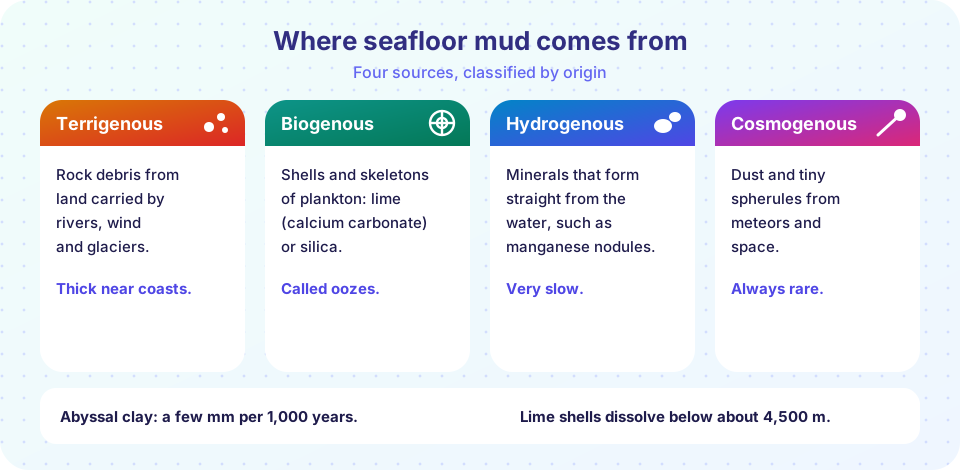
Marine geologists classify sediment by where it comes from.
Terrigenous sediment
Terrigenous ("from the land") sediment is made of rock debris: sand, silt and clay delivered by rivers, wind, glaciers and coastal erosion. It dominates on continental shelves, slopes and rises, and is thickest near big river mouths, where it can pile up for kilometers. Far from land, a thin layer of very fine wind-blown dust and volcanic ash settles slowly and forms abyssal red clay, rich in iron oxides.
Biogenous sediment
Biogenous sediment is made of the hard parts of organisms. Microscopic plankton make shells out of two materials:
- Calcium carbonate (calcite or aragonite): foraminifera and coccolithophores build these, which form calcareous ooze.
- Silica (opal): diatoms and radiolarians build these, forming siliceous ooze.
Where surface waters are rich in life, a steady rain of shells falls to the bottom. Siliceous oozes cover large belts under the cold, nutrient-rich waters of the Southern Ocean and the equatorial Pacific. Calcareous ooze covers shallower seafloor, such as mid-ocean ridges and their flanks.
Hydrogenous sediment
Hydrogenous sediment forms from chemical reactions in seawater or at the seafloor. The best-known examples are manganese nodules, potato-sized lumps rich in manganese, iron, nickel, copper and cobalt that grow around a seed such as a shark tooth, at only millimeters per million years. Others are metal-rich crusts and the sulfide deposits near hydrothermal vents, and, in warm, shallow, enclosed seas, salts left behind by evaporation.
Cosmogenous sediment
Cosmogenous sediment comes from space: cosmic dust and tiny spherules left by meteors. It is a minuscule fraction of the total but is found everywhere.
| Type | Source | Where it dominates | Example |
|---|---|---|---|
| Terrigenous | Land | Margins, near rivers and deserts | Mud on the continental rise |
| Biogenous | Organisms | Productive surface waters | Diatom ooze in the Southern Ocean |
| Hydrogenous | Chemical precipitation | Very slow areas, vents | Manganese nodules |
| Cosmogenous | Space | Everywhere, tiny amounts | Micrometeorite spherules |
Why the deep sea has few shells: the CCD
Cold, deep water holds more dissolved carbon dioxide and is under high pressure, which makes it corrosive to calcium carbonate. Shells dissolve as they sink. Above a certain depth, shells still reach the bottom and build up. Below it, they dissolve completely. This depth, the carbonate compensation depth, is around 4,000 to 5,000 m in much of the ocean, shallower in the Pacific and near the poles. That is why the deepest abyssal plains are covered with clay or siliceous ooze rather than limy ooze. The CCD depends on chemistry, a topic we return to in chapter 3 when we discuss ocean acidification.
How fast do sediments settle and pile up?
Settling. Small particles sink slowly. For a tiny sphere falling slowly through water, Stokes' law gives the speed:
v = 2 (ρ_particle − ρ_water) g r² / (9 μ)
where r is the radius, g is 9.81 m/s² and μ is the viscosity of water (about 1.5 × 10⁻³ Pa·s in cold water). The speed rises with the square of the radius: a particle ten times wider sinks a hundred times faster. A 1 µm radius clay particle would take decades to sink 4,000 m on its own, but in reality particles clump into larger aggregates and are packaged in the fecal pellets of zooplankton, so they reach the bottom in days to weeks. This "marine snow" is the main way material reaches the deep sea.
Accumulation. Once on the seafloor, the pile grows at very different rates:
- Near river mouths and on margins: tens of centimeters or more per thousand years.
- Under productive waters: a few centimeters per thousand years.
- Abyssal red clay far from land: roughly 1 mm per thousand years.
Worked example. A 20 m core is taken where sediment accumulates at 2 cm per 1,000 years. How old is the bottom of the core?
age = 2,000 cm / (2 cm per 1,000 yr) = 1,000 thousand years = 1 million years
A 10 m core from an abyssal red-clay plain at 1 mm per 1,000 years reaches back 10,000 mm / 1 mm per 1,000 yr = 10,000,000 years. A shorter core in the clay reaches further back in time, but each millimeter holds a thousand years, so fine details are lost.
Reading the record
Cores are extracted by dropping a heavy tube into the mud or, for deeper layers, by drilling from a ship such as the JOIDES Resolution, which has recovered thousands of kilometers of core. What scientists read:
- Fossil shells. Different species prefer different temperatures, so the mix of species shows past temperature.
- Oxygen isotope ratio. The ratio of oxygen-18 to oxygen-16 in shell carbonate depends on temperature and on how much water is locked in ice. This is the main tool for dating glacial cycles.
- Ash layers and spherules. Volcanic eruptions and impacts leave thin layers that serve as time markers.
- Magnetic reversals. Like the seafloor crust, sediments record the direction of Earth's magnetic field, which gives ages.
The sediment is also a source of resources and a concern: oil and gas are produced from thick shelf sediments, and plans for mining manganese nodules raise questions about disturbing deep-sea ecosystems.
Common misconceptions
"Deep-sea mud is just mud from rivers." Terrigenous mud dominates near the continents, but in the open ocean most sediment is the shells of plankton or very fine dust.
"Sediments accumulate at the same rate everywhere." Rates range over a factor of 10,000 or more, from millimeters to meters per thousand years.
"Shells that fall into the deep sea simply pile up." Below the CCD, calcium carbonate shells dissolve away before they can settle.
Try it
The first example uses Stokes' law to estimate how long particles of different sizes take to sink 4,000 m, if they fell alone. It is a simplified model: real particles clump, and Stokes' law is only accurate for very small particles.
Press Run (or Ctrl + Enter) to see the result here.
Program input · what you'd type while the program runs
Type the answers before you press Run, one per line. Each time the program reads a line (with input()), it gets the next line from this box.
The second example converts core length and accumulation rate into age. Change the numbers to compare sites.
Press Run (or Ctrl + Enter) to see the console output here.
No output.
Check your understanding
Quick check · 5 questions
of 5 answered You scored / 5 · perfect!
-
1. Which type of sediment is made of the hard parts of organisms?
Biogenous sediment consists of shells and skeletons, such as foraminifera and diatoms. -
2. Why are the deepest abyssal plains usually covered with clay rather than limy ooze?
Below the CCD, deep, cold, high-pressure water dissolves calcium carbonate before it can accumulate. -
3. Sediment accumulates at 2 cm per 1,000 years. How old is the bottom of a 10 m core?
1,000 cm / 2 cm per 1,000 yr = 500 thousand years. -
4. If a particle's radius is 10 times larger, by what factor does Stokes' settling speed change?
The speed is proportional to r², so 10² = 100 times faster. -
5. What are manganese nodules?
They are hydrogenous deposits that grow at millimeters per million years.
Summary
- Marine sediment is terrigenous (land), biogenous (organisms), hydrogenous (chemical) or cosmogenous (space).
- Oozes are made of plankton shells, either calcium carbonate or silica; carbonate shells dissolve below the CCD.
- Small particles sink slowly unless clumped into marine snow; Stokes' speed grows with r².
- Accumulation rates range from a millimeter to meters per thousand years, so core age depends on where it was taken.
- Cores record temperature, ice volume, eruptions and magnetic reversals.
Next: Chapter 2 Review
Track your progress
Create a free account to tick off lessons and pick up where you left off on any device.
of Oceanography lessons completed