


















Lesson 33 of 49 · Marine Life and Ecosystems
Chapter 6 Review: Marine Life and Ecosystems
Review chapter 6: depth zones, phytoplankton and the Redfield ratio, trophic efficiency, the biological pump, coral reefs, vents and deep-sea pressure, with a ten-question quiz.
Chapter 6 followed life in the sea from a single phytoplankton cell to the largest animals, and from the sunlit surface to the black floor of the trenches. One theme ran through every lesson: life needs energy, and the supply of energy and nutrients decides where it can live and how much of it there can be. This review pulls the numbers and rules together.
What you will learn
- The key numbers and rules of chapter 6
- How the topics connect: light, nutrients, energy flow and habitats
- What to revisit before studying human impacts
Key terms
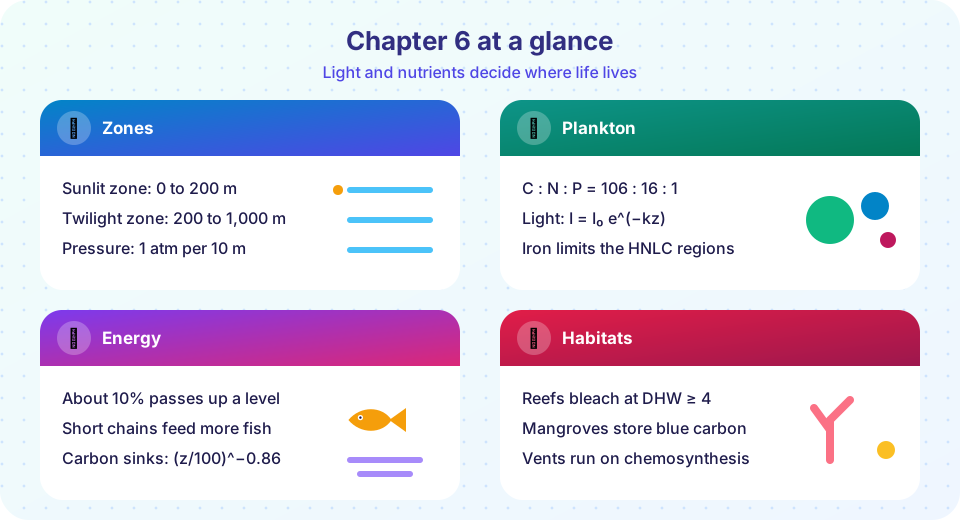
Redfield ratio: C : N : P = 106 : 16 : 1; nitrogen limits most of the ocean and iron limits the HNLC regions.
Euphotic depth: ln(100) / k, the 1% light depth: about 115 m for k = 0.04 per meter.
Trophic efficiency: about 10% of energy passes from one level to the next.
Biological pump: export of carbon on sinking particles, falling off as (z/100)^(−0.86).
Degree heating weeks: the heat-stress measure for coral: 4 °C-weeks means significant bleaching, 8 severe.
Recap table
| Lesson | Core idea | Numbers and formulas |
|---|---|---|
| Chapter 6 Overview | Depth zones and three ways of living: plankton, nekton, benthos | Photic zone about 200 m; hadal below 6,000 m |
| Plankton and Primary Production | Light from above and nutrients from below limit phytoplankton | Ocean net primary production about 50 Gt C/yr; I = I₀ e^(−kz); C:N:P = 106:16:1 |
| Food Webs and Energy Flow | Energy shrinks by about 90% at each trophic level; carbon sinks | Export 5 to 12 Gt C/yr; Martin curve with b about 0.86 |
| Coasts, Reefs and the Deep Sea | Nurseries, reefs and vents each have their own energy source | 1 atm per 10 m; Challenger Deep about 1,100 atm; DHW 4 and 8 |
How the pieces connect
Light and nutrients meet in a thin layer near the surface, where phytoplankton turn them into organic matter. Grazers and predators pass about a tenth of that energy up each step of the food web, and the rest is respired, lost or sinks as marine snow, feeding the deep sea and, through the biological pump, storing carbon. Coastal wetlands, reefs and vents are the places where physical conditions (shelter, warm clear water or hot chemical-rich fluid) concentrate energy into dense communities. Every number in this chapter, from the 1% light depth to the 14% of carbon that reaches 1,000 m, is a different view of the same question: where does the energy come from, and where does it go?
Common misconceptions
"Clear blue water is full of life." It is clear because it has few cells and few nutrients.
"A food chain has about as many tuna as plankton." Energy falls by about 90% per step, so top predators are rare.
"The deep sea is lifeless." It is sparse, but vents and seeps support dense communities on chemical energy.
"Bleached coral is dead." It is starving but can recover if the stress ends.
Try it
The first example is a drill that recomputes several chapter 6 numbers.
Press Run (or Ctrl + Enter) to see the console output here.
No output.
The second example compares how much energy reaches each trophic level for three efficiencies, on a logarithmic scale. A change from 10% to 20% per step makes a huge difference at the top.
Press Run (or Ctrl + Enter) to see the result here.
Program input · what you'd type while the program runs
Type the answers before you press Run, one per line. Each time the program reads a line (with input()), it gets the next line from this box.
Check your understanding
Quick check · 10 questions
of 10 answered You scored / 10 · perfect!
-
1. What is the main reason the open subtropical ocean is a biological desert?
Stratification keeps deep nutrient-rich water below the sunlit layer. -
2. Which is the limiting nutrient in the HNLC regions?
Iron, supplied mostly by dust, limits phytoplankton where nitrate and phosphate are plentiful. -
3. Phytoplankton production of 1,000,000 kg C and 10% efficiency: how much reaches level 3?
Two steps: 1,000,000 × 0.1 × 0.1 = 10,000 kg. -
4. In the Martin curve (b = 0.86), what fraction of the 100 m flux is left at 1,000 m?
10^(−0.86) ≈ 0.14. -
5. A coral reef at DHW of 8 °C-weeks is expected to experience...
DHW at or above 8 signals severe bleaching and some death. -
6. Pressure at 2,000 m depth is closest to...
About 1 atm per 10 m plus surface pressure: roughly 200 atm. -
7. Which organisms are the base of the food web at hydrothermal vents?
Bacteria oxidize hydrogen sulfide to make organic matter. -
8. What does an upside-down biomass pyramid in the plankton mean?
Phytoplankton replace themselves within days, so a small standing stock can support a larger grazer stock. -
9. A bloom can start only if the mixed layer is...
Above the critical depth, growth in the light outweighs losses (Sverdrup). -
10. Which is NOT a feature of the Peruvian upwelling food chain?
Upwelling zones have short chains, which is why they are so productive for fish.
Summary
- Marine life depends on light from above and nutrients from below; the Redfield ratio and critical depth explain blooms and limits.
- About 10% of energy passes to each next trophic level, so food chain length controls fish yield.
- The biological pump exports carbon, but most of it is recycled above 1,000 m.
- Coasts, reefs and vents are hot spots of life built on different energy sources, and reefs are especially sensitive to heat.
- Chapter 7 examines what people are doing to these systems.
Track your progress
Create a free account to tick off lessons and pick up where you left off on any device.
of Oceanography lessons completed