


















Lesson 36 of 49 · Human Impacts
Pollution, Plastics and Dead Zones
Learn where marine pollution comes from, how nutrient runoff creates dead zones with low oxygen, how plastics and microplastics spread, and how toxins build up in food chains.
In 1956 in the Japanese fishing town of Minamata, cats began to stagger and fall into the sea. Soon people fell ill, too, with numbness, tremors and, in the worst cases, severe brain damage. The cause was mercury, released into the bay by a chemical factory, converted into a more toxic form by microorganisms and concentrated at each step of the food chain until it reached the fish that the townspeople ate every day. Minamata became a lesson in how a pollutant that is too dilute to notice in sea water can reach harmful levels in a predator, or in a person.
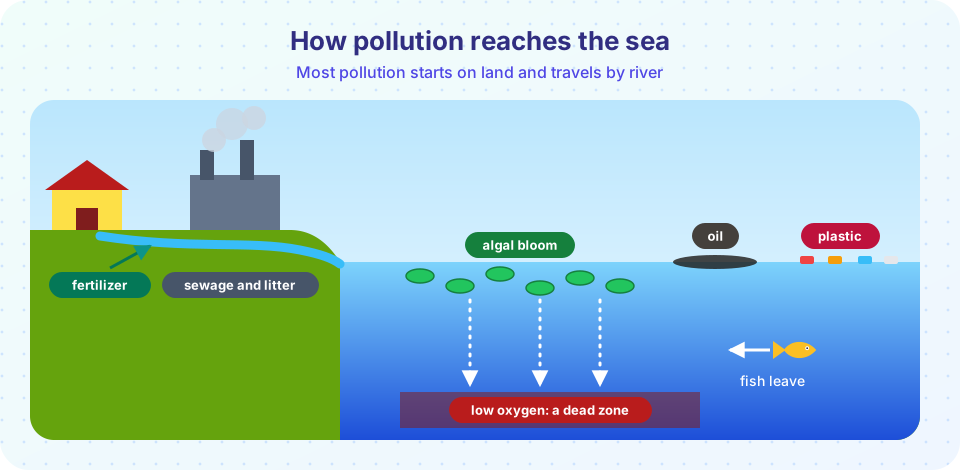
Pollution reaches the sea by many routes, and about 80% of it begins on land. This lesson sorts the main kinds into nutrients, plastics, oil and persistent chemicals. It shows the physics, chemistry and biology behind each one, and ends with what has worked.
What you will learn
- The main sources and pathways of marine pollution
- How nutrient runoff causes eutrophication and dead zones, with an oxygen calculation
- What microplastics are and why plastic is so persistent
- How oil spills and chronic oil inputs differ
- What biomagnification is and how to calculate it
Key terms
Eutrophication: enrichment of water with nutrients, causing excess growth of algae and, later, oxygen loss.
Hypoxia: dissolved oxygen below about 2 mg/L, too low for most fish and bottom animals.
Microplastic: a plastic particle smaller than 5 mm.
Persistent organic pollutant (POP): a long-lived chemical that resists breakdown, such as DDT and PCBs.
Biomagnification: the increase in concentration of a substance at each step up a food chain.
Nutrients and dead zones
In chapter 6 you learned that nitrogen and phosphorus limit growth in the sea. Since the early twentieth century, people have added huge amounts of both. The Haber-Bosch process, developed in 1909 to 1913, makes ammonia from the nitrogen of the air, and it now supports modern fertilizer use. Fertilizer, animal manure and sewage wash into rivers, and rivers carry them to the coast.
The extra nutrients fuel blooms of phytoplankton. Eventually the cells die and sink, and bacteria decompose them, using oxygen. If the water is stratified, with a warm, light layer above a cold, dense layer, the deeper water is cut off from the surface air, and the oxygen cannot be replaced. The oxygen falls below 2 mg/L and the water becomes hypoxic. Fish swim away and the bottom animals that cannot move suffocate. The result is a dead zone.
Worked example: oxygen demand
Recall the Redfield chemistry of chapter 6: decomposing one mole of organic carbon uses about 138/106 = 1.30 moles of oxygen. Suppose a bloom sinks 20 g of carbon per square meter into a bottom layer 10 m thick:
- Moles of carbon: 20 g / 12.01 g/mol = 1.67 mol per m².
- Moles of oxygen consumed: 1.67 × 1.30 = 2.17 mol per m².
- Mass of oxygen: 2.17 × 32 g/mol = 69 g per m².
- Spread over 10 m of water: 69 / 10 = 6.9 g per m³ = 6.9 mg/L.
Sea water at 25 °C holds only about 6.4 mg/L of oxygen when saturated. A bloom of this size can therefore remove all the oxygen from an isolated bottom layer. This is the mechanism behind the largest dead zone in the United States, in the northern Gulf of Mexico, fed by the Mississippi and Atchafalaya rivers that drain about 40% of the lower 48 states. The summer dead zone typically covers 10,000 to 20,000 km², and reached a record near 22,700 km² in 2017. Hundreds of other dead zones exist, in the Baltic Sea, the Chesapeake Bay, the East China Sea and many other coastal areas, and the number has grown since 1960.
The remedies are as simple as the cause: less fertilizer lost from fields, better sewage treatment, wetlands and buffer strips that trap nutrients. Where nutrient loads have been reduced, as in Tampa Bay and parts of the Black Sea, the water has recovered.
Plastics
Plastic production has grown from about 2 million tonnes a year in 1950 to about 400 million tonnes now. A study led by Jenna Jambeck in 2015 estimated that between 5 and 13 million tonnes of plastic waste entered the ocean in 2010 from coastal countries, mostly from mismanaged waste on land. The material comes from litter, rivers, fishing gear and wastewater.
Plastic is made to last, and that is the problem. It does not rot in a way that returns it to nature; it fragments under sunlight and waves into smaller and smaller pieces. Particles under 5 mm are microplastics. They are found in surface water, in deep-sea sediments, in Arctic ice and in the guts of animals from plankton to whales. Some come from larger objects, others are made small to begin with, such as microbeads in cosmetics (now banned in many countries) and fibers shed from synthetic clothes in the washing machine.
Large rotating currents (the gyres of chapter 4) collect floating debris. The best known is the so-called Great Pacific Garbage Patch in the North Pacific Subtropical Gyre. It is not an island or a solid raft, but a diffuse cloud of mostly small pieces, estimated in 2018 to cover about 1.6 million km² and to hold some 80,000 tonnes. Note, though, that the plastic floating at the surface is only a small fraction of what is estimated to have entered: the rest sinks, washes up on beaches and is eaten or buried.
The harm of plastic includes entanglement (especially in lost fishing gear, which keeps catching animals), swallowing (seabirds and turtles that mistake plastic for food, with blocked guts), the transport of invasive species on floating debris and the possible effect of microplastics and the chemicals in them on food webs and on human health, which is still being studied.
Oil
Oil reaches the sea from natural seeps, which are in fact the largest single source globally, from shipping, from drilling and from runoff of used oil from land. Spectacular spills attract the most attention. The Exxon Valdez spill in Alaska in 1989 released about 41,000 m³ of crude oil, and the Deepwater Horizon blowout in the Gulf of Mexico in 2010 released about 780,000 m³ over 87 days. Oil coats feathers and fur, destroying their insulation, and poisons filter-feeding animals. Microbes degrade oil, and the warm Gulf broke down much of the oil faster than in cold Alaska, but the long-term effects in sheltered shores and in the deep can last for decades.
Persistent chemicals and biomagnification
Some pollutants do not break down and are stored in fat. When a predator eats many contaminated prey, the pollutant accumulates in its body and does not leave. At each trophic level the concentration rises, a process called biomagnification. If the concentration is multiplied by a factor f at each step, then at trophic level n above the water it is
C_n = C_water × f^n
With f = 10 and four steps, concentrations in a top predator are 10,000 times higher than in the plankton that started the chain. This is why the pesticide DDT, which was harmless to humans at the doses used, caused eggshell thinning and population crashes in fish-eating birds such as ospreys and bald eagles. Rachel Carson's book Silent Spring (1962) made the problem widely known. Many such persistent organic pollutants are now banned or restricted by the Stockholm Convention (2001). Mercury, from coal burning and mining, is another: tuna, swordfish and sharks contain more than smaller fish, which is why health agencies advise limits on how much of them certain groups should eat.
Noise is a less visible form of pollution. Ship engines, sonar and seismic surveys raise the background level of sound across the ocean, and sound is the main sense by which whales and many fish communicate and find food.
Common misconceptions
"The Great Pacific Garbage Patch is a floating island." It is a dilute scatter of mostly small fragments that you cannot walk on or see from a ship in many places.
"Dead zones are caused by toxic chemicals." They are caused by too many nutrients, and the death is from lack of oxygen.
"Plastic breaks down into harmless dust." It fragments but persists, and the particles enter food webs.
"Oil spills are the main source of ocean oil." Natural seeps and chronic inputs from land and ships together exceed the large spills.
Try it
The first example calculates biomagnification: how a pollutant's concentration rises at each step of a food chain, for different magnification factors.
Press Run (or Ctrl + Enter) to see the console output here.
No output.
The second example models a dead zone. A bottom layer starts with oxygen near saturation and loses it to decomposing organic matter. When the water is stratified (no mixing), the oxygen falls linearly until the layer is hypoxic. When the wind mixes the layer with the surface, oxygen is resupplied and stays high. The rates are round demonstration numbers.
Press Run (or Ctrl + Enter) to see the result here.
Program input · what you'd type while the program runs
Type the answers before you press Run, one per line. Each time the program reads a line (with input()), it gets the next line from this box.
Check your understanding
Quick check · 5 questions
of 5 answered You scored / 5 · perfect!
-
1. What directly causes the death of animals in a dead zone?
Excess nutrients cause blooms; bacteria decomposing the dead cells use up the oxygen. -
2. How much oxygen is consumed when 1 mole of organic carbon is decomposed (Redfield ratio)?
138/106 ≈ 1.3 moles of O₂ per mole of carbon. -
3. What is a microplastic?
Microplastics are particles under 5 mm, made small or fragmented from larger items. -
4. If a pollutant is multiplied by 10 at each trophic step, how much more concentrated is it four steps up?
10⁴ = 10,000. -
5. Which is the largest single source of oil entering the ocean?
Natural seeps contribute the largest share, but big spills cause concentrated harm.
Summary
- About 80% of marine pollution begins on land and reaches the sea through rivers, drains and the air.
- Nutrient runoff causes eutrophication; decomposition of blooms in stratified water creates oxygen-free dead zones (1.3 mol O₂ per mol C).
- Plastics persist and fragment into microplastics that enter food webs; the garbage patches are diffuse, not solid.
- Persistent chemicals such as DDT and mercury biomagnify, harming top predators.
- Regulation and better management (MARPOL, the Stockholm Convention, nutrient control) have worked where applied.
Track your progress
Create a free account to tick off lessons and pick up where you left off on any device.
of Oceanography lessons completed