


















Lesson 34 of 49 · Human Impacts
Chapter 7 Overview: Human Impacts
Overview of how people change the ocean: warming, sea level rise, acidification, deoxygenation, pollution, dead zones and overfishing, with lesson links and key numbers.
For most of history the ocean seemed too big to change. It still is too big for us to empty or fill in the way we can a lake. But the last two centuries have shown that a large enough number of people, with large enough machines, can alter its temperature, its chemistry, its oxygen, its fish and its shores. Roughly 40% of humanity lives within about 100 kilometers of a coast, more than three billion people depend on fish for a large share of their animal protein, and the ocean has quietly absorbed a large fraction of the heat and carbon dioxide that human activity has released.
This chapter looks at what has changed and why. It is based on the processes of chapters 3 to 6: the same laws of heat capacity, gas solubility, nutrient limitation and energy transfer that explain the natural ocean also explain what happens when we push it.
What you will learn
- The main ways that human activity is changing the ocean
- How much heat and carbon the ocean has absorbed, and what that does to it
- Why the pressures interact, so that the combined effect is bigger than any one
- How the lessons in this chapter fit together
Key terms
Anthropogenic: caused or produced by human activity.
Ocean heat content: the total heat stored in the ocean, measured in joules.
Ocean acidification: the fall in sea water pH caused by absorbing carbon dioxide.
Deoxygenation: the loss of dissolved oxygen from sea water.
Overfishing: removing fish faster than the population can replace them.
Where the carbon and heat go
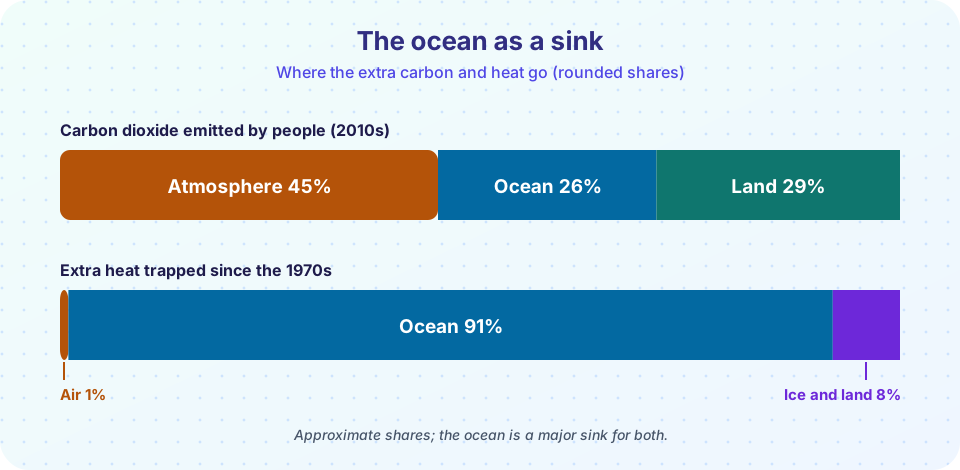
People release carbon dioxide mostly by burning fossil fuels and clearing land. Not all of it stays in the air. In recent decades roughly 45% of the carbon dioxide emitted each year remained in the atmosphere, about 25% to 30% was taken up by the ocean, and about 30% by land vegetation and soils (rounded values from the Global Carbon Budget). The ocean works as a sink because the gas dissolves in the surface water and is then mixed downward. That slows the growth of atmospheric carbon dioxide, but the dissolved gas turns into carbonic acid: this is the cause of ocean acidification.
Heat follows a more extreme split. Of the extra energy trapped by greenhouse gases since the 1970s, more than 90% has gone into the ocean, because of its large heat capacity (chapter 5). The warmth expands the water, melts floating and land ice and changes circulation and marine life.
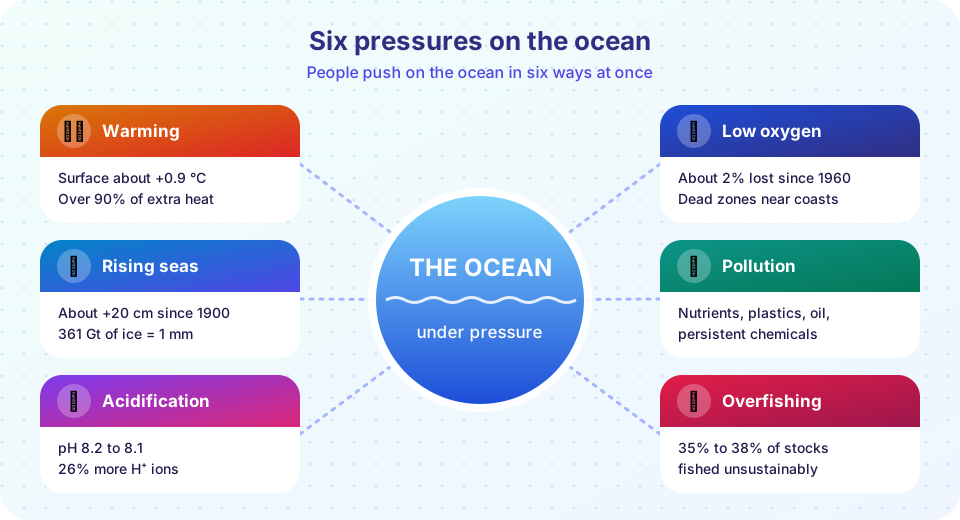
The six pressures
Warming and sea level
Chemistry
Pollution
Fishing
Responses
The pressures interact
Each pressure matters on its own, but they overlap in the same places. A coral reef, for example, suffers from warming (bleaching), acidification (weaker skeletons), land runoff (sediment and nutrients) and fishing (loss of grazers that keep algae in check) at the same time. A fish stock weakened by overfishing is more vulnerable to a warm summer. Warmer water holds less oxygen while nutrient runoff increases the oxygen demand. Scientists call these combinations multiple stressors, and a lot of current research asks whether the combined effect is smaller than, equal to or larger than the sum of the parts.
What each lesson covers
| Lesson | Question it answers |
|---|---|
| Warming, Sea Level and Acidification | How much has the ocean changed in heat, height and chemistry, and why? |
| Pollution, Plastics and Dead Zones | Where do pollutants come from and how do they affect marine life? |
| Fisheries and Overfishing | What is a sustainable catch, and how do fisheries collapse? |
| Chapter 7 Review | Key numbers and a ten-question quiz. |
Common misconceptions
"The ocean is so big that human effects are negligible." The ocean's size is why it absorbed so much heat and carbon, and the absorption changes it.
"Because the ocean absorbs carbon dioxide, we do not need to worry." The same absorption causes acidification, and the sink may weaken as the water warms.
"These are problems for the future." Many of the changes are already measured. Sea level, ocean heat and surface pH all have records spanning decades.
Try it
The first example calculates the carbon budget shares from yearly numbers. Change the values to see how the shares move. The default figures are rounded values for the 2010s, in gigatonnes of carbon per year.
Press Run (or Ctrl + Enter) to see the console output here.
No output.
The second example draws the budget as a bar chart for carbon and for heat, using the rounded figures from the text.
Press Run (or Ctrl + Enter) to see the result here.
Program input · what you'd type while the program runs
Type the answers before you press Run, one per line. Each time the program reads a line (with input()), it gets the next line from this box.
Check your understanding
Quick check · 4 questions
of 4 answered You scored / 4 · perfect!
-
1. About what share of the extra heat trapped by greenhouse gases has gone into the ocean?
The ocean's large heat capacity means it has absorbed more than 90% of the excess heat since the 1970s. -
2. Roughly what fraction of emitted carbon dioxide does the ocean absorb?
Around 25% to 30% is taken up by the ocean in recent decades. -
3. What is the main chemical effect of carbon dioxide dissolving in sea water?
CO₂ forms carbonic acid, lowering the pH and carbonate ion concentration. -
4. What does 'multiple stressors' mean?
Warming, acidification, pollution and fishing often overlap, and their effects can combine.
Summary
- The ocean has taken up more than 90% of the extra heat and about a quarter to a third of the carbon dioxide emitted by people.
- The six main pressures are warming, rising seas, acidification, low oxygen, pollution and overfishing.
- They interact, so ecosystems often face several at once.
- The next lessons give the numbers and the mechanisms behind each.
Track your progress
Create a free account to tick off lessons and pick up where you left off on any device.
of Oceanography lessons completed