


















Lesson 12 of 49 · Seawater Chemistry and Physics
Chapter 3 Overview: Seawater Chemistry and Physics
A guided overview of seawater: salinity, temperature, density, dissolved gases, pH, light and sound, with an interactive dive and what each lesson covers.
You have seen the container; now look at what it holds. Seawater looks simple, but it is a remarkable fluid: a solution of dozens of salts and gases, more or less the same everywhere in its proportions, yet different in temperature, density and chemistry from the surface to the abyss. Almost everything in the rest of the course, from currents and climate to marine life, depends on three properties of a parcel of water: its temperature, its salinity and the pressure it is under.
This chapter builds your understanding of those properties one at a time. It starts with why water is a special molecule, then shows how heat and salt control density and layering, how gases and acidity matter for chemistry and life, and how light and sound behave in the water.
What you will learn
- The three variables that define the state of seawater: temperature, salinity and pressure
- Typical values and why they matter
- How the chapter's four lessons build on each other
- How to read profiles of the water column
Key terms
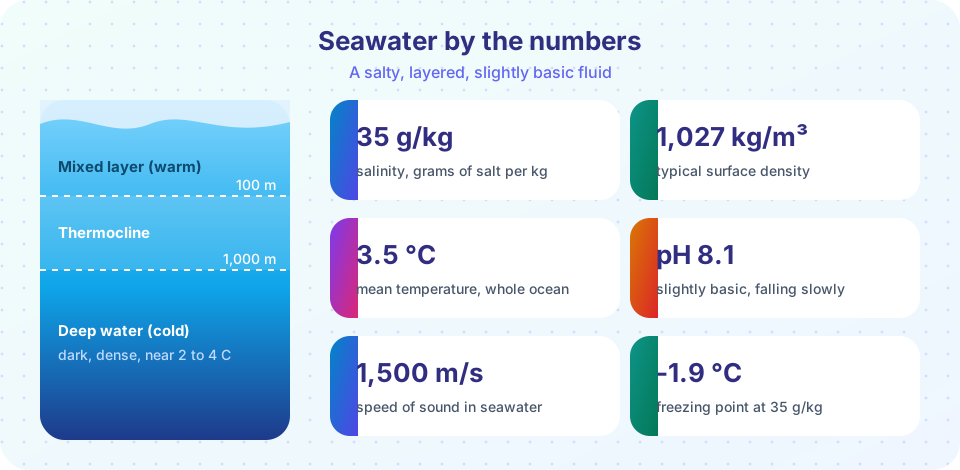
Salinity: the amount of dissolved salt in seawater, about 35 g per kg on average (also written 35 parts per thousand).
Density: mass per unit volume; for seawater about 1,027 kg/m³ at the surface.
Stratification: the layering of the water column by density, with light water above heavy water.
Profile: a graph of a property (such as temperature) against depth.
pH: a scale describing acidity; lower pH means more acidic.
The big picture
Imagine taking a small sealed sample of water at any place and depth. Three numbers tell you most of what you need: temperature, salinity and pressure. From them you can compute the density, the speed of sound and the freezing point. Pressure is easy: it grows by about one atmosphere every 10 m. Temperature and salinity vary, and their variations drive the ocean's layering and circulation.
The remarkable regularity is that although the total salt varies by a few percent between places, the proportions of the main salts barely change. This is known as the principle of constant proportions. Rain and rivers dilute surface water in some places, and evaporation concentrates it in others, but the ratio of sodium to chloride stays the same. That is why a single measurement, such as electrical conductivity, can be used to find salinity almost anywhere.
Water is polar
Heat and salt set density
Gases and acidity
Light and sound
What each lesson covers
- The Water Molecule and Salinity: why water is a great solvent, where the salt comes from and how salinity is measured.
- Temperature, Density and Ocean Layers: how heat and salt control density, the thermocline and the pycnocline.
- Gases, pH and the Carbon Cycle: oxygen, carbon dioxide, carbonate chemistry and ocean acidification.
- Light and Sound in the Sea: how light is absorbed, why the deep is dark and how the sound channel works.
- Chapter 3 Review: the chapter in one picture and a mixed quiz.
Common misconceptions
"Seawater is the same everywhere." Salinity ranges from about 32 to 37 g/kg in the open ocean, temperature from about -2 to 30 °C, and these differences drive currents.
"The ocean is salty because of buried salt mines." The salt comes from the weathering of rock on land, carried by rivers, and from vents on the seafloor; it stays because water evaporates but salt does not.
"Colder water is always denser." Fresh water is densest at about 4 °C, but seawater with a salinity above about 24.7 g/kg keeps getting denser all the way to its freezing point.
Try it
The first example is an interactive dive. Drag the slider to descend and see typical temperature, salinity, density, pressure and light conditions for a mid-latitude ocean. The profile is illustrative, built from rounded values.
The second example gives you a small unit helper that you will need throughout the chapter: converting between salinity units and computing the mass of salt in a volume of seawater.
Press Run (or Ctrl + Enter) to see the console output here.
No output.
Check your understanding
Quick check · 4 questions
of 4 answered You scored / 4 · perfect!
-
1. Which three variables describe the state of seawater?
From temperature, salinity and pressure you can calculate density, sound speed and more. -
2. What is the average salinity of the ocean?
Average salinity is about 35 g per kg, or 3.5% by mass. -
3. What does the principle of constant proportions say?
Evaporation and rain change the total salt, but the ratios of the main ions stay about the same. -
4. Roughly how much does pressure rise every 10 m of depth?
About one atmosphere per 10 m, from p = ρ g h.
Summary
- Temperature, salinity and pressure define seawater's state; density, sound speed and freezing point follow from them.
- Total salinity varies a little, but the ratios of the main ions are constant.
- Properties change with depth: warm and sunlit at the top, cold, dense and dark below.
- The chapter covers water and salt, layers, gases and pH, and light and sound.
Track your progress
Create a free account to tick off lessons and pick up where you left off on any device.
of Oceanography lessons completed