


















Lesson 28 of 49 · Ocean-Atmosphere Interaction
Chapter 5 Review: Ocean-Atmosphere Interaction
Review chapter 5: the surface heat budget, bulk formulas for evaporation, trade winds and the Hadley cell, ENSO and the ONI, hurricanes and monsoons, with a ten-question quiz.
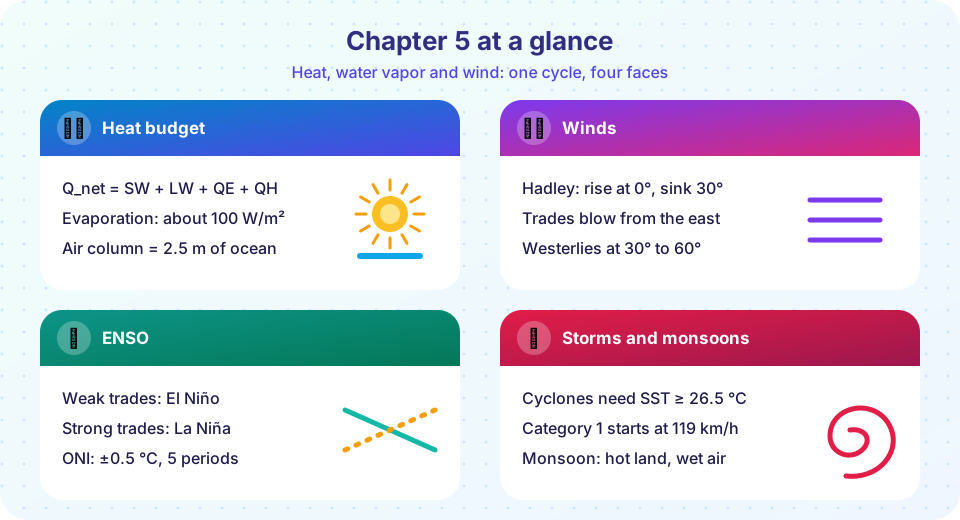
Chapter 5 showed the ocean and atmosphere as partners. The sea gives the air heat and water vapor, the air gives the sea wind, and the pair together produce winds, storms, rains and the swings of El Niño. This review collects the key formulas and facts so you can see how one small set of ideas covers phenomena a thousand times apart in size.
What you will learn
- The formulas and numbers of chapter 5 and when each applies
- How the topics connect through heat, water vapor and wind
- Which ideas to revisit before studying marine life
Key terms
Surface heat budget: Q_net = Q_SW + Q_LW + Q_E + Q_H, with evaporation usually the largest loss.
Bulk formula: Q_E = ρ L C_E U (q_s − q_a), proportional to wind speed.
Hadley cell: equator-to-30° overturning that creates the trade winds and the ITCZ.
ONI: Niño 3.4 SST anomaly of at least ±0.5 °C for five overlapping 3-month periods.
Saffir-Simpson scale: five hurricane categories based on 1-minute sustained wind.
Recap table
| Lesson | Core idea | Formulas and numbers |
|---|---|---|
| Chapter 5 Overview | The ocean and atmosphere trade heat, water and momentum | 86% of evaporation from the sea; top 2.5 m of ocean has the heat capacity of the atmosphere |
| Heat, Winds and Air-Sea Exchange | Evaporation is the biggest surface heat loss; winds follow circulation cells | Q_E about 100 to 160 W/m²; L = 2.5 × 10⁶ J/kg; poleward transport 5 to 6 PW |
| El Niño and the Southern Oscillation | The Bjerknes feedback makes the Pacific switch states | Kelvin wave c = √(g′H) about 2.4 m/s; ENSO period 2 to 7 years |
| Hurricanes and Monsoons | Warm sea water fuels storms; land-sea contrast drives the monsoon | SST at least 26.5 °C; Category 1 at 119 km/h; force grows with v² |
Common misconceptions
"The atmosphere heats the ocean." On average the sea heats the air, mostly through evaporation.
"El Niño is a storm." It is a months-long change in the Pacific's temperature pattern and winds.
"Hurricane categories measure total damage." They rank wind speed only.
"The monsoon is one storm." It is a seasonal reversal of wind and rain.
Try it
The first example is a formula drill for the chapter. Each line recomputes a number from the lessons.
Press Run (or Ctrl + Enter) to see the console output here.
No output.
The second example uses a simple formula for the sunlight Earth absorbs at each latitude and compares it with a flat outgoing infrared of 238 W/m². The tropics have a surplus and the poles a deficit, which is the reason winds and ocean currents carry heat poleward. The emission is flattened for simplicity: real emission also falls toward the poles.
Press Run (or Ctrl + Enter) to see the result here.
Program input · what you'd type while the program runs
Type the answers before you press Run, one per line. Each time the program reads a line (with input()), it gets the next line from this box.
Check your understanding
Quick check · 10 questions
of 10 answered You scored / 10 · perfect!
-
1. Which is the largest loss of heat from a tropical sea surface?
Latent heat flux, around 100 W/m² or more, is the largest of the loss terms. -
2. In the bulk formula for evaporation, doubling the wind speed (everything else equal) does what to the flux?
Q_E is proportional to U, so doubling U doubles Q_E. -
3. Why does the Hadley cell make trade winds blow from the east?
The Coriolis effect bends the equatorward return flow, giving northeasterly and southeasterly trades. -
4. In El Niño the trade winds are...
Weaker trades let the warm pool slide east and reduce upwelling. -
5. La Niña is declared when the Niño 3.4 anomaly is at most...
The ONI rule is symmetrical: at most −0.5 °C for five consecutive overlapping 3-month periods. -
6. Which Saffir-Simpson category covers winds of 220 km/h?
Category 4 runs from 209 to 251 km/h. -
7. Why is the 26.5 °C threshold important for cyclones?
Warm sea water gives large evaporation and a large temperature contrast with the upper air. -
8. What causes the summer monsoon over India?
Land heats, pressure falls, and moist ocean air flows in and rises. -
9. The whole atmosphere has the heat capacity of about how much ocean?
About 10 MJ/(m² K) matches roughly 2.5 m of seawater. -
10. Which is an example of a teleconnection?
Teleconnections link weather in distant places through changes in the large-scale winds.
Summary
- Surface heat budget: sunlight in; infrared, evaporation and sensible heat out; evaporation dominates the losses.
- Winds follow circulation cells: trades, westerlies and the ITCZ; ocean and air together carry 5 to 6 PW poleward.
- ENSO: the Bjerknes feedback with the delay set by Kelvin and Rossby waves; defined by the ONI.
- Tropical cyclones need warm water; storm surge and rain are major hazards; the monsoon is a seasonal wind reversal.
- Chapter 6 turns to the living ocean, which runs on sunlight and the nutrients that upwelling and mixing deliver.
Track your progress
Create a free account to tick off lessons and pick up where you left off on any device.
of Oceanography lessons completed