


















Lesson 15 of 49 · Seawater Chemistry and Physics
Gases, pH and the Carbon Cycle
Learn how oxygen and carbon dioxide dissolve in seawater, how carbonate chemistry buffers pH, how the ocean absorbs CO2 and what ocean acidification means.
When you open a cold fizzy drink, bubbles escape because the gas was dissolved under pressure. The ocean holds dissolved gases too, and two of them shape life and climate: oxygen, which animals need, and carbon dioxide, which the ocean absorbs from the atmosphere in huge quantities. The second has a side effect that makes headlines: when carbon dioxide dissolves, it changes the water's chemistry and makes it slightly more acidic.
This lesson explains how gases enter and leave seawater, how oxygen varies with depth, how the carbon dioxide system works, what pH actually measures and what "ocean acidification" means. We stay quantitative: you will convert between pH and hydrogen ion concentration and estimate how much carbon dioxide the ocean takes up.
What you will learn
- How temperature and pressure control gas solubility
- Why oxygen has a minimum at mid-depth
- The carbonate system and how it buffers pH
- How pH is defined and how to convert it to hydrogen ion concentration
- How the ocean takes up carbon dioxide and what acidification does to shells
Key terms
Solubility: how much of a gas can dissolve in water at a given temperature, salinity and pressure.
pH: −log₁₀[H⁺], where [H⁺] is the hydrogen ion concentration in mol per liter.
Alkalinity: the water's capacity to neutralize acid, mostly from bicarbonate and carbonate.
Oxygen minimum zone: a layer, usually between 200 and 1,000 m, where oxygen is lowest because organisms use it up decomposing sinking material.
Ocean acidification: the decrease in ocean pH caused by absorbing carbon dioxide.
Gases in seawater
Gases dissolve at the surface until the water is in balance with the air. The amount they hold depends on:
- Temperature. Cold water holds more gas. Oxygen-saturated seawater at 0 °C holds about 8 ml of oxygen per liter; at 25 °C, only about 4.7 ml per liter. That is why polar waters are rich in oxygen and a warmer ocean holds less.
- Salinity. Saltier water holds slightly less.
- Pressure. Higher partial pressure in the air means more dissolved gas.
The exchange is faster when wind and waves stir the surface and carry in bubbles. Gas can also be added or removed by organisms.
Oxygen
Oxygen enters from the atmosphere and from photosynthesis by algae in the sunlit layer. Below that layer, it is consumed by animals and bacteria breaking down organic material that sinks from above. Since new oxygen cannot reach the middle depths quickly, the oxygen concentration falls with depth to an oxygen minimum zone at around 200 to 1,000 m, then rises again slightly in the deep, cold water that was recently at the surface in polar regions. In some regions with strong productivity and weak circulation, such as the eastern tropical Pacific and the Arabian Sea, the minimum is so low that most animals cannot live there. Measurements show the ocean has lost roughly 2% of its oxygen in the last 50 years, partly because warm water holds less and partly because stratification limits ventilation of the interior.
The carbon dioxide system
The ocean holds about 50 times as much carbon as the atmosphere, mostly as dissolved inorganic carbon. When carbon dioxide gas dissolves, it reacts with water:
CO₂ + H₂O ⇌ H₂CO₃ ⇌ H⁺ + HCO₃⁻ ⇌ 2 H⁺ + CO₃²⁻
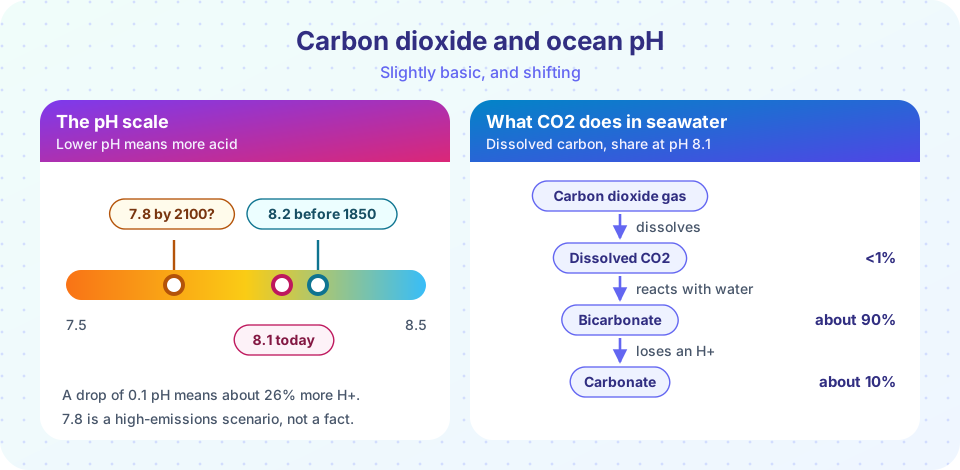
The result is three dissolved forms: dissolved CO₂ (including carbonic acid), bicarbonate (HCO₃⁻) and carbonate (CO₃²⁻). At the typical surface pH of about 8.1, roughly 90% of the dissolved carbon is bicarbonate, about 10% carbonate and less than 1% dissolved CO₂. The ocean's total dissolved inorganic carbon is around 2,000 micromoles per kilogram.
Importantly, this chemistry buffers the water. Added CO₂ is partly neutralized by carbonate ions (CO₂ + CO₃²⁻ + H₂O → 2 HCO₃⁻). That is why the ocean can absorb so much, and also why each additional unit of CO₂ is harder to absorb than the last: as carbonate is used up, the buffer weakens. The buffering strength is expressed by the Revelle factor, about 10 for surface seawater, which means that a 1% rise in total dissolved carbon raises the CO₂ partial pressure of the water by about 10%.
How the ocean takes up carbon
Three "pumps" move carbon:
- Solubility pump. Cold polar water absorbs CO₂ and carries it into the deep as it sinks.
- Biological pump. Algae take up CO₂ in photosynthesis; some of the organic matter sinks and is respired deeper, storing carbon away from the atmosphere for decades to centuries.
- Carbonate pump. Organisms that build calcium carbonate shells remove carbonate from the water; when they sink and dissolve, it returns at depth.
Since the Industrial Revolution, the ocean has absorbed roughly a quarter of the carbon dioxide that humans have emitted, about 2.5 to 3 billion tonnes of carbon per year at present.
What is pH?
The pH scale expresses acidity: pH = −log₁₀[H⁺], with [H⁺] in moles per liter. It is logarithmic, so each unit is a factor of 10.
Worked example. Seawater at pH 8.1 has:
[H⁺] = 10⁻⁸·¹ = 7.9 × 10⁻⁹ mol/L
Water at the pre-industrial value of about 8.2 has 10⁻⁸·² = 6.3 × 10⁻⁹ mol/L. The ratio is 10^0.1 = 1.26, so a 0.1 drop in pH means about 26% more hydrogen ions.
Seawater has a pH above 7, which is neutral, so it is still slightly basic. "Ocean acidification" means that its pH is moving toward the acid side, not that it has become acidic. The global surface average has fallen by about 0.1 pH units since the 1800s. Depending on future emissions, climate models suggest drops of roughly 0.3 to 0.4 by 2100 under the highest-emission scenarios, which would be a rise in hydrogen ion concentration of 100% or more.
Why it matters for life
The extra hydrogen ions combine with carbonate ions, reducing the carbonate available. Shell-building organisms such as corals, oysters, mussels, sea urchins and some plankton (pteropods, coccolithophores) need carbonate to build shells and skeletons of calcium carbonate. When carbonate falls, the water becomes less saturated with respect to aragonite and calcite, shell building takes more energy and, in undersaturated water, existing shells can dissolve. Cold, high-latitude waters have naturally lower carbonate and will be affected first. The responses of different species vary, and some organisms (such as some algae and seagrasses) may benefit from additional CO₂, so the ecosystem effect is a topic of active research.
Common misconceptions
"The ocean is becoming acidic." It is still basic, with a pH above 8. It is becoming less basic, and the process is called acidification because the direction is toward lower pH.
"A change of 0.1 pH is tiny." The scale is logarithmic, so 0.1 pH is a 26% increase in hydrogen ions.
"Oxygen is highest in the deep ocean because there is so much water." Oxygen is highest at the surface and in cold deep water that recently left the surface; the minimum is at intermediate depths.
"CO₂ and oxygen are the only gases that matter." Nitrogen, argon, methane and nitrous oxide also dissolve and take part in cycles, but CO₂ and O₂ are the key ones for biology and climate.
Try it
The first example plots the fractions of dissolved carbon in each form (a Bjerrum plot) against pH. The equilibrium constants are rounded values for seawater at 25 °C, so the exact crossover pH values vary with temperature and salinity.
Press Run (or Ctrl + Enter) to see the result here.
Program input · what you'd type while the program runs
Type the answers before you press Run, one per line. Each time the program reads a line (with input()), it gets the next line from this box.
The second example is a calculator for pH, hydrogen ions and the carbon dioxide absorbed by the ocean. The emission value is a rounded figure used for illustration.
Press Run (or Ctrl + Enter) to see the console output here.
No output.
Check your understanding
Quick check · 5 questions
of 5 answered You scored / 5 · perfect!
-
1. How does the solubility of oxygen change with temperature?
Cold water holds more dissolved gas; warm water holds less. -
2. What is the main dissolved form of inorganic carbon at pH 8.1?
About 90% of dissolved inorganic carbon is bicarbonate at the typical surface pH. -
3. A drop in pH from 8.2 to 8.1 means the hydrogen ion concentration rose by about...
10^0.1 = 1.26, so [H+] is about 26% higher. -
4. Why is there an oxygen minimum zone at mid-depths?
Decomposition consumes oxygen, and mid-depth water is slow to be replenished from the surface. -
5. Roughly what share of human CO2 emissions has the ocean absorbed?
The ocean has taken up roughly a quarter of emitted CO2, with the rest in the air and on land.
Summary
- Gas solubility falls as water warms, so cold polar water holds more oxygen and CO₂.
- Oxygen is lowest at mid-depth (200 to 1,000 m) where sinking material decays.
- CO₂ reacts with water to form bicarbonate and carbonate, a buffer system; at pH 8.1 about 90% of dissolved carbon is bicarbonate.
pH = −log₁₀[H⁺]; a 0.1 drop is about 26% more H⁺.- The ocean absorbs about a quarter of emitted CO₂; acidification reduces carbonate and stresses shell-building organisms.
Track your progress
Create a free account to tick off lessons and pick up where you left off on any device.
of Oceanography lessons completed