


















Lesson 48 of 49 · Projects and Practice
Cheat Sheet
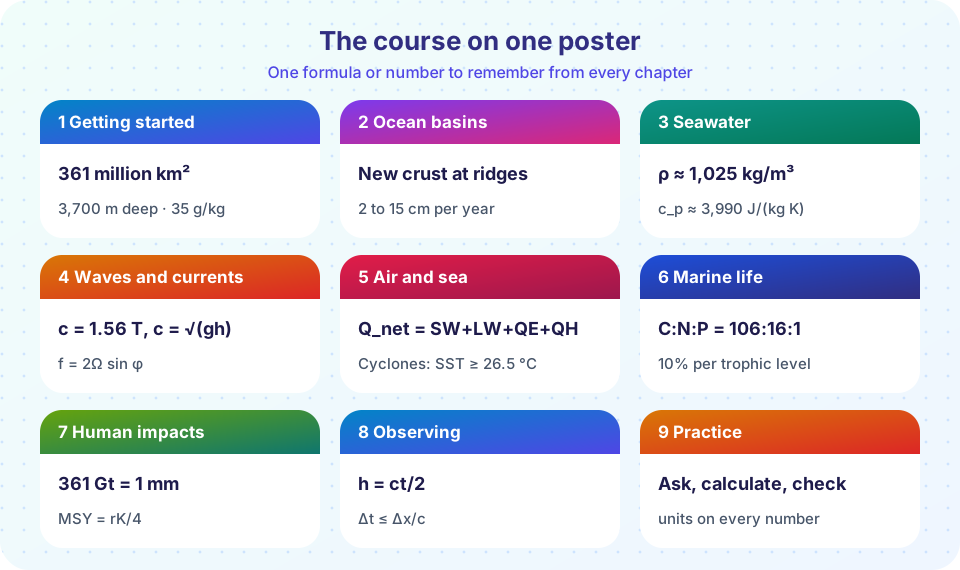
A one-page oceanography cheat sheet: ocean size and seawater constants, wave, tide and current formulas, air-sea fluxes, plankton and food-web rules, impacts and model formulas in one place.
This is the one-page summary of the course: the numbers worth remembering and the formulas you can use. It is organized by chapter so that you can find a formula by topic. Use it as a quick reference and for revision, but remember that a formula is only a compressed explanation. If one of them does not mean anything to you, follow the link to its lesson.
What you will learn
- The key constants and formulas of the course in one place
- Which formula applies to which kind of question
- Typical sizes, so that you can judge an answer
- Where to go for the full explanation
Key terms
Constant: a fixed number such as g or c_p.
Rule of thumb: a simple approximation that is good enough for estimating.
Scale: the typical size of a quantity.
Dimensional check: confirming that both sides of a formula have the same units.
Order of magnitude: the power of ten of a quantity.
Constants and sizes
| Quantity | Value |
|---|---|
| Ocean area; share of Earth's surface | 3.61 × 10¹⁴ m² (361 million km²); 71% |
| Ocean volume; average depth | 1.34 × 10¹⁸ m³; about 3,700 m |
| Deepest point (Challenger Deep) | about 10,900 m; about 1,100 atm |
| Average salinity | about 35 g/kg |
| Density of sea water; specific heat | 1,025 kg/m³; 3,990 J/(kg K) |
| Gravity; Earth's rotation rate | 9.81 m/s²; 7.292 × 10⁻⁵ s⁻¹ |
| Latent heat of vaporization | 2.5 × 10⁶ J/kg |
| Speed of sound in sea water | about 1,500 m/s |
| Sverdrup; petawatt; zettajoule | 10⁶ m³/s; 10¹⁵ W; 10²¹ J |
| Pressure | about 1 atm (10 dbar) per 10 m of depth |
Formulas by chapter
| Chapter | Formula | Meaning |
|---|---|---|
| 4 Waves, tides, currents | λ = 1.56 T², c = 1.56 T (deep water); c = √(g h) (shallow) |
Wavelength and speed from the period; tsunami speed |
| 4 | f = 2Ω sin φ; M = τ / (ρ f); τ = ρ_air C_D U² |
Coriolis parameter; Ekman transport; wind stress |
| 4 | Lunar day 24 h 50 min; tidal period 12 h 25 min; Moon : Sun tide about 2.2 : 1 | Tide timing and strength |
| 5 Air and sea | Q_net = Q_SW + Q_LW + Q_E + Q_H |
Surface heat budget |
| 5 | Q_E = ρ_air L C_E U (q_s − q_a) |
Evaporation (latent heat flux) |
| 5 | c = √(g′ H); ONI: ±0.5 °C for five overlapping 3-month periods |
Kelvin wave speed; ENSO definition |
| 5 | Category 1 at 119 km/h; cyclones need SST of at least 26.5 °C | Hurricanes |
| 6 Life | I = I₀ e^(−kz); euphotic depth = 4.6 / k |
Light with depth |
| 6 | C : N : P = 106 : 16 : 1; 138 O₂ per 106 C | Redfield ratio |
| 6 | About 10% transfer per trophic level; F(z) = F₁₀₀ (z/100)^(−0.86) |
Energy flow; sinking carbon |
| 7 Impacts | 361 Gt of ice = 1 mm of sea level; Δh = α h ΔT |
Sea level conversions |
| 7 | pH = −log₁₀[H⁺]; 0.1 pH unit = 26% more H⁺ |
Acidity |
| 7 | C_n = C_water × f^n |
Biomagnification |
| 7 | dB/dt = rB(1 − B/K) − qEB; MSY = rK/4 at E = r/(2q); collapse at E = r/q |
Fisheries |
| 8 Observation and models | h = c t / 2; u = (g/f)(Δη/Δx) |
Altimetry; geostrophic current |
| 8 | Δt ≤ Δx / c; x_a = (x_b/σ_b² + y/σ_o²) / (1/σ_b² + 1/σ_o²) |
CFL limit; assimilation |
How to use the sheet
Find your question by chapter, choose the formula and write down the units before you put in numbers. If the formula seems to need a constant that is not in the first table, it is probably the wrong formula. After you calculate, compare the answer with the typical sizes: a wave speed of 2,000 m/s or a current of 50 m/s would be a warning. The sheet cannot say when a formula stops applying, so remember the conditions: deep-water wave formulas need a depth greater than half the wavelength, geostrophy fails at the equator, and the Schaefer model ignores age structure and uncertainty.
Rules of thumb
- Doubling the wave period quadruples the wavelength.
- A tsunami in 4,000 m of water moves at about 700 km/h.
- The atmosphere has the heat capacity of the top 2.5 m of the ocean.
- Evaporation takes about 100 W/m² from a tropical sea; it is the largest way the sea surface loses heat.
- Only about 2% of surface light reaches 100 m in clear water (k = 0.04 per meter).
- Light is the limit near the surface; nutrients (and iron in places) are the limit elsewhere.
- Each trophic step loses about 90% of the energy.
- The ocean holds more than 90% of the extra heat from greenhouse gases and has taken up a quarter to a third of emitted CO₂.
- Fishing at MSY has no margin for error; aim lower.
Common misconceptions
"A cheat sheet replaces understanding." It is a memory aid. If you cannot say what a symbol means, return to the lesson.
"All formulas are exact." Many (c = 1.56 T, the Redfield ratio, the 10% rule, Martin's curve) are approximations with a range of validity.
"Units are optional." An answer without units is incomplete, and a wrong unit is a common source of error by factors of 1,000 or more.
Try it
The first example is a calculator with the key formulas of the course as functions. Call them with your own numbers.
Press Run (or Ctrl + Enter) to see the console output here.
No output.
The second example puts the sizes of things in the ocean on one logarithmic ruler, from a bacterium to an ocean basin. It helps you judge whether an answer is plausible. All the lengths are approximate.
Press Run (or Ctrl + Enter) to see the result here.
Program input · what you'd type while the program runs
Type the answers before you press Run, one per line. Each time the program reads a line (with input()), it gets the next line from this box.
Check your understanding
Quick check · 4 questions
of 4 answered You scored / 4 · perfect!
-
1. Which formula gives the speed of a tsunami in the open ocean?
A tsunami wavelength far exceeds the depth, so the shallow-water speed √(g h) applies. -
2. Roughly how deep does the atmosphere's heat capacity correspond to in the ocean?
Both columns hold about 10 MJ per m² per K. -
3. 1 mm of sea level corresponds to how much melted ice?
361 Gt, from the ocean area of 3.61 × 10¹⁴ m². -
4. At what effort is the Schaefer yield maximal?
The yield parabola peaks at E = r/(2q), giving MSY = rK/4.
Summary
- Sizes to remember: 361 million km², 3,700 m average depth, 35 g/kg salinity, 1,025 kg/m³ density, 3,990 J/(kg K).
- Waves, tides and currents:
c = 1.56 T,c = √(gh),f = 2Ω sin φ, lunar day 24 h 50 min. - Air-sea: the heat budget and
Q_Ebulk formula; ENSO by the ONI; hurricanes need 26.5 °C. - Life:
e^(−kz)light, Redfield 106:16:1, 10% transfer, Martin curve. - Impacts and tools: 361 Gt per mm, pH logarithm,
rK/4,h = ct/2,Δt ≤ Δx/c.
Next: Further Study
Track your progress
Create a free account to tick off lessons and pick up where you left off on any device.
of Oceanography lessons completed