


















Lesson 13 of 49 · Seawater Chemistry and Physics
The Water Molecule and Salinity
Learn why water is polar, why it stores so much heat, what ions make up sea salt, how salinity is measured and why it varies from the Baltic to the Red Sea.
A single drop of seawater contains about two billion billion molecules of water, each only about 0.3 nanometers across, along with ions of sodium, chloride, magnesium and a handful of other elements. The shape of that tiny molecule explains an astonishing amount of what the ocean does: why it dissolves salt, why it stores heat, why ice floats and why the sea is so slow to change temperature.
This lesson starts with the molecule and works up to the whole ocean's salt: what it is, where it comes from, how we measure it and why it varies from place to place.
What you will learn
- Why the water molecule is polar and how that leads to hydrogen bonding
- Why water has a high heat capacity and what that means for climate
- The main ions in seawater and the principle of constant proportions
- How salinity is defined and measured, and why it varies
- How to do simple salinity mixing and evaporation calculations
Key terms
Polar molecule: a molecule with a slight positive charge at one end and a slight negative charge at the other.
Hydrogen bond: the attraction between the positive hydrogen end of one water molecule and the negative oxygen end of another.
Specific heat capacity: the energy needed to raise 1 kg of a substance by 1 °C; for seawater about 3,990 J/(kg·K).
Salinity: the amount of dissolved salts in seawater, about 35 g per kg on average.
CTD: an instrument measuring conductivity, temperature and depth (pressure).
Why water is special
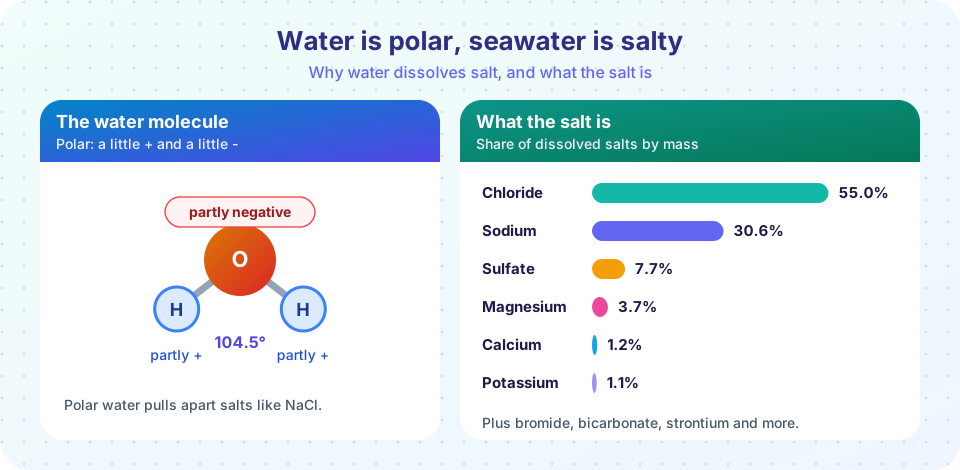
A water molecule, H₂O, has one oxygen atom and two hydrogen atoms bonded at an angle of about 104.5 degrees. Oxygen pulls the shared electrons closer than hydrogen does, so the oxygen end is slightly negative (written δ−) and the hydrogen ends are slightly positive (δ+). The molecule is polar, like a tiny magnet.
Opposite charges attract, so the hydrogen end of one molecule is drawn to the oxygen end of its neighbor. These hydrogen bonds are much weaker than the bonds inside a molecule but strong enough to give water unusual properties:
- A high boiling point. Without hydrogen bonds, a molecule as small as water would boil at around −80 °C and the ocean would be a gas.
- A high heat capacity. Heating water has to break and stretch the network of hydrogen bonds, so it absorbs a lot of energy for each degree of warming. The specific heat of seawater is about 3,990 J/(kg·K), roughly four times that of dry rock and four times that of air.
- A high latent heat. Evaporating water takes about 2.4 million joules per kilogram, which carries heat from the tropics to the atmosphere.
- Ice floats. As water freezes, the molecules lock into an open lattice that is less dense than the liquid, so sea ice stays on top and insulates the water below.
- Excellent dissolving power. Polar water molecules crowd around ions and pull them apart, which is why salt dissolves.
Worked example: how much heat does the ocean hold?
How much energy does it take to warm 1 m³ of seawater by 1 °C? Its mass is about 1,027 kg, so:
Q = m c ΔT = 1,027 kg × 3,990 J/(kg·K) × 1 K ≈ 4.1 × 10⁶ J
For 1 m³ of air (mass about 1.2 kg, c about 1,005 J/(kg·K)), the same warming needs only about 1,200 J. The ratio is about 3,400, which means that 1 m³ of seawater holds about as much heat per degree as 3,400 m³ of air. This is why the top few meters of the ocean store as much heat as the whole atmosphere, why coastal climates are milder than inland ones and why the ocean controls Earth's temperature.
What is in sea salt?
Seawater contains almost every element, but six ions make up more than 99% of the dissolved salts:
| Ion | Symbol | Share of salts (by mass) |
|---|---|---|
| Chloride | Cl⁻ | about 55% |
| Sodium | Na⁺ | about 30.6% |
| Sulfate | SO₄²⁻ | about 7.7% |
| Magnesium | Mg²⁺ | about 3.7% |
| Calcium | Ca²⁺ | about 1.2% |
| Potassium | K⁺ | about 1.1% |
Table salt (sodium chloride) is therefore about 85% of the total, with magnesium and sulfate salts providing the bitter taste. The principle of constant proportions (Forchhammer, 1865; refined by Dittmar after the Challenger expedition) says that these ratios are almost the same everywhere in the open ocean. Rain, rivers and evaporation change the total amount of salt per kilogram, but they do not change the ratio. This is the reason salinity can be estimated from just one property, such as electrical conductivity.
Nutrients such as nitrate and phosphate, and trace metals, are present only in tiny amounts but are crucial for life. Unlike the major salts, their concentrations vary strongly with depth and location, because organisms consume and release them.
Where the salt comes from
Rivers carry dissolved ions from the weathering of rock on land to the sea. Seafloor vents add more and remove magnesium and sulfate in exchange. The salt stays because water leaves by evaporation but salt does not. The ocean also loses salt, to sediments, to reactions in the crust and to evaporite deposits in dry coastal basins. Chloride and sodium stay in the water for tens of millions of years, so on human time scales, salinity of the whole ocean is steady.
Measuring salinity
Salinity is defined as the mass of dissolved salts in a kilogram of seawater. Evaporating the water and weighing the salt is too slow and unreliable, so oceanographers measure electrical conductivity, which rises with the amount of ions. A CTD instrument lowered from a ship (often with a ring of bottles called a rosette) measures conductivity, temperature and pressure continuously on the way down. For decades salinity was reported on the unitless Practical Salinity Scale (a value of about 35); the modern standard (TEOS-10) uses Absolute Salinity in grams per kilogram. For most purposes, "35" and "35 g/kg" are close enough to treat as the same.
Why salinity varies
The open-ocean surface runs from about 32 to 37 g/kg. The pattern follows the balance between evaporation (E) and precipitation (P) plus river input and ice:
- High salinity (up to about 37): the subtropics (around 20 to 30° latitude), where dry descending air makes evaporation exceed rain.
- Low salinity: the equatorial belt and high latitudes, where rain, river runoff and melting ice dilute the surface.
- Marginal seas: the Baltic Sea is brackish (surface salinity of about 7 to 10, and lower in its northern parts) because it receives a lot of river water, while the Red Sea (about 40) and the eastern Mediterranean (about 38 to 39) are saltier because evaporation is strong and exchange with the ocean is limited.
Near the poles, freezing is itself a salt pump: sea ice contains much less salt than the water it forms from, and the rejected salt makes the water below the ice (brine) especially cold and dense, which sinks (see lesson 330 and chapter 4).
Worked examples
Mixing. If you mix 3 kg of water with salinity 36 and 1 kg with salinity 32, what is the result? Weight by mass:
S = (3 × 36 + 1 × 32) / (3 + 1) = 140 / 4 = 35.0
Evaporation. If a parcel of surface water with salinity 35 loses 10% of its mass by evaporation, the salt stays but the water decreases:
S₂ = S₁ × (m₁ / m₂) = 35 / 0.90 ≈ 38.9
This is why enclosed, hot seas get saltier.
Common misconceptions
"The ocean is salty because of buried salt." It is mostly from the weathering of rock and from vents, concentrated by billions of years of evaporation.
"Salinity of the ocean is increasing steadily." Over human time scales it is essentially steady overall, although regional patterns are changing as rainfall and ice melt change.
"The Dead Sea is part of the ocean." It is a landlocked lake with about ten times the salinity of seawater (around 340 g/kg).
"Sea ice is as salty as seawater." Young sea ice holds some brine, but melted sea ice is much fresher than the water it came from.
Try it
The first example compares surface salinity in several waters. The values are rounded typical numbers, used for demonstration, and vary by season and location.
Press Run (or Ctrl + Enter) to see the result here.
Program input · what you'd type while the program runs
Type the answers before you press Run, one per line. Each time the program reads a line (with input()), it gets the next line from this box.
The second example is a salinity calculator for mixing, evaporation and the freezing point (using the standard UNESCO polynomial at atmospheric pressure).
Press Run (or Ctrl + Enter) to see the console output here.
No output.
Check your understanding
Quick check · 5 questions
of 5 answered You scored / 5 · perfect!
-
1. Why does salt dissolve so well in water?
The partial charges on water molecules attract the ions and pull them apart. -
2. About how many times more heat per degree does 1 m³ of seawater hold than 1 m³ of air?
Seawater is about 1,000 times denser than air and has about 4 times the specific heat, giving a ratio in the thousands. -
3. Which two ions make up most of sea salt?
Chloride (about 55%) and sodium (about 30.6%) make up roughly 85% of the dissolved salts. -
4. If 2 kg of water at salinity 30 is mixed with 2 kg at salinity 38, what is the salinity?
(2 × 30 + 2 × 38) / 4 = 34. -
5. Why is the Red Sea saltier than the average ocean?
Strong evaporation, little rain or river input and a narrow connection to the ocean concentrate its salt.
Summary
- Water is a polar, bent molecule whose hydrogen bonds give it a high heat capacity, high boiling point and great dissolving power.
- 1 m³ of seawater holds thousands of times more heat per degree than 1 m³ of air.
- Chloride and sodium make up about 85% of sea salt; the ratios of the main ions are nearly constant (constant proportions).
- Salinity averages 35 g/kg and varies with evaporation, rain, rivers and ice.
- Mixing is a mass-weighted average; evaporation raises salinity by
S₁ / (1 − fraction lost).
Track your progress
Create a free account to tick off lessons and pick up where you left off on any device.
of Oceanography lessons completed