


















Lesson 30 of 49 · Marine Life and Ecosystems
Plankton and Primary Production
Learn how phytoplankton turn light and nutrients into food, why nitrogen, phosphorus, iron and silicon limit growth, the Redfield ratio, spring blooms and critical depth.
A single drop of sea water from the sunlit ocean can contain tens of thousands of living cells. Most are too small to see without a microscope, and together they make up the base of nearly every food chain in the sea. These drifting plant-like cells, the phytoplankton, capture sunlight and turn carbon dioxide and water into the sugars that feed all marine animals. Their total yearly output is comparable with that of all the forests, grasslands and crops on land.
This lesson explains who the phytoplankton are, what they need, what limits them and why their numbers rise and crash in a seasonal rhythm. It closes with a small model that shows why a deep, stirred layer can be too dark for a bloom to start.
What you will learn
- The main groups of phytoplankton and their sizes
- The photosynthesis equation and what the Redfield ratio says about nutrient needs
- Which nutrients limit growth in which regions, including the iron story
- How seasonal blooms work and what critical depth means
- How satellites measure ocean chlorophyll
Key terms
Phytoplankton: microscopic drifting organisms that photosynthesize, including diatoms, dinoflagellates, coccolithophores and cyanobacteria.
Redfield ratio: the typical atomic ratio of carbon, nitrogen and phosphorus in plankton, C : N : P = 106 : 16 : 1.
Limiting nutrient: the nutrient in shortest supply compared with demand, which controls how much can grow.
Spring bloom: the sudden growth of phytoplankton as light increases and the water column stabilizes.
Euphotic depth: the depth where light falls to 1% of its surface value.
Who the phytoplankton are
Phytoplankton are sorted mainly by their size and their chemistry:
- Picoplankton (0.2 to 2 micrometers) include the cyanobacteria Prochlorococcus and Synechococcus. Prochlorococcus, discovered in 1986 by Sallie Chisholm and colleagues, is probably the most numerous photosynthetic organism on Earth, with an estimated 10²⁷ cells in the ocean. It dominates the nutrient-poor subtropical gyres.
- Diatoms (typically 20 to 200 micrometers) have glassy shells made of silica. They bloom explosively in nutrient-rich cool water and are large enough to sink quickly and to be eaten by krill.
- Coccolithophores such as Emiliania huxleyi wear plates of calcium carbonate. Their blooms are so bright that they turn large patches of sea milky turquoise in satellite images.
- Dinoflagellates can swim with two whip-like flagella. Some produce toxins; dense blooms of such species are called harmful algal blooms ("red tides").
The total weight (biomass) of phytoplankton at any moment is small, less than 1% of the world's photosynthetic biomass, because each cell lives for only a day or a few days and is eaten or dies quickly. But the rate at which they make new organic matter, net primary production, is about 50 billion tonnes of carbon per year, roughly half of the planet's total.
What they need
Photosynthesis, in its simplest form:
6 CO₂ + 6 H₂O + light → C₆H₁₂O₆ + 6 O₂
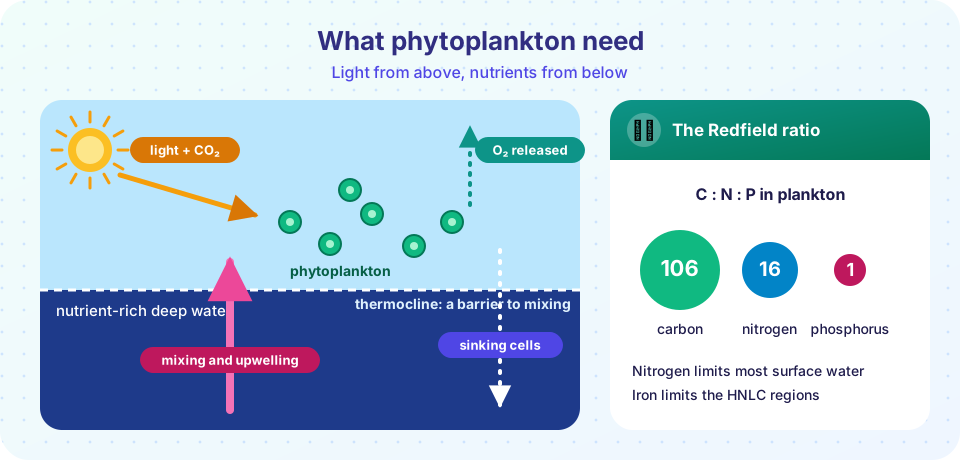
The cells need more than carbon, water and light. To build proteins, DNA and membranes, they need nitrogen, phosphorus and, for diatoms, silicon, together with trace metals such as iron. The proportions are surprisingly constant. In 1934 the oceanographer Alfred Redfield noticed that the atoms in plankton and in deep sea water occur in roughly fixed proportions:
C : N : P = 106 : 16 : 1
This Redfield ratio is a very useful rule of thumb. It tells you, for example, how much carbon a given supply of nitrate can build, and it also says that producing 106 moles of organic carbon releases about 138 moles of oxygen (and consuming it by respiration uses the same amount: a fact that matters in the dead-zone story of chapter 7).
The limiting nutrient
Growth stops when one needed ingredient runs out. This is Liebig's law of the minimum. In most of the surface ocean, the limiting nutrient is nitrogen: the water has plenty of phosphorus compared with the Redfield 16 : 1 requirement, but nitrate is exhausted first. Nutrients are used up in the sunlit layer, and sink out with dead cells and fecal pellets into the dark water, where they are returned to dissolved form by bacteria. So the deep ocean is rich in nutrients and the surface is poor. Life is rich only where physical processes bring the nutrients up (chapter 5): coastal upwelling, equatorial upwelling, winter mixing at high latitudes and river inputs.
The iron surprise
There are also large regions where nitrate and phosphate are plentiful but chlorophyll is low: the Southern Ocean, the subarctic North Pacific and the eastern equatorial Pacific. These are called high-nutrient, low-chlorophyll (HNLC) regions. The oceanographer John Martin proposed in the late 1980s that they lack the trace metal iron, which arrives mostly as windblown dust, and which is needed for the enzymes of photosynthesis. Later ship experiments, such as IronEx and SOIREE in the 1990s, added iron to patches of water and saw chlorophyll rise several-fold or more within days. Iron limits growth in roughly a quarter to a third of the ocean.
Light, mixing and the spring bloom
Light shrinks with depth according to I = I₀ e^(−k z) (the attenuation coefficient k is about 0.04 per meter in clear ocean water). The euphotic depth, where the light is down to 1%, is ln(100) / k = 4.6 / k: about 115 m for k = 0.04, and only about 23 m in murky coastal water with k = 0.2.
A phytoplankton cell is carried up and down by turbulence in the mixed layer. If the layer is thin and well lit, the cell spends most of its time in good light and grows. If the layer is deep, the cell spends much of its time in the dark and its average light is low. In 1953 Harald Sverdrup showed that a bloom can start only when the mixed layer is shallower than a critical depth: above it, growth in the light outweighs the losses (respiration, grazing and sinking) that continue everywhere in the water column.
This explains the spring bloom at midlatitudes. In winter the surface is cold, stormy and deeply mixed, so cells are in the dark, but nutrients are replenished from below. In spring the Sun rises higher and the surface warms and stratifies. The mixed layer shallows past the critical depth, and the cells are kept in strong light with plenty of nutrients. The bloom explodes. Within weeks it uses up the nutrients, the zooplankton catch up, and the bloom collapses. In some places there is a smaller second bloom in autumn.
Seeing it from space
Chlorophyll absorbs blue and red light and reflects green, so the color of the sea tells us how much of it there is. A satellite instrument, the Coastal Zone Color Scanner (1978 to 1986), first revealed global patterns; the SeaWiFS sensor (1997 onward) and its successors have mapped them ever since. Typical surface chlorophyll is about 0.03 to 0.1 mg per cubic meter in the subtropical gyres, but above 1 mg/m³ in upwelling zones and coastal waters. A map of the seasonal bloom is one of the most striking images in oceanography.
Common misconceptions
"The richest water is the clearest and bluest." Clear blue water means very few particles and cells; it is nutrient-poor. Green or turquoise water usually means more plankton.
"Plankton are all animals." Phytoplankton are photosynthetic organisms. Zooplankton are the animal-like ones.
"The deep sea has no nutrients." The deep water has more nutrients than the surface. What it lacks is light.
"More nutrients always means more life." Excess nutrients from land cause eutrophication and dead zones (chapter 7).
Try it
The first example uses the Redfield ratio. For several nitrate supplies, it computes the carbon that phytoplankton can build, and the oxygen released, assuming that nitrogen is limiting.
Press Run (or Ctrl + Enter) to see the console output here.
No output.
The second example is a simple light-limited growth model in the spirit of Sverdrup. The average light in the mixed layer falls as the layer deepens, so the net growth rate falls, and it turns negative below the critical depth. The parameters are rounded and illustrative, not tuned to a real place.
Press Run (or Ctrl + Enter) to see the result here.
Program input · what you'd type while the program runs
Type the answers before you press Run, one per line. Each time the program reads a line (with input()), it gets the next line from this box.
Check your understanding
Quick check · 5 questions
of 5 answered You scored / 5 · perfect!
-
1. What is the Redfield ratio for C : N : P in plankton?
Plankton and deep sea water have atomic ratios close to 106 carbon : 16 nitrogen : 1 phosphorus. -
2. Why are HNLC regions (such as the Southern Ocean) low in chlorophyll despite high nitrate?
Iron, supplied mostly by dust, is the limiting nutrient there, as the iron-fertilization experiments showed. -
3. The euphotic depth (1% light) for k = 0.04 per meter is about...
ln(100) / 0.04 = 4.605 / 0.04 ≈ 115 m. -
4. What triggers the midlatitude spring bloom?
Rising light and surface stratification keep cells in the sunlight, and winter has stored nutrients. -
5. Most of the surface open ocean is nutrient-poor because...
The biological pump moves nutrients out of the surface; mixing and upwelling are needed to return them.
Summary
- Phytoplankton range from 1 µm cyanobacteria to 200 µm diatoms and produce about 50 Gt of carbon per year, around half of global net primary production.
- Plankton have a nearly constant composition, C : N : P = 106 : 16 : 1; nitrogen limits most of the ocean and iron limits the HNLC regions.
- Light fades exponentially; blooms start when the mixed layer is shallower than the critical depth.
- Satellites measure ocean color to map chlorophyll globally.
Track your progress
Create a free account to tick off lessons and pick up where you left off on any device.
of Oceanography lessons completed