


















Lesson 19 of 49 · Waves, Tides and Currents
Ocean Waves
Understand ocean waves: wavelength, period and speed, wave generation by wind, orbital motion, shoaling and breaking at the coast, and how tsunamis differ from wind waves.
A wave is one of the most misunderstood things in the ocean. Watch a piece of seaweed on a swell: it rises, moves a little forward, drops, moves a little back and ends up almost where it started. The wave itself, however, may have crossed an ocean. What travels is a pattern and the energy it carries, not the water.
This lesson takes you from the language of waves (crest, trough, wavelength, period) to the formulas that govern their speed, shows how wind builds them, explains what happens when they reach shallow water and finally covers the strange long waves called tsunamis.
What you will learn
- The measures of a wave and how they relate: speed, wavelength and period
- How wind builds waves and what fetch and duration mean
- How waves behave in deep water and in shallow water
- Why waves break and how shoaling works
- What makes a tsunami different from a wind wave
Key terms
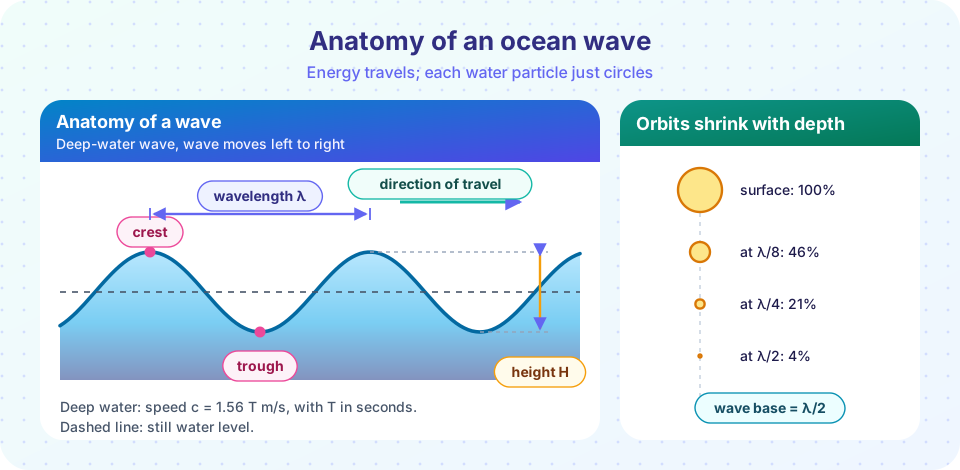
Wavelength (λ): the distance from one crest to the next.
Period (T): the time for one full wave to pass a point; frequency is 1/T.
Wave height (H): the vertical distance from trough to crest.
Fetch: the distance of open water over which the wind blows.
Shoaling: the changes in a wave (slowing, growing taller) as it enters shallow water.
Wave basics
For any wave, speed equals wavelength divided by period:
c = λ / T
A wave that has a wavelength of 100 m and a period of 8 s moves at 100 / 8 = 12.5 m/s, which is 45 km/h. The steepness is the ratio of height to wavelength, H / λ. A wave becomes unstable and breaks when the steepness reaches about 1/7.
How wind makes waves
Wind blowing over water drags at the surface and also creates pressure differences over small ripples. Energy flows from wind to waves, so waves grow. Three things limit how large they get:
- Wind speed: stronger wind gives bigger waves.
- Fetch: the longer the water the wind blows over, the more energy is transferred.
- Duration: the longer the wind blows, the bigger the waves.
When all three have gone on long enough that waves can no longer take more energy, the sea is said to be fully developed. Near the storm, waves are steep and messy, a "sea". As they leave the storm, longer waves outrun the shorter ones and the wave train sorts itself into smooth, regular swell. Swell can cross entire oceans: surfers in California ride waves generated by storms near New Zealand or Alaska.
Wave heights are commonly reported as the significant wave height, the mean height of the highest third of the waves. Individual waves vary widely around it, and occasionally a rogue wave appears that is more than twice the significant height. These are not myths: a platform sensor in the North Sea recorded a wave of about 25 m during the 1995 New Year storm.
Deep-water waves
When the water is deep compared to the wavelength (depth greater than about half the wavelength), the bottom does not matter. The wave speed depends only on the wavelength:
c = √(g λ / 2π)
Using λ = cT, this gives two handy forms (with g = 9.81 m/s²):
c = g T / 2π ≈ 1.56 T m/s and λ = 1.56 T² m
Longer waves travel faster, so a storm's waves sort themselves by wavelength with distance, which is called dispersion.
Worked example: a swell crossing an ocean
A storm produces swell with a period of 14 s. Then
- wavelength:
λ = 1.56 × 14² = 306 m, - phase speed:
c = 1.56 × 14 = 21.8 m/s ≈ 79 km/h.
But energy does not move at the crest speed. In deep water the wave energy travels at the group velocity, which is half the phase speed: c_g = c / 2 = 10.9 m/s ≈ 39 km/h. To cross 5,000 km, the swell takes 5,000,000 m / 10.9 m/s = 459,000 s ≈ 5.3 days. That is why a surf forecaster can predict arrival times days in advance.
Orbits
In a deep-water wave, each particle of water moves in a nearly circular orbit whose radius equals half the wave height at the surface and decays with depth as e^(−2πz/λ). At a depth of half the wavelength the orbit is only about 4% of its surface size. That depth, λ/2, is called the wave base: below it, waves are not felt. This is why submarines avoid storm waves by diving, and why the seafloor in deep water is unaffected by surface waves.
Shallow-water waves
When the depth h is less than about λ/20, the wave "feels" the bottom. The speed no longer depends on wavelength:
c = √(g h)
Deeper water carries waves faster. A wave approaching a beach therefore slows down, and some things change while one stays constant:
- the period stays the same,
- the speed and wavelength decrease (
λ = cT), - the height increases, because the same energy is squeezed into a shorter, slower wave (shoaling),
- the wave front refracts, bending to become nearly parallel to the shoreline, because the part of the crest in shallower water travels more slowly.
When the height reaches about 0.78 times the water depth (H / h ≈ 0.78), or the steepness exceeds the limit, the wave breaks. The type of breaker depends on the beach slope: a gentle slope gives spilling breakers, a medium slope plunging breakers (the surfer's tube) and a steep slope surging breakers.
Waves that break at an angle drive a longshore current that moves sand along the beach. Water pushed shoreward by breaking waves returns seaward in narrow, fast rip currents, a major danger for swimmers: if caught in one, swim parallel to the shore, not against it.
Tsunamis
A tsunami (Japanese for "harbor wave") is a very long wave caused by a sudden displacement of the water: usually a large undersea earthquake at a subduction zone (see chapter 2), but also landslides and volcanic eruptions. It is not related to tides.
In the open ocean a tsunami has a wavelength of 100 to 200 km, a period of 10 to 60 minutes and a height of only a meter or so. Because its wavelength is much greater than the depth of the ocean, it behaves as a shallow-water wave everywhere and travels at c = √(g h):
c = √(9.81 × 4,000) = 198 m/s ≈ 713 km/h
That is about the speed of a jet airliner. Across the Pacific, it takes about a day. As the wave enters shallow water, it slows dramatically but loses little energy: at 10 m depth, c = √(9.81 × 10) = 9.9 m/s = 36 km/h. By Green's law the amplitude grows roughly as h^(−1/4), so going from 4,000 m to 10 m multiplies the height by (400)^(1/4) ≈ 4.5, and local effects can raise it further. The tsunami may arrive as a rapidly rising tide that floods inland for many minutes, or as a breaking surge, with repeated waves for hours.
The 2004 Indian Ocean tsunami, caused by a magnitude 9.1 earthquake, killed about 230,000 people, and the 2011 Tohoku tsunami in Japan killed about 18,000. Warning systems such as the DART buoys (pressure sensors on the seafloor that detect the passing wave) and seismic networks give minutes to hours of warning, and natural warning signs, such as a strong earthquake or the sea withdrawing, mean you should move to high ground immediately.
Common misconceptions
"The water in a wave travels with it." The water moves in orbits and returns to nearly its starting place. Only in breaking waves is there a net movement shoreward.
"A tsunami is a giant breaking wave." In the open ocean a tsunami is a barely noticeable long wave. It builds on approach to the shore and often looks like a fast-rising flood.
"Bigger waves are always faster." In deep water, speed depends on wavelength (period), not height.
"A rogue wave is a myth." Rogue waves have been measured by instruments and satellites. They are rare but real.
Try it
The first example is an interactive wave. Change the period and the water depth, and the model solves the full wave dispersion relation (ω² = g k tanh(k h)) to give the wavelength and speed, tells you whether it is a deep-water or shallow-water wave and animates a surface wave with an orbiting particle.
The second example plots how wave speed depends on depth for two swell periods and for a tsunami. For the swells the speed follows the full dispersion relation; for the tsunami it follows √(g h). Notice that the tsunami curve keeps climbing with depth, while the swell speeds level off in deep water.
Press Run (or Ctrl + Enter) to see the result here.
Program input · what you'd type while the program runs
Type the answers before you press Run, one per line. Each time the program reads a line (with input()), it gets the next line from this box.
Check your understanding
Quick check · 5 questions
of 5 answered You scored / 5 · perfect!
-
1. A wave has wavelength 80 m and period 8 s. What is its speed?
c = λ / T = 80 / 8 = 10 m/s. -
2. Using λ = 1.56 T², what is the wavelength of a deep-water wave with a 10 s period?
λ = 1.56 × 10² = 156 m. -
3. What happens to the period of a wave as it moves into shallow water?
Period is set by the source and does not change; speed and wavelength decrease. -
4. How fast does a tsunami travel in 4,000 m of water?
c = √(g h) = √(9.81 × 4,000) ≈ 198 m/s, about 713 km/h. -
5. What does a rip current do?
Water pushed ashore by waves returns offshore in narrow rip currents; swim parallel to the shore to escape.
Summary
- Wave speed is
c = λ/T; in deep waterc = 1.56 Tm/s andλ = 1.56 T²m, and energy travels at half that speed. - Wind builds waves according to wind speed, fetch and duration; swell is sorted by wavelength and can cross oceans.
- In shallow water
c = √(g h); waves slow, steepen, refract and break whenH/h ≈ 0.78. - Tsunamis are long, shallow-water waves traveling at jet speed in the open ocean and growing tall near the shore.
Next: Tides
Track your progress
Create a free account to tick off lessons and pick up where you left off on any device.
of Oceanography lessons completed