


















Lesson 20 of 49 · Waves, Tides and Currents
Tides
Learn what causes tides: the Moon's and Sun's gravity, two bulges, the 24 h 50 min lunar day, spring and neap tides, tidal range and how tides are predicted.
Twice a day, on most coasts, the sea creeps up the beach, pauses and slides back. Fishermen, sailors and shell collectors have noticed for thousands of years that the rhythm of the tides is tied to the Moon: high tide comes about 50 minutes later each day, just as the Moon rises later. It took Isaac Newton, in 1687, to explain why, and today tides are among the most precisely predicted phenomena in science.
This lesson explains where tides come from, why there are two bulges rather than one, why the sizes of tides change through the month and how real coasts modify the simple picture. It also shows how tide tables are made, by adding up a few regular cycles.
What you will learn
- Why the Moon and Sun raise tides, and why there are two bulges
- How the lunar day creates the 12 h 25 min tidal rhythm
- How spring and neap tides arise and how large the difference is
- How coastlines and basins change tidal range
- How tides are predicted from tidal constituents
Key terms
Tidal range: the vertical difference between high and low tide.
Spring tide: a larger-than-average tide when Sun, Earth and Moon line up (new and full moon).
Neap tide: a smaller-than-average tide when the Sun and Moon are at right angles (quarter moons).
Semidiurnal / diurnal tide: two high tides per day / one high tide per day.
Tidal constituent: one of the regular sinusoidal cycles that add up to the observed tide.
Gravity and the tidal force
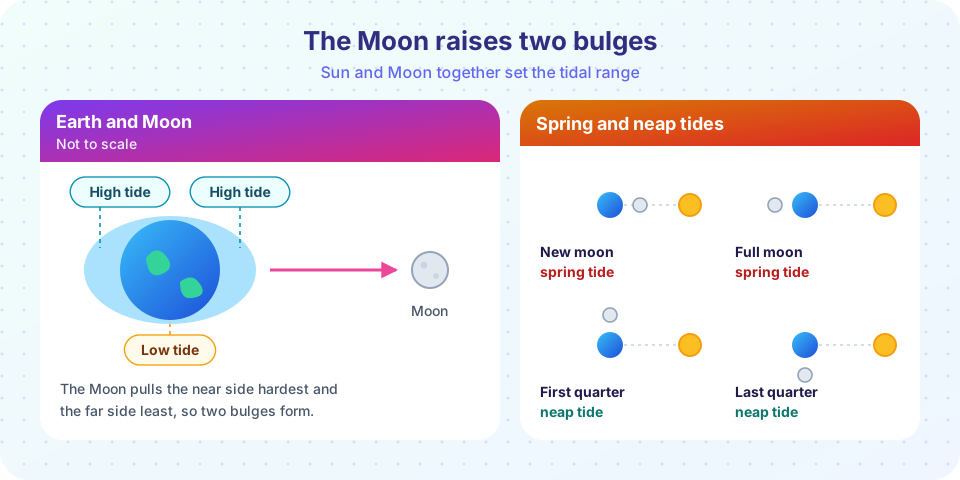
Newton's law says the gravitational pull between two bodies falls off with the square of the distance. The Moon's pull on the side of Earth nearest to it is slightly stronger than on Earth's center, and slightly weaker on the far side. Relative to the planet's center, the near-side water is pulled toward the Moon and the far-side water is "left behind", which is the same as being pulled away. The result is a tidal force: a stretching of the ocean along the Earth-Moon line. It creates two bulges, one facing the Moon and one on the opposite side.
The tidal force depends on the difference in pull across Earth, so it falls off with the cube of the distance, not the square:
tidal force ∝ M / d³
Worked example: Moon versus Sun
Compare the Moon (mass 7.35 × 10²² kg, distance 384,400 km) with the Sun (mass 1.989 × 10³⁰ kg, distance 149.6 million km):
(M_moon / M_sun) × (d_sun / d_moon)³ = (3.70 × 10⁻⁸) × (389.2)³ = 3.70 × 10⁻⁸ × 5.90 × 10⁷ ≈ 2.2
So the Moon's tidal effect is about 2.2 times that of the Sun, or the Sun's is about 46% of the Moon's. The Sun is vastly more massive, but it is so much farther away that the cube of distance wins. (It is the Sun's pull on Earth, not its tidal effect, that holds Earth in its orbit.)
A common misconception is that the far-side bulge is caused mainly by "centrifugal force". The better description is the simple one above: a difference in gravitational pull across Earth.
The lunar day and the rhythm of tides
Earth spins once in 24 hours, but the Moon is also orbiting in the same direction, once every 27.3 days. By the time a point on Earth has completed a rotation, the Moon has moved on, so it takes extra time, about 50 minutes, to catch up with it again. This gives the lunar day of 24 hours and 50 minutes. A spot on Earth passes under two bulges per lunar day, so high tides come about every 12 hours and 25 minutes.
You can check: Moon's cycle between new moons is 29.5 days, so 24 h × 29.5 / 28.5 = 24.84 h = 24 h 50 min.
Spring and neap tides
At new moon and full moon, the Sun, Earth and Moon are in a line, so the solar and lunar tidal forces add: spring tides (nothing to do with the season) with the highest highs and lowest lows. At first and last quarter, the Sun and Moon pull at right angles and partly cancel: neap tides, with the smallest range. This happens twice a month, about every 14.8 days.
Worked example. With the Sun at 46% of the Moon, the equilibrium ranges are in the ratio:
spring / neap = (1 + 0.46) / (1 − 0.46) = 1.46 / 0.54 ≈ 2.7
Spring tidal ranges are about 2.7 times neap ranges in this simple theory. Real harbors differ because of local effects, but spring ranges are always clearly larger than neap ranges. Also, the Moon's orbit is slightly elliptical: when it is closest (perigee), tides are about 20% stronger, and a perigee that coincides with a spring tide gives especially large tides.
Real tides: coasts and basins
The simple "two bulges" theory (the equilibrium tide) predicts a range of only about 0.5 m, but real ranges vary from nearly zero to over 15 m. The reason: ocean basins and the coast respond dynamically, much like water sloshing in a bathtub.
- Rotation matters. The tide wave in an ocean basin is steered by the Coriolis effect and rotates around points of zero tidal range called amphidromic points.
- Resonance. If a basin has a natural sloshing period close to the 12.4 h tidal period, the tide is amplified. The Bay of Fundy in Canada has the largest ranges in the world, up to about 16 m, partly because its natural period is close to the tidal period.
- Funneling and shallowing. Where a tide wave runs into a narrowing estuary or shallow shelf, the range grows, as for the Severn Estuary in the UK.
- Types. Most places have semidiurnal tides (two similar highs and lows), some have diurnal tides (one high and one low per day, as in the Gulf of Mexico and parts of Southeast Asia), and many have mixed tides with unequal highs, like the US West Coast.
Tides also drive tidal currents that flow in and out of bays and channels. They can be strong enough to create whirlpools, and in some rivers a tidal bore, a wave moving upstream. Tides are crucial for coastal life: the intertidal zone is home to organisms adapted to both wetting and drying, and many animals time feeding, spawning or hunting to the tides. Tidal energy (barrages and turbines) is a predictable source of renewable power.
Predicting tides
A tide record looks complicated, but it is the sum of a handful of regular cycles, constituents, each caused by a particular motion of the Moon, Sun and Earth. The main ones are:
| Constituent | Period | Origin |
|---|---|---|
| M2 | 12.42 h | Main lunar semidiurnal |
| S2 | 12.00 h | Main solar semidiurnal |
| N2 | 12.66 h | Lunar elliptical orbit |
| K1 | 23.93 h | Lunar-solar diurnal |
| O1 | 25.82 h | Main lunar diurnal |
By measuring a few months of tide height, you can find the amplitude and phase of each constituent for a port (harmonic analysis) and then predict tides years ahead. The spring-neap cycle emerges automatically as the "beat" between M2 and S2: their combined period is 1 / (1/12.00 − 1/12.42) h ≈ 354 h ≈ 14.8 days.
Common misconceptions
"There is only one tidal bulge, under the Moon." There are two, one on each side of Earth, so there are two high tides a day.
"Spring tides happen in spring." They occur twice a month, at new and full moon, in all seasons.
"Tides are small tsunamis." Tides are periodic, caused by gravity, and predictable. Tsunamis are caused by sudden displacement of water.
"Tides are the same size everywhere." Tidal range varies from under 0.5 m in the Mediterranean to about 16 m in the Bay of Fundy.
Try it
The first example builds a tide from constituents. The amplitudes are rounded values typical of a mid-latitude Atlantic port. Watch the spring-neap cycle appear when M2 and S2 combine.
Press Run (or Ctrl + Enter) to see the result here.
Program input · what you'd type while the program runs
Type the answers before you press Run, one per line. Each time the program reads a line (with input()), it gets the next line from this box.
The second example is a tide-time helper and a Moon-versus-Sun calculator.
Press Run (or Ctrl + Enter) to see the console output here.
No output.
Check your understanding
Quick check · 5 questions
of 5 answered You scored / 5 · perfect!
-
1. Why are there usually two high tides a day?
The tidal force stretches the ocean along the Earth-Moon line, making two bulges. -
2. How much later does a given tide come each day?
The lunar day is 24 h 50 min because the Moon moves on in its orbit. -
3. Which pair of Moon phases gives spring tides?
When Sun, Earth and Moon line up (new and full moon), their tidal forces add. -
4. Why is the Sun's tidal effect smaller than the Moon's despite its huge mass?
Tidal force is proportional to M / d³; the Sun's distance makes its effect about 46% of the Moon's. -
5. The M2 and S2 constituents have periods 12.42 h and 12.00 h. What is their beat period (the spring-neap cycle)?
1 / (1/12.00 − 1/12.42) is about 354 h, or 14.8 days.
Summary
- Tides come from the difference in gravitational pull across Earth, which raises two bulges; the Moon's effect is about 2.2 times the Sun's.
- The lunar day is 24 h 50 min, so high tides come about every 12 h 25 min.
- Spring tides (new and full moon) are larger than neap tides (quarter moons), by about 2.7 times in simple theory.
- Basin shape, resonance and coastline change the range, from under 0.5 m to about 16 m.
- Tides are predicted by summing constituents such as M2, S2, K1 and O1.
Track your progress
Create a free account to tick off lessons and pick up where you left off on any device.
of Oceanography lessons completed