


















Lesson 17 of 49 · Seawater Chemistry and Physics
Chapter 3 Review: Seawater Chemistry and Physics
Review chapter 3: the water molecule, salinity, density and layers, dissolved gases, pH, light and sound, with a recap table, formulas and a ten-question quiz.
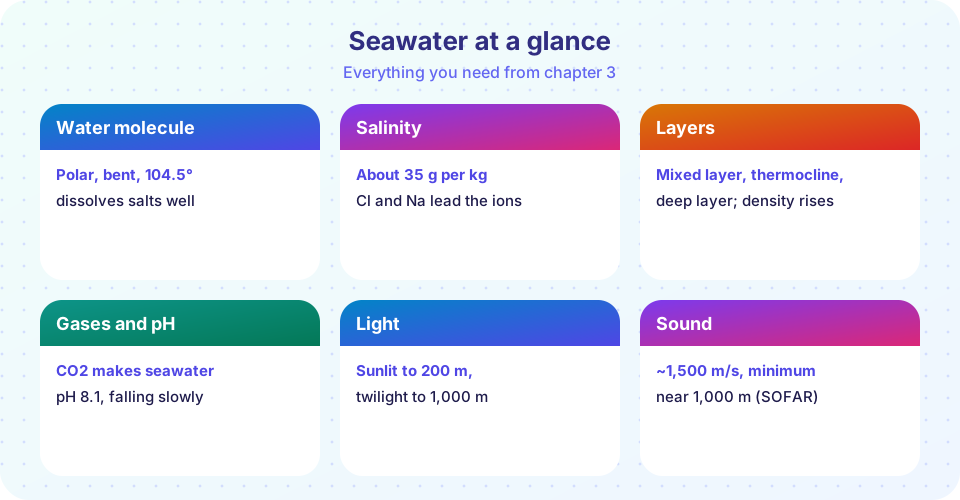
You have now looked inside a drop of seawater and followed its properties from the surface to the abyss. This review collects the key ideas, formulas and numbers from chapter 3. Try to explain each of the six cards in the picture in your own words before you read the table, and use the practice examples to check your arithmetic.
What you will learn
- Which facts and formulas from chapter 3 to know by heart
- How the chapter's ideas connect to each other
- Where to review before moving on to waves, tides and currents
Key terms
Polar molecule: water has slightly charged ends, so it dissolves salts and has a high heat capacity.
Salinity: about 35 g/kg; the proportions of the main ions are constant.
Pycnocline: the layer where density rises quickly with depth, usually with the thermocline.
pH: −log₁₀[H⁺]; ocean surface pH is about 8.1 and falling.
SOFAR: the sound channel near 1,000 m where sound speed is lowest.
Recap table
| Lesson | Core idea | Numbers and formulas |
|---|---|---|
| Chapter 3 Overview | Temperature, salinity and pressure define seawater | 35 g/kg, 1,027 kg/m³, about 1 atm per 10 m |
| The Water Molecule and Salinity | Polar water dissolves salt and stores heat | Cl⁻ and Na⁺ about 85% of salts; Q = m c ΔT; mixing is a mass-weighted mean |
| Temperature, Density and Ocean Layers | Cold and salty water is dense; the ocean is layered | Mixed layer, thermocline, deep layer; N² = (g/ρ₀)(Δρ/Δz) |
| Gases, pH and the Carbon Cycle | Gases dissolve; CO₂ lowers pH | pH = −log₁₀[H⁺]; 0.1 pH is about 26% more H⁺; ocean takes about a quarter of emissions |
| Light and Sound in the Sea | Light fades; sound is trapped | I = I₀ e^(−Kz); euphotic depth 4.6/K; d = ct/2 |
The ideas fit together as a chain. Water's polarity makes seawater salty and heat-hungry. Temperature and salinity set density, which creates layers. Layers control where gases, nutrients and heat can mix. The same temperature and depth structure shapes how light and sound travel.
Common misconceptions
"Salinity is the same everywhere." It runs from about 32 to 37 g/kg in the open ocean and much lower in estuaries and the Baltic Sea.
"The deep ocean is warm in the tropics." At 1,000 m it is only about 5 °C, even at the equator.
"Ocean acidification means the ocean is acidic." Its pH is above 8, so it is slightly basic and becoming less so.
"Light reaches the bottom of the ocean." There is no sunlight below about 1,000 m.
Try it
The first example is a flashcard-style formula drill with a hidden answer. Edit the values and see the answers update.
Press Run (or Ctrl + Enter) to see the console output here.
No output.
The second example puts a whole water column together in one plot: temperature, salinity and density, with the mixed layer and thermocline marked. The profile is illustrative.
Press Run (or Ctrl + Enter) to see the result here.
Program input · what you'd type while the program runs
Type the answers before you press Run, one per line. Each time the program reads a line (with input()), it gets the next line from this box.
Check your understanding
Quick check · 10 questions
of 10 answered You scored / 10 · perfect!
-
1. Why does water dissolve salts so well?
The partial charges on water molecules separate and surround ions. -
2. What is the approximate average salinity of the ocean?
The average is about 35 g/kg, or 3.5% by mass. -
3. Which two ions make up most of the salt in seawater?
Chloride and sodium account for roughly 85% of the dissolved salts. -
4. What does the thermocline do?
The thermocline is the layer of rapid temperature decrease, usually about 100 to 1,000 m. -
5. Which water mass is the densest in the ocean?
AABW forms on the Antarctic shelves by freezing and cooling. -
6. A fall from pH 8.2 to 8.1 raises hydrogen ions by about...
10^0.1 = 1.26, so [H+] is about 26% higher. -
7. If K = 0.046 per meter, the euphotic depth is about...
z = 4.6 / 0.046 = 100 m. -
8. Where is dissolved oxygen typically lowest?
Decomposition of sinking organic matter uses up oxygen at mid-depths. -
9. Why is sound trapped near 1,000 m in the SOFAR channel?
Rays bend toward lower speed, so they stay near the minimum and travel far. -
10. An echo returns after 10 s at 1,500 m/s. How deep is the seafloor below the ship?
d = 1,500 × 10 / 2 = 7,500 m.
Summary
- Water is polar, so it dissolves salts and stores heat; salinity averages 35 g/kg with constant proportions.
- Density rises with cooling, salinity and pressure; the ocean is layered and stable.
- CO₂ dissolves into bicarbonate and carbonate and lowers pH; the ocean takes about a quarter of emissions.
- Light fades exponentially; sound is trapped by a speed minimum near 1,000 m.
- Next: how the water moves, in waves, tides and currents.
Track your progress
Create a free account to tick off lessons and pick up where you left off on any device.
of Oceanography lessons completed