


















Lesson 43 of 49 · Projects and Practice
Chapter 9 Overview: Projects and Practice
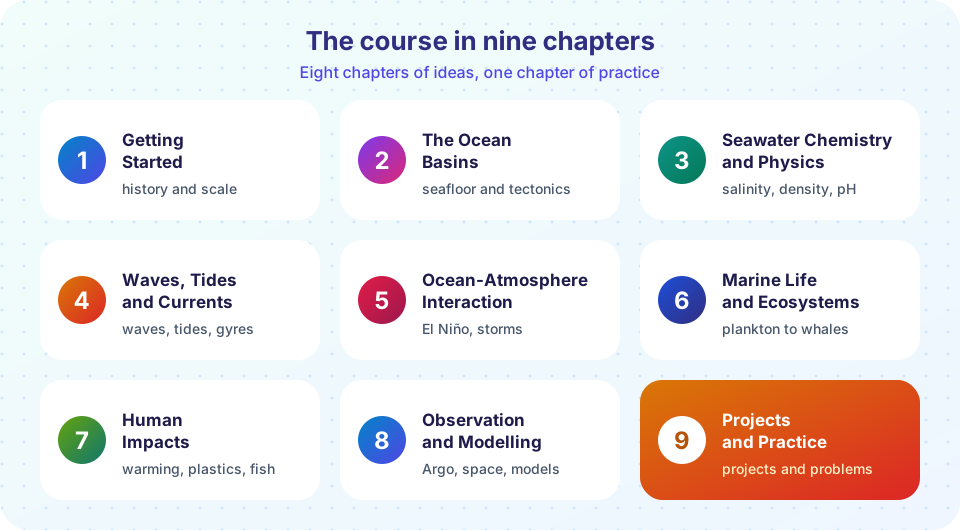
Overview of the final chapter: two hands-on projects, a fisheries case study, a problem set with worked answers, a glossary, a cheat sheet and a guide to further study.
You have now met the ocean from its seafloor to its surface, from its chemistry to its life, and from its natural rhythms to the changes people have brought. Knowing the ideas is one thing. Using them is another. The last chapter asks you to use them: to calculate, to simulate, to check a claim against the physics and to explain what you find.
Oceanographers rarely solve problems with a single formula. A typical question, such as "has the ocean absorbed enough heat to explain the sea level rise we see?", draws on heat capacity (chapter 5), thermal expansion and ice (chapter 7) and observations (chapter 8). The projects in this chapter are built the same way.
What you will learn
- How the lessons of this chapter build on the previous eight
- A working method for any quantitative ocean question
- The conversions and constants you will use again and again
- Where to find the projects, the problem set and the reference pages
Key terms
Order-of-magnitude estimate: a quick calculation that gets the size of a number right, to within a factor of ten, before doing it precisely.
Budget: an accounting of inputs, outputs and storage of a quantity, such as heat, water or carbon.
Sanity check: comparing an answer with what you already know to see if it is plausible.
Sensitivity: how much the result changes when an input changes.
Closure: when the parts of a budget add up to the observed total.
A method for quantitative questions
Most of the problems in this chapter respond to the same five steps:
- State the question in one sentence, with units: "How many millimeters of sea level per year does a heat uptake of 0.8 W/m² produce?"
- List the quantities you know and the constants you need (
ρ= 1,025 kg/m³,c_p= 3,990 J/(kg K), the ocean area 3.61 × 10¹⁴ m²,g= 9.81 m/s²). - Pick the relationship from the lessons:
Δh = α E / (ρ c_p). - Calculate, keeping the units with each number, and estimate the answer first so that you notice errors.
- Check and interpret. Is the answer the right size? What would change it? What does it mean for the ocean?
Practice this method on every example. It is the habit that separates getting the right number from understanding the ocean.
Chapter 9 map
Reference pages
The method
What each lesson covers
| Lesson | What you do |
|---|---|
| Project: The Ocean's Heat and Sea Level | Build a heat and sea level budget for 1970 to 2020 and check whether the parts add up |
| Case Study: The Collapse of the Northern Cod | Simulate a fishery with different management rules |
| Practice Problems with Worked Answers | Solve fourteen problems across the course |
| Glossary | Look up and review the key terms |
| Cheat Sheet | One-page summary of formulas and numbers |
| Further Study | Plan what to learn next |
Common misconceptions
"A model that runs is a model that is right." Always check your results against a hand estimate and against data.
"Precision means accuracy." An answer with ten digits is not better than one with two if the inputs are only known to ten percent.
"If the parts do not add up, the physics is wrong." More often an input is rounded, a unit is wrong or a small term was left out.
Try it
The first example is a toolbox of conversions that you will need in the projects. Run it and read the output: every line has a reason in the lessons.
Press Run (or Ctrl + Enter) to see the console output here.
No output.
The second example arranges the time scales you met through the course on one logarithmic axis, from a breaking wave to the overturning circulation. The values are round figures from the lessons.
Press Run (or Ctrl + Enter) to see the result here.
Program input · what you'd type while the program runs
Type the answers before you press Run, one per line. Each time the program reads a line (with input()), it gets the next line from this box.
Check your understanding
Quick check · 3 questions
of 3 answered You scored / 3 · perfect!
-
1. What is the first step of the method for a quantitative question?
A clear question with units shows which quantities and relationships you need. -
2. Why estimate an answer before computing it?
A rough estimate gives you something to compare against. -
3. What does 'closure' of a budget mean?
If closure fails, an input, unit or term needs a second look.
Summary
- Chapter 9 turns the course into practice: two projects, a problem set and reference pages.
- A five-step method (ask, list, relate, calculate with units, check) works for most quantitative ocean questions.
- Budgets and order-of-magnitude estimates are the oceanographer's main tools.
Track your progress
Create a free account to tick off lessons and pick up where you left off on any device.
of Oceanography lessons completed