


















Lesson 5 of 49 · Getting Started
Chapter 1 Review: Getting Started
Review chapter 1 of oceanography: what the field studies, its four branches, key ocean numbers and the history of exploration, with a mixed ten-question quiz.
You have met the field, its four branches, its biggest numbers and its history. This review gathers them into one place so you can check what you remember before moving on to the seafloor in chapter 2. Read the picture first, scan the table, try the two practice examples and then take the longer quiz. Anything you miss tells you which lesson to revisit.
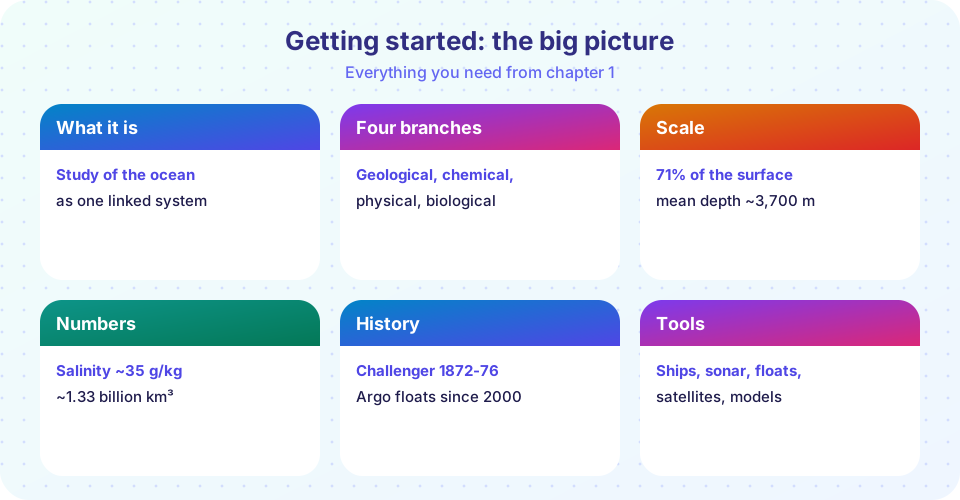
What you will learn
- Which ideas from chapter 1 you can already use, and which need another look
- How to turn the key numbers into quick estimates
- Which instruments belong to which era of exploration
Key terms
Oceanography: the study of the ocean's floor, water, motion and life.
Mean depth: about 3,700 m; the maximum is about 10,900 m.
Hydrostatic pressure: p = p₀ + ρ g h; about one atmosphere more for every 10 m of depth.
Echo sounding: depth = (speed of sound × round-trip time) / 2.
Argo: a global array of about 3,000 or more profiling floats.
Recap table
| Lesson | Big idea | Number or fact to remember |
|---|---|---|
| What Is Oceanography? | Four branches, one system | Geological, chemical, physical, biological |
| Ocean Scale and Key Numbers | Large, deep, cold, thin | 71% of surface, 1.33 billion km³, mean depth 3,700 m |
| A Short History of Ocean Exploration | Each new tool opened a new window | Challenger 1872 to 1876, Trieste 1960, vents 1977, Argo 2000 |
Three habits will help you through the rest of the course:
- Write the unit with every number.
3,700 mand3.7 kmare the same depth;3,700alone is nothing. - Estimate before you calculate. If you expect about 100 atmospheres at 1,000 m, a result of 10 or 1,000 tells you to look for a mistake.
- Ask which branch could answer the question. If you can name two, you probably understand the problem well.
Common misconceptions
"The ocean is mostly warm." Most of its volume is cold: the mean temperature is only about 3.5 °C because the warm layer is thin.
"Oceanographers mostly study animals." Biology is one of four branches, and many oceanographers never handle an organism.
"Exploration is finished." Most of the seafloor has not been mapped in detail, and the deep sea is still being explored with new instruments.
Try it
The first example is a flashcard drill. Edit the cards to practice what you most need to remember.
Press Run (or Ctrl + Enter) to see the console output here.
No output.
The second example is an echo-sounding practice sheet. It generates depths from echo times so you can check your own mental arithmetic.
Press Run (or Ctrl + Enter) to see the result here.
Program input · what you'd type while the program runs
Type the answers before you press Run, one per line. Each time the program reads a line (with input()), it gets the next line from this box.
Check your understanding
Quick check · 10 questions
of 10 answered You scored / 10 · perfect!
-
1. What fraction of Earth's surface is ocean?
The ocean covers about 71% of the surface. -
2. Which branch of oceanography studies why seawater is salty and how nutrients cycle?
Chemical oceanography studies what is dissolved in seawater and the cycling of elements. -
3. About how much does pressure increase for each 10 m of descent in seawater?
ρ g h = 1,027 × 9.81 × 10 ≈ 1 × 10⁵ Pa, about one atmosphere. -
4. Roughly how deep is the ocean on average?
Mean depth is about 3,700 m, over four times the mean height of land. -
5. Which tool did the German Meteor expedition use to reveal the Atlantic's mid-ocean mountain range?
Meteor made tens of thousands of echo soundings in 1925 to 1927. -
6. What did the 1977 Alvin dive at the Galápagos Rift discover?
Hydrothermal vents support tube worms and other animals fed by chemosynthetic bacteria. -
7. An echo returns after 2.0 s. With sound at 1,500 m/s, what is the depth?
depth = 1,500 × 2.0 / 2 = 1,500 m. -
8. Why does the Pacific matter so much for the climate of the whole planet?
Its size and heat storage give it a large influence on global weather and climate. -
9. Which statement about ocean temperature is correct?
A thin warm layer sits on top of a large, cold interior. -
10. Why is the ocean described as a thin film?
3.7 km of depth against a 6,371 km radius is a very thin layer.
Summary
- Oceanography has four branches and always treats the ocean as one system.
- Remember the key numbers: 71%, 1.33 billion km³, 3,700 m, 10,900 m, 35 g/kg, 1 atm per 10 m.
- Tools define eras: ships and lines, echo sounders, submersibles, satellites and floats.
- Next, we look at what the seafloor itself looks like and why.
Track your progress
Create a free account to tick off lessons and pick up where you left off on any device.
of Oceanography lessons completed