


















Lesson 46 of 49 · Projects and Practice
Practice Problems with Worked Answers
Fourteen oceanography problems on waves, heat budgets, evaporation, El Niño, plankton, food webs, pressure, sea level, pH, fisheries, currents and data assimilation, with step-by-step answers.
The best way to learn quantitative oceanography is to calculate. This lesson gives you fourteen problems that range over the course. Try each one on paper first, using only the formulas you have met, then compare your work with the worked answers. A code cell at the end recomputes every answer, so you can check yourself and change the numbers.
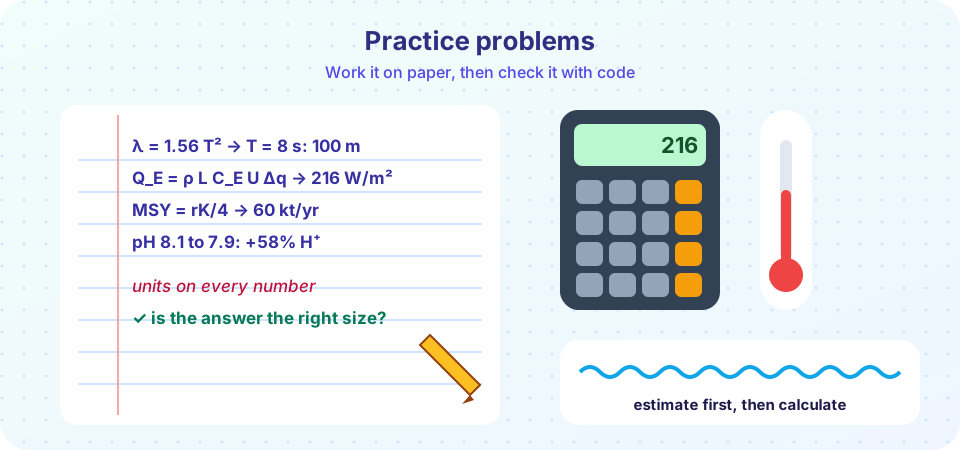
Remember the method: write the question with units, list what you know, choose the relationship, calculate with units on every number, and check whether the answer is the right size.
What you will learn
- How to apply the course formulas to new numbers
- How to keep units straight through a calculation
- How to check an answer for plausibility
- Which topics need more review
Key terms
Given and unknown: the values supplied in the problem and the value to find.
Units analysis: checking that the units of the answer match the quantity you want.
Estimate: a rough calculation to see the size of the answer before the exact one.
Constants used: g = 9.81 m/s², ρ = 1,025 kg/m³ (1,027 for pressure), c_p = 3,990 J/(kg K), L = 2.5 × 10⁶ J/kg, Ω = 7.292 × 10⁻⁵ s⁻¹.
Effective expansion coefficient: α = 1.6 × 10⁻⁴ per °C for the whole ocean.
The problems
Waves, tides and currents
- A deep-water swell has a period of 8 s. Using
λ = 1.56 T²andc = 1.56 T, find its wavelength (m) and speed (m/s). - A tsunami crosses an ocean 5,000 m deep. Find its speed (km/h) and the time to cross 8,000 km (hours).
- A geostrophic current is observed across a sea surface height difference of 0.5 m over 200 km at 45°N. Find its speed (m/s) from
u = (g/f)(Δη/Δx),f = 2Ω sin φ.
Heat, wind and air-sea interaction
- A sea surface gains 210 W/m² of sunlight and loses 55 W/m² (net longwave), 130 W/m² (latent) and 15 W/m² (sensible). Find the net flux, and the warming in 30 days of a mixed layer 100 m deep.
- Wind speed is 10 m/s and the humidity gap
q_s − q_ais 0.006. Withρ_air= 1.2 kg/m³ andC_E= 1.2 × 10⁻³, find the latent heat flux (W/m²) and the evaporation (mm/day). - A Kelvin wave travels in a layer 120 m thick with reduced gravity 0.03 m/s². Find its speed and the time to cross 14,000 km (days).
Marine life
- How much carbon (µmol/L and mg C/L) can phytoplankton build from 3 µmol/L of nitrate, using the Redfield ratio C : N = 106 : 16?
- Net primary production is 5,000,000 kg C. With a 15% transfer efficiency, how much carbon reaches level 4 (three transfers)?
- Find the pressure in atmospheres at 6,000 m depth (use
ρ= 1,027 kg/m³; 1 atm = 101,325 Pa; add the atmosphere at the surface). - Light decays as
I = I₀ e^(−kz)withk= 0.1 per meter. Find the 1% light depth and the light at 20 m (% of the surface).
Human impacts
- Melting of 540 Gt of land ice raises sea level by how many millimeters? Separately, how much does an ocean heat uptake of 0.8 W/m² (per m² of ocean) raise it in one year by thermal expansion with
α= 1.6 × 10⁻⁴? - Surface pH falls from 8.1 to 7.9. By what percentage does the hydrogen ion concentration rise?
- A stock has
r= 0.3 per year andK= 800 kt, with catchabilityq= 0.0005. Find MSY,E_MSYand the effort at which the stock collapses.
Observation and models
- A model forecasts 15.0 °C with an error of 2.0 °C and a float reports 17.0 °C with an error of 1.0 °C. Find the analysis and its error.
Worked answers
1. λ = 1.56 × 8² = 99.8 m, about 100 m; c = 1.56 × 8 = 12.5 m/s. (A check: c = λ/T = 99.8 / 8 = 12.5 m/s.)
2. c = √(9.81 × 5,000) = √49,050 = 221 m/s, which is 797 km/h. Time: 8,000,000 m / 221 m/s = 36,100 s, or 10.0 hours.
3. f = 2 × 7.292 × 10⁻⁵ × sin 45° = 1.031 × 10⁻⁴ s⁻¹. The slope is 0.5 / 200,000 = 2.5 × 10⁻⁶. So u = (9.81 / 1.031 × 10⁻⁴) × 2.5 × 10⁻⁶ = 0.24 m/s.
4. Net: 210 − 55 − 130 − 15 = +10 W/m². Warming rate: Q / (ρ c_p h) = 10 / (1,025 × 3,990 × 100) = 2.45 × 10⁻⁸ K/s, or 0.0021 K per day. Over 30 days: about 0.06 K.
5. Q_E = 1.2 × 2.5 × 10⁶ × 1.2 × 10⁻³ × 10 × 0.006 = 216 W/m². Evaporation: 216 / (1,000 × 2.5 × 10⁶) = 8.64 × 10⁻⁸ m/s, which is 7.5 mm per day.
6. c = √(0.03 × 120) = √3.6 = 1.90 m/s. Time: 14,000,000 / 1.90 = 7.4 × 10⁶ s, about 85 days.
7. Carbon: 3 × 10⁶/16 = 19.9 µmol/L. Mass: 19.9 × 12.011 = 239 µg/L, or 0.24 mg C/L. (Oxygen released: 3 × 138/16 = 25.9 µmol/L.)
8. After three transfers: 5,000,000 × 0.15³ = 5,000,000 × 0.003375 = 16,900 kg (about 17 tonnes).
9. P = 1 + ρ g h / 101,325 = 1 + (1,027 × 9.81 × 6,000) / 101,325 = 1 + 596.6 ≈ 598 atm.
10. 1% depth = ln(100)/k = 4.605 / 0.1 = 46 m. At 20 m: e^(−2) = 0.135, or 13.5% of the surface light.
11. 540 / 361 = 1.5 mm. Thermal expansion: Δh = α N t / (ρ c_p) = 1.6 × 10⁻⁴ × 0.8 × 3.156 × 10⁷ / (1,025 × 3,990) = 9.9 × 10⁻⁴ m, about 1.0 mm per year.
12. 10^(8.1 − 7.9) = 10^0.2 = 1.585: the hydrogen ion concentration rises by about 58%.
13. MSY = rK/4 = 0.3 × 800 / 4 = 60 kt/yr. E_MSY = r/(2q) = 0.3 / 0.001 = 300. Collapse at E = r/q = 600.
14. Weights 1/4 = 0.25 and 1/1 = 1. Analysis: (15 × 0.25 + 17 × 1) / 1.25 = 16.6 °C. Error: √(1/1.25) = 0.89 °C.
Try it
The first example recomputes all the answers. Change an input and rerun it to explore.
Press Run (or Ctrl + Enter) to see the console output here.
No output.
The second example explores problem 4 further: what a seasonal cycle of heating does to the temperature of the mixed layer. It integrates dT/dt = Q(t) / (ρ c_p h) for a heating that varies sinusoidally with an amplitude of 120 W/m². This is a one-box teaching model with no mixing from below and no horizontal transport.
Press Run (or Ctrl + Enter) to see the result here.
Program input · what you'd type while the program runs
Type the answers before you press Run, one per line. Each time the program reads a line (with input()), it gets the next line from this box.
Check your understanding
Quick check · 5 questions
of 5 answered You scored / 5 · perfect!
-
1. A 12 s deep-water wave has what speed?
c = 1.56 × 12 = 18.7 m/s. -
2. Doubling the mixed layer depth (same heating) does what to the temperature amplitude?
ΔT is proportional to 1/h in the one-box model. -
3. How many millimeters of sea level do 722 Gt of melted ice make?
722 / 361 = 2 mm. -
4. A drop of 0.2 in pH raises [H⁺] by a factor of...
10^0.2 ≈ 1.585. -
5. Which problem type needs the Coriolis parameter?
u = (g/f)(Δη/Δx) uses f = 2Ω sin φ.
Summary
- A systematic method (given, unknown, relationship, units, check) works across waves, heat, ecology, impacts and models.
- Working a problem twice, by estimate and by calculation, catches most errors.
- In a one-box mixed-layer model the seasonal temperature range is inversely proportional to the layer depth and lags the heating by a quarter year.
- If a problem was difficult, return to the lesson that introduced its formula.
Next: Glossary
Track your progress
Create a free account to tick off lessons and pick up where you left off on any device.
of Oceanography lessons completed