


















Lesson 29 of 49 · Marine Life and Ecosystems
Chapter 6 Overview: Marine Life and Ecosystems
Overview of life in the ocean: depth zones, plankton, nekton and benthos, light and nutrients, food webs, coasts, reefs and the deep sea, with lesson links.
The ocean is the largest living space on Earth. Because life can use the water from the surface down to the seafloor, and not only a thin skin of land, the sea contains most of the planet's habitable volume. It holds creatures from bacteria a thousandth of a millimeter long to the blue whale, the largest animal that has ever lived. Life very likely began here, at least 3.5 billion years ago, and it is still here that about half of the world's photosynthesis takes place.
Everything in the previous chapters now matters for biology. Light fades with depth (chapter 3). Currents and upwelling (chapters 4 and 5) deliver nutrients. Temperature, salinity, oxygen and pressure set the limits of where each species can live. This chapter shows how those physical conditions become ecosystems.
What you will learn
- The depth zones of the ocean and how light, temperature and pressure change through them
- The three ways of making a living in the sea: plankton, nekton and benthos
- Why most marine life is concentrated near the surface and the coast
- How the lessons in this chapter fit together
Key terms
Plankton: organisms that drift with the water: phytoplankton (plant-like) and zooplankton (animal-like).
Nekton: animals that swim strongly against currents, such as fish, squid and whales.
Benthos: organisms that live on or in the seafloor.
Photic (euphotic) zone: the sunlit upper layer, about the top 200 m, where photosynthesis can happen.
Primary production: the creation of organic matter from carbon dioxide and light (or chemical energy).
Zones of the sea
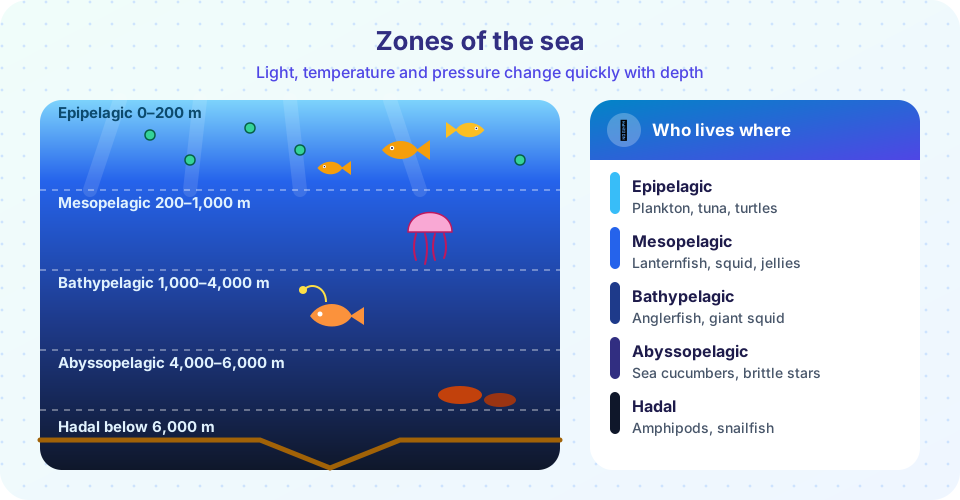
Marine biologists divide the water column by depth. The boundaries are approximate and depend on the clarity of the water, but they are useful:
| Zone | Depth | Conditions |
|---|---|---|
| Epipelagic (sunlit) | 0 to 200 m | Enough light for photosynthesis; warm; most marine life |
| Mesopelagic (twilight) | 200 to 1,000 m | Dim blue light, no photosynthesis; temperature drops fast |
| Bathypelagic (midnight) | 1,000 to 4,000 m | Dark except for bioluminescence; near 4 °C; high pressure |
| Abyssopelagic | 4,000 to 6,000 m | Cold, dark, still; pressure above 400 atmospheres |
| Hadal | below 6,000 m | Trenches; pressure up to about 1,100 atmospheres |
The same sea can also be split sideways: the intertidal shore between the tides, the shallow neritic shelf waters, and the oceanic waters beyond the continental shelf. Plankton and nekton live in the water (the pelagic realm) and benthos on the bottom (the benthic realm).
Three ways of making a living
- Drifters (plankton). Most plankton are tiny. Phytoplankton such as diatoms and cyanobacteria use light to make food and sit at the base of nearly all marine food webs. Zooplankton graze on them. Some animals, such as jellyfish, are large but still drift.
- Swimmers (nekton). Fish, squid, turtles, seals and whales. Their speed and range let them hunt for food across whole ocean basins.
- Bottom dwellers (benthos). Corals, sponges, clams, crabs, worms and seaweeds. Many have drifting larvae that travel far before settling.
Where life is abundant
Life in the sea is not spread evenly. It clusters where two things meet: light at the top and nutrients from below. Because the sunlit layer is thin and the nutrient-rich water lies deep, most of the open ocean is a biological desert, with large subtropical gyres that resemble deserts on the satellite maps. Life is rich where mixing or upwelling brings nutrients to the light: along continental shelves, in coastal upwelling zones like Peru and California, near river mouths, and in cold polar waters in summer.
The chapter map
Light and nutrients
Plankton
Food webs
Habitats
What each lesson covers
| Lesson | Question it answers |
|---|---|
| Plankton and Primary Production | Who makes the food, and what limits them? |
| Food Webs and Energy Flow | How does energy pass from plankton to whales, and where does it go? |
| Coasts, Reefs and the Deep Sea | What lives in the most distinctive marine habitats? |
| Chapter 6 Review | Formulas, numbers and a ten-question quiz. |
Common misconceptions
"The deep sea is empty." It is sparse, but huge in volume. Many animals live and migrate through the midwater and on the bottom.
"Trees make most of our oxygen." Land plants and ocean phytoplankton each account for roughly half of the planet's photosynthesis. (Much of the oxygen produced is used again by respiration, so the net supply is a small difference.)
"All the ocean is rich in life." Large parts of the subtropical oceans are nutrient-poor and relatively unproductive.
Try it
The first example shows how quickly light vanishes with depth. It uses the exponential law I = I₀ e^(−k z) with a diffuse attenuation coefficient k of 0.04 per meter, typical of clear open-ocean water, and compares it with murkier coastal water.
Press Run (or Ctrl + Enter) to see the console output here.
No output.
The second example plots three illustrative profiles against depth: light, temperature and pressure. The light is the exponential law above, the temperature is a typical tropical profile (a rounded curve, not a measurement) and the pressure follows from the weight of the water.
Press Run (or Ctrl + Enter) to see the result here.
Program input · what you'd type while the program runs
Type the answers before you press Run, one per line. Each time the program reads a line (with input()), it gets the next line from this box.
Check your understanding
Quick check · 4 questions
of 4 answered You scored / 4 · perfect!
-
1. What are plankton?
Plankton drift; nekton swim strongly; benthos live on the bottom. -
2. Roughly how deep is the sunlit (photic) zone in clear ocean water?
Light is strong enough for photosynthesis down to about 200 m in clear water. -
3. Where is marine life most abundant?
Light from above plus nutrients from below give the highest production, as in upwelling zones and shelves. -
4. The hadal zone refers to...
Hadal depths are named after Hades and describe the trenches.
Summary
- The ocean is divided by depth into sunlit, twilight, midnight, abyssal and hadal zones.
- Organisms are plankton (drift), nekton (swim) or benthos (live on the bottom).
- Life is concentrated where light from above and nutrients from below meet.
- The next lessons follow energy from the phytoplankton up to whales and then tour the main habitats.
Track your progress
Create a free account to tick off lessons and pick up where you left off on any device.
of Oceanography lessons completed