


















Lesson 1 of 49 · Getting Started
Course Map: How This Oceanography Course Works
Meet the oceanography course: who it is for, what you need to know first, the nine chapters at a glance and a simple plan for studying the sea.
The ocean covers about 71% of Earth's surface, holds roughly 97% of its water, soaks up most of the extra heat trapped by greenhouse gases and feeds hundreds of millions of people. Yet people have seen only a tiny part of it up close. Oceanography is the science that closes that gap: it uses ships, robots, satellites, chemistry and computer models to work out how the sea is built, how it moves and what lives in it.
This course takes you from the first question ("what is oceanography?") to a working understanding of the whole system. You do not need to be a scientist to start. If you can read a graph and follow a short calculation, you have what you need.
What you will learn
- Who this course is for and what to know before you start
- How the nine chapters fit together into one story
- How to study with the lesson pattern used in every chapter
- How the interactive examples work, and what they are (and are not)
Key terms
Oceanography: the scientific study of the oceans, including their floors, water, motion and life.
System: a set of parts that influence one another; the ocean, atmosphere, land and ice form one system.
Model: a simplified description (an equation or a program) used to explain or predict something.
Observation: a measurement of the real world, such as a temperature reading or a depth sounding.
Who this course is for
The course is written for learners of about 11 to 18 and for adults who want a clear refresher. It follows the common ground of the international school syllabi: Cambridge IGCSE and A Level earth and environmental science, the IB Diploma's environmental systems, and US AP Environmental Science and introductory college oceanography. It uses SI units (meters, kilograms, seconds, degrees Celsius) throughout, and mentions other units only when you are likely to meet them.
You do not need any oceanography. You should be comfortable with:
- reading a line graph or a bar chart,
- multiplying, dividing and using percentages,
- basic ideas about density and temperature from school science.
Anything beyond that is explained the first time it appears. Chapters that use equations always show the numbers worked out by hand before any code appears.
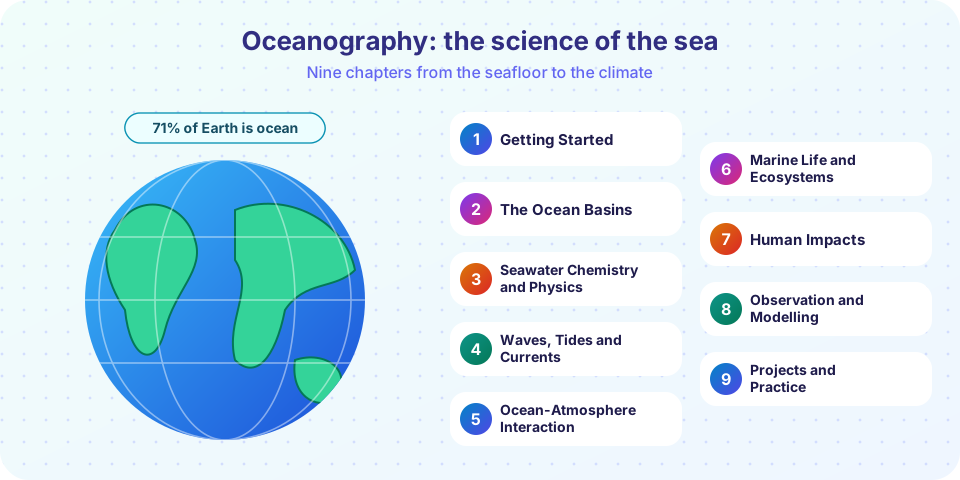
The nine chapters
The story starts with the planet's biggest feature and moves outward, step by step, until it reaches people.
Part 1: the container
Part 2: the water
Part 3: the system
Part 4: people
Here is the same plan as a list, with the question each chapter answers.
| Chapter | Title | Big question |
|---|---|---|
| 1 | Getting Started | What is the ocean, how big is it and how did we learn about it? |
| 2 | The Ocean Basins | What does the seafloor look like and why? |
| 3 | Seawater Chemistry and Physics | What is in seawater and how do its properties change with depth? |
| 4 | Waves, Tides and Currents | Why does the sea move, and in what patterns? |
| 5 | Ocean-Atmosphere Interaction | How do sea and air shape weather and climate? |
| 6 | Marine Life and Ecosystems | Who lives in the sea and how are they connected? |
| 7 | Human Impacts | How are we changing the ocean? |
| 8 | Observation and Modelling | How do we know what we know? |
| 9 | Projects and Practice | Can I use all this myself? |
The first four chapters (this half of the course) build the foundations: the planet, the seafloor, the water itself and its motion. The later chapters use those foundations to explain climate, life and human effects.
How each lesson works
Every content lesson has the same shape, so you always know where you are:
- What you will learn: three to five outcomes.
- Key terms: the vocabulary of the lesson in one box.
- The lesson itself: explanation, worked numbers and a picture.
- Common misconceptions: wrong ideas that many learners (and some adults) hold, with the correction.
- Try it: runnable examples you can change.
- Check your understanding: a short quiz with an explanation for every answer.
- Summary: the lesson in a few bullets.
Chapter overviews give the big picture, and chapter reviews finish each chapter with a one-page picture, a recap table and a longer quiz that mixes all its lessons.
Common misconceptions
"The ocean is just a big bathtub." The ocean is layered, moving and chemically active. Its top 100 meters can be warm and sunlit while the water below 1,000 meters is near freezing and dark.
"We have mapped the seafloor." Ships and satellites have given us a global picture at coarse resolution, but detailed sonar maps cover only a fraction of the seafloor. We have better maps of the Moon's surface than of much of the deep sea floor at fine scale.
"Oceanography is only biology." Marine biology is one branch. Most of the ocean's behavior comes from physics, chemistry and geology.
Try it
The first example uses real numbers you will meet again in chapter 1: the area share of ocean and land, and the average depth compared with the average height of land. Change the numbers and watch the picture update.
Press Run (or Ctrl + Enter) to see the result here.
Program input · what you'd type while the program runs
Type the answers before you press Run, one per line. Each time the program reads a line (with input()), it gets the next line from this box.
The second example is a small planner. It divides your weeks between the nine chapters, giving the longer chapters more time.
Press Run (or Ctrl + Enter) to see the console output here.
No output.
These are demonstrations of calculations, not real measurements. Later chapters label every simulation the same way, and describe laboratory and field work without presenting it as results you measured yourself.
Check your understanding
Quick check · 4 questions
of 4 answered You scored / 4 · perfect!
-
1. About what percentage of Earth's surface is covered by ocean?
The ocean covers about 71% of the surface and land about 29%. -
2. Which unit system does this course use?
The course uses SI units throughout and mentions other units only when you are likely to meet them. -
3. Why is oceanography described as more than marine biology?
Marine biology is one branch; the ocean's structure, chemistry and motion come from geology, chemistry and physics. -
4. What does the 'Try it' section give you?
Try it examples are labelled demonstrations: calculators, simulations and plots you can edit.
Summary
- Oceanography studies the ocean's floor, water, motion and life as one connected system.
- The course has nine chapters that move from the container (basins) to the water, its motion, its link with the air, its life and its human story.
- Every content lesson follows the same seven-part pattern.
- Examples are demonstrations; lab and field work is described, never invented as results.
Next: What Is Oceanography?
Track your progress
Create a free account to tick off lessons and pick up where you left off on any device.
of Oceanography lessons completed