


















Lesson 25 of 49 · Ocean-Atmosphere Interaction
Heat, Winds and Air-Sea Exchange
Learn the sea surface heat budget, how evaporation cools the ocean, why Earth has trade winds and westerlies, and how the Hadley cell and ITCZ move heat poleward.
Stand on a tropical beach at noon and you can feel the heat arriving: sunlight at about 1,000 watts per square meter hits the sand and the sea. But the sea does not simply heat up without limit. It also loses energy, as infrared radiation, as evaporating water and as warmth passed to the air. The difference between what comes in and what goes out is the surface heat budget, and it decides whether any patch of ocean warms, cools or stays put.
This lesson follows the energy. You will add up the gains and losses at the sea surface, see why evaporation is the largest loss, learn how the atmosphere organizes itself into wind belts, and find out how ocean and air together carry heat from the tropics toward the poles.
What you will learn
- The four terms of the surface heat budget and typical sizes in W/m²
- How to estimate evaporation and sensible heat loss with bulk formulas
- Why the atmosphere has trade winds, westerlies and polar easterlies
- How the ocean and atmosphere share the poleward transport of heat
Key terms
Heat flux: energy per second crossing one square meter, in watts per square meter (W/m²).
Latent heat flux: heat carried away by evaporating water. Evaporating 1 kg of water takes about 2.5 × 10⁶ J.
Sensible heat flux: heat conducted and mixed between sea and air because their temperatures differ.
Hadley cell: the overturning loop of air between the equator and about 30° latitude.
ITCZ (Intertropical Convergence Zone): the belt near the equator where trade winds meet and air rises, bringing heavy rain.
The surface heat budget
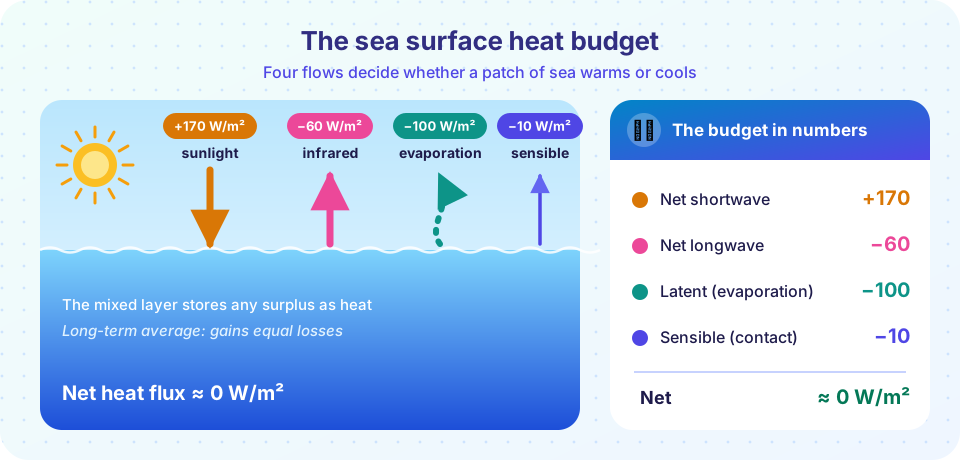
Think of the ocean's top layer as a bank account. Four flows deposit or withdraw energy:
| Term | Symbol | Direction | Typical tropical value |
|---|---|---|---|
| Net shortwave (sunlight absorbed) | Q_SW |
into the ocean | +170 W/m² |
| Net longwave (infrared up minus down) | Q_LW |
out of the ocean | −60 W/m² |
| Latent heat (evaporation) | Q_E |
out of the ocean | −100 W/m² |
| Sensible heat (conduction and mixing) | Q_H |
out of the ocean | −10 W/m² |
The net heat flux is Q_net = Q_SW + Q_LW + Q_E + Q_H. With the round numbers above it comes to about 0, which is what you expect for a long-term average: an ocean region that gained heat forever would boil. In real life the budget swings by hundreds of W/m² between day and night, and by tens of W/m² between summer and winter. Averaged over the whole ocean and over many years, the net flux is only a fraction of one W/m², and the sign of that small number is what the climate story is about (see chapter 7).
Sunlight. The Sun delivers about 1,361 W/m² to a surface facing it at the top of the atmosphere. Because Earth is a sphere that is lit only on one side, the average over the whole planet is a quarter of that, 340 W/m². About 30% is reflected, so Earth absorbs about 240 W/m². The ocean is dark: when the Sun is high, only about 6% of the light is reflected from calm sea (the albedo is higher when the Sun is low, which is why the polar seas absorb little).
Infrared. The sea is warm, so it glows in the infrared. The water radiates about σT⁴, which is about 450 W/m² at 26 °C (σ = 5.67 × 10⁻⁸ W/m²/K⁴, T in kelvin). But the humid air and clouds above radiate heat back down, so the net loss is only 50 to 70 W/m².
Evaporation: the biggest loss
Water molecules at the surface escape into the air, and each one carries off energy. Evaporating one kilogram of water costs the sea about 2.5 million joules, the latent heat of vaporization L. The sea does not feel it as a drop in temperature right away; it feels it as a heat flux. Scientists estimate it with a bulk formula:
Q_E = ρ_air · L · C_E · U · (q_s − q_a)
Here ρ_air is the air's density (about 1.2 kg/m³), C_E is a dimensionless exchange coefficient (about 1.2 × 10⁻³ over open water), U is the wind speed in m/s, q_s is the saturation specific humidity at the sea temperature (kg of vapor per kg of air) and q_a is the actual specific humidity of the air above the surface. The difference q_s − q_a is how "thirsty" the air is.
The key lesson is in the product: evaporation increases with wind speed and with dryness of the air. Strong winds sweep away humid air and bring dry air to the surface. That is why the trade-wind belts, with steady breezes and dry sinking air, have some of the strongest evaporation on Earth.
Sensible heat has a similar form, Q_H = ρ_air · c_p · C_H · U · (T_sea − T_air), but it is usually smaller over the sea because the air is only a degree or so cooler than the water.
Worked example
Take a trade-wind sea at 26 °C with a wind of 8 m/s. The saturation specific humidity of the sea (corrected by about 2% for salt) is 0.0205, and the air's specific humidity is 0.0150. Then:
Q_E = 1.2 × (2.5 × 10⁶) × (1.2 × 10⁻³) × 8 × (0.0205 − 0.0150) ≈ 158 W/m²
To turn that into evaporation depth, divide by the water density and latent heat: 158 / (1000 × 2.5 × 10⁶) = 6.3 × 10⁻⁸ m/s, or about 5.5 mm per day. Over a year this is 2 meters of water, which matches the high evaporation in the subtropics.
Why the winds blow where they do
Evaporation and heating are not uniform: the equator gets much more sunlight than the poles. The atmosphere responds with a set of circulation cells, and the ocean's currents (chapter 4) follow the winds those cells produce.
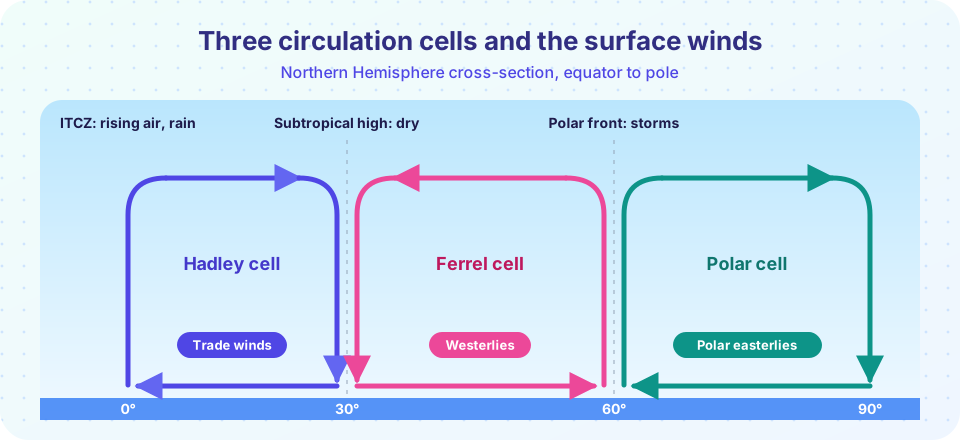
Start at the equator. Intense sunshine and evaporation produce warm, moist, light air that rises in towering clouds, releasing the latent heat as it condenses to rain. At altitude the air spreads poleward. Near 30° it cools, sinks and warms again as it is compressed, forming a belt of dry air and high pressure, the subtropical highs. The surface air then flows back toward the equator, completing the Hadley cell (described by George Hadley in 1735).
Because Earth rotates, the Coriolis effect (chapter 4) bends the returning flow to the west: northeast in the north, southeast in the south. These are the trade winds, named for the sailing ships that used them for trade. Where the trades from the two hemispheres meet, air converges and rises: the ITCZ, a belt of cloud and rain that shifts a few hundred kilometers north in the northern summer and south in the southern summer. Old sailors called the light winds there the doldrums.
In midlatitudes, between about 30° and 60°, surface winds blow from the west: the westerlies, which carry weather from the Atlantic to Europe. Near the poles the polar easterlies flow from the east. The three circulation cells (Hadley, Ferrel and polar) are a convenient simplification, and in the real atmosphere storms and jet streams do much of the work, but the surface wind belts they predict are real and steady enough that you can see them in the average pattern of ocean currents. The subtropical high-pressure belts are also where most of the world's deserts lie, because the sinking air is dry.
Heat moves poleward
The tropics absorb more heat than they radiate away, and the poles radiate more than they absorb. For the planet to stay in balance, something must carry energy poleward: about 5 to 6 petawatts (1 PW = 10¹⁵ W) at the peak, which is several hundred times human energy use. The atmosphere and ocean share the job. In the deep tropics the ocean's transport is larger, thanks to wind-driven gyres and the overturning circulation. At midlatitudes the atmosphere, with its storms, carries most. The ocean's peak transport is about 2 PW near 15° to 20° latitude.
This is also why warm western boundary currents like the Gulf Stream matter: they bring tropical heat to latitudes where the heat then escapes into the cold air, a main reason northwest Europe is milder than places at the same latitude in Canada.
Common misconceptions
"The sea warms the air because it is hot." The ocean's main route for heating the atmosphere is evaporation. The air gains heat when the vapor condenses into cloud, often far from where the water evaporated.
"Trade winds blow from the east because Earth rotates eastward." The rotation bends air that is moving toward the equator to the west. The wind exists because of the Hadley cell; rotation only sets its direction.
"The ocean's heat budget is zero at every place and time." It is close to zero only on average. A particular region can gain or lose hundreds of W/m² for months.
Try it
The first example is a surface heat budget calculator. Change the numbers to see how a cloudy day or a windy, dry day changes the balance. The values are round illustrative numbers, not a measured data set.
Press Run (or Ctrl + Enter) to see the console output here.
No output.
The second example plots latent heat flux against wind speed for three levels of air dryness. The straight lines show the bulk formula: the flux rises in proportion to wind speed, and a larger humidity gap steepens the line.
Press Run (or Ctrl + Enter) to see the result here.
Program input · what you'd type while the program runs
Type the answers before you press Run, one per line. Each time the program reads a line (with input()), it gets the next line from this box.
Check your understanding
Quick check · 5 questions
of 5 answered You scored / 5 · perfect!
-
1. Which surface heat budget term is usually the largest loss of heat from the tropical ocean?
Evaporation removes about 100 W/m² from a typical tropical sea, more than net infrared or sensible heat. -
2. A trade-wind sea has wind 8 m/s and a humidity gap of 0.0055. If the wind doubles to 16 m/s and the gap stays the same, the latent heat flux...
The bulk formula is proportional to wind speed, so doubling the wind doubles the flux. -
3. Why are the trade winds easterly?
Air returning toward the equator in the Hadley cell is deflected by the Coriolis effect, giving northeasterly and southeasterly winds. -
4. Where is the ITCZ?
The ITCZ is the rising, cloudy belt where the trades from both hemispheres meet. -
5. About how much seawater has the same heat capacity as the whole atmosphere?
A 10,000 kg column of air with cp about 1,005 J/(kg K) matches roughly 2.5 m of seawater.
Summary
- The surface heat budget is
Q_net = Q_SW + Q_LW + Q_E + Q_H; evaporation is the largest loss in the tropics. - Bulk formulas show that latent and sensible heat loss grow with wind speed and with the air's dryness or coolness.
- Rising air at the equator, sinking air near 30° and Earth's rotation set the trade winds, westerlies and ITCZ.
- Ocean and atmosphere together carry about 5 to 6 PW of heat poleward.
Track your progress
Create a free account to tick off lessons and pick up where you left off on any device.
of Oceanography lessons completed