


















Lesson 18 of 49 · Waves, Tides and Currents
Chapter 4 Overview: Waves, Tides and Currents
Overview of ocean motion from seconds to centuries: wind waves, tsunamis, tides, surface gyres and deep circulation, with drivers, time scales and lesson links.
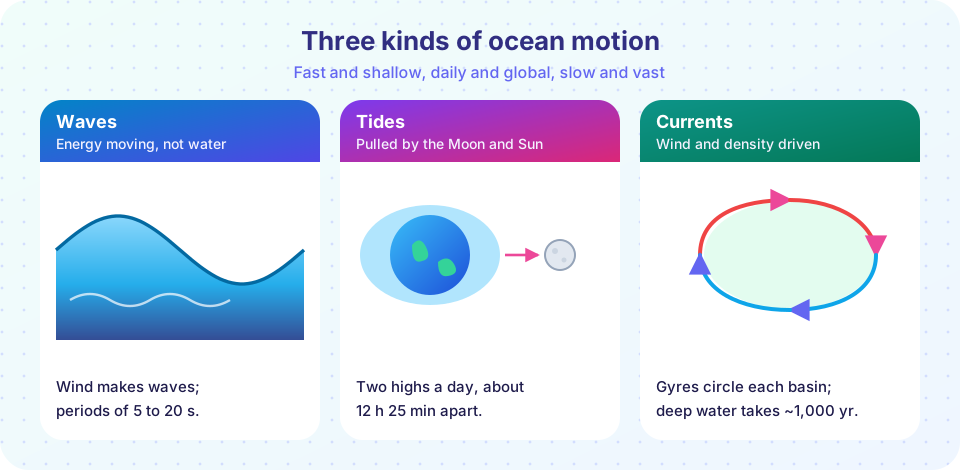
If you stand on a beach, the ocean seems to be doing several things at once. Waves arrive every few seconds. The water level rises and falls over about six hours. Further out, invisible to you, great currents carry water around entire ocean basins. These motions look unrelated, but they follow a small set of rules: something pushes on the water (wind, gravity from the Moon and Sun, or differences in density), and the water responds, shaped by Earth's rotation and by the coasts and seafloor it meets.
This chapter takes those motions in turn, from the fastest (waves) to the slowest (the deep circulation that takes a thousand years to complete a loop). First, this overview gives you the map.
What you will learn
- The main kinds of ocean motion and their time scales
- What drives each motion: wind, gravity or density
- Why Earth's rotation (the Coriolis effect) matters
- How the lessons in this chapter fit together
Key terms
Wave: a disturbance that moves energy across the water surface without moving the water far.
Tide: the rise and fall of sea level caused mostly by the Moon's and Sun's gravity.
Current: a steady flow of water over a long distance.
Gyre: a huge circular system of surface currents around an ocean basin.
Coriolis effect: the apparent deflection of moving things, caused by Earth's rotation, to the right in the Northern Hemisphere and to the left in the Southern Hemisphere.
A spectrum of motions
Ocean motions come in a wide range of time scales. A useful way to see them is as a spectrum from seconds to centuries:
| Motion | Typical period or time scale | Main driver |
|---|---|---|
| Wind waves and swell | 1 to 30 seconds (typically 5 to 20) | Wind |
| Tsunamis | 10 to 60 minutes | Earthquakes, landslides, eruptions |
| Tides | About 12 h 25 min or 24 h 50 min | Gravity of Moon and Sun |
| Mesoscale eddies | Weeks to months | Instability of currents |
| Surface gyres | Years to decades to circulate | Wind and Earth's rotation |
| El Niño | 2 to 7 years between events | Ocean-atmosphere coupling |
| Deep circulation | Roughly 500 to 2,000 years for a loop | Density (temperature and salinity) |
Notice how the periods spread over about ten orders of magnitude. Different physics dominates at each end. Short waves are controlled by gravity and the water's surface. Long, slow motions are controlled by Earth's rotation and the density structure you studied in chapter 3.
Three drivers and one steering wheel
- Wind. It stirs the surface, making waves and, over long distances, driving the gyres.
- Gravity from the Moon and Sun. It makes tides, and it has a tiny but regular effect on the whole ocean.
- Density differences. Cold, salty water sinks; warm, fresh water floats. Sinking in one place and rising in another drives the deep circulation.
The "steering wheel" is Earth's rotation. Because the planet spins, moving water is deflected: to the right of its motion in the Northern Hemisphere, to the left in the Southern. This effect is tiny for a wave crossing a bay but dominates the ocean's large-scale flows, setting the clockwise and counter-clockwise spin of the gyres.
Waves: seconds
Tides: hours
Currents: years
Deep flow: centuries
What each lesson covers
- Ocean Waves: wave anatomy, speed, orbital motion, shoaling and breaking, and tsunamis.
- Tides: why there are two bulges, spring and neap tides and coastal tidal ranges.
- Surface Currents and Gyres: wind stress, Coriolis, Ekman transport and boundary currents.
- Deep Ocean Circulation: how sinking and upwelling form the overturning circulation.
- Chapter 4 Review: the chapter in one picture and a mixed quiz.
Common misconceptions
"A wave carries water across the ocean." Water particles move in small circles; the wave form and its energy travel. A floating bottle just bobs.
"Tides are caused by the Moon only." The Sun also contributes, about 46% as strongly as the Moon, which is why tides vary over the month.
"Currents flow in straight lines from warm to cold regions." Earth's rotation and the coastlines bend them into great circles.
"Water goes down the drain in opposite directions in each hemisphere." The Coriolis effect is far too weak at sink scale; it matters for ocean-scale motions.
Try it
The first example shows the whole spectrum of ocean motion on a single logarithmic time axis. The ranges are rounded typical values.
Press Run (or Ctrl + Enter) to see the result here.
Program input · what you'd type while the program runs
Type the answers before you press Run, one per line. Each time the program reads a line (with input()), it gets the next line from this box.
The second example is a quick classifier. Enter a period and it suggests which kind of motion you are looking at. It is a rule of thumb for learning, not a research tool.
Press Run (or Ctrl + Enter) to see the console output here.
No output.
Check your understanding
Quick check · 4 questions
of 4 answered You scored / 4 · perfect!
-
1. Which of these is driven mainly by differences in density?
Cold, salty water sinks and warm, fresh water floats, which drives the deep circulation. -
2. What is the Coriolis effect?
Earth's rotation deflects moving things right in the Northern Hemisphere and left in the Southern. -
3. Roughly how long is the period of typical wind waves?
Wind waves usually have periods of a few to about 20 seconds. -
4. What moves across the ocean in a wave?
Water particles move in small circles; the wave pattern and its energy travel.
Summary
- Ocean motions run from seconds (waves) through hours (tides) and years (gyres) to centuries (deep circulation).
- Wind, the gravity of the Moon and Sun, and density differences drive them.
- Earth's rotation steers large-scale flow, producing clockwise gyres in the north and counter-clockwise gyres in the south.
- The next lessons take these motions one at a time, starting with waves.
Next: Ocean Waves
Track your progress
Create a free account to tick off lessons and pick up where you left off on any device.
of Oceanography lessons completed