


















Lesson 47 of 49 · Projects and Practice
Glossary
A glossary of about fifty oceanography terms from seafloor and seawater to currents, plankton, dead zones, Argo and data assimilation, each with a short definition and a link to the lesson.
Every science has its own vocabulary. Oceanography borrows words from physics, chemistry, geology, biology and meteorology, and adds some of its own. This glossary gathers the terms from the whole course, with a short definition and a link to the lesson where you can read more. Use it for review, and use the flashcards below it to test yourself.
What you will learn
- The meaning of the main terms in each chapter
- Where each term is taught in the course
- How terms link across chapters: for example, thermocline, stratification and nutrient limitation
- How to test yourself with flashcards
Key terms
Glossary: a list of specialist words with their meanings.
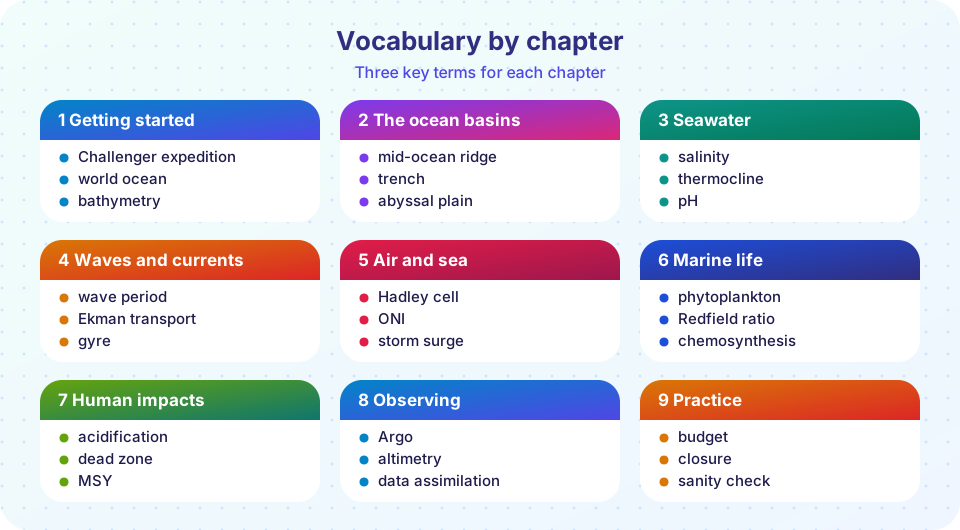
Concept map: a diagram linking ideas; the picture above is a simple one.
Active recall: testing yourself from memory, which works better for learning than rereading.
Spaced review: coming back to material at growing intervals.
Cross-reference: a pointer from one entry to another related one.
Terms
| Term | Meaning | Learn more |
|---|---|---|
| Abyssal plain | The flat, deep seafloor, mostly 3,000 to 6,000 m, covered by fine sediment | Seafloor Sediments |
| Acidification | The fall in sea water pH caused by absorbing carbon dioxide | Warming, Sea Level and Acidification |
| Albedo | The fraction of sunlight a surface reflects | Heat, Winds and Air-Sea Exchange |
| Altimetry | Measuring the height of the sea surface from space with radar | Ships, Floats and Satellites |
| Argo | A global array of about 4,000 profiling floats that measure the upper 2,000 m | Ships, Floats and Satellites |
| Biological pump | The transfer of carbon from the surface to the deep ocean by sinking organic particles | Food Webs and Energy Flow |
| Biomagnification | The increase in the concentration of a pollutant at each step up a food chain | Pollution, Plastics and Dead Zones |
| Bleaching | The loss of algae from coral tissue under heat stress | Coasts, Reefs and the Deep Sea |
| Carrying capacity | The largest population an environment can support | Fisheries and Overfishing |
| CFL condition | The rule that a wave must not cross more than one grid cell per time step in a model | Models and Data |
| Chemosynthesis | Making organic matter from chemical energy instead of light | Coasts, Reefs and the Deep Sea |
| Coriolis effect | The apparent deflection of moving things caused by Earth's rotation | Surface Currents and Gyres |
| CTD | An instrument that measures conductivity, temperature and depth | Ships, Floats and Satellites |
| Data assimilation | Blending observations with a model to obtain the best estimate | Models and Data |
| Dead zone | A coastal area with oxygen so low that most animals cannot live there | Pollution, Plastics and Dead Zones |
| Ekman transport | The net movement of surface water at 90° to the wind | Surface Currents and Gyres |
| El Niño | A warm phase of the tropical Pacific with weak trade winds | El Niño and the Southern Oscillation |
| Euphotic zone | The sunlit upper layer, to about 200 m, where photosynthesis is possible | Chapter 6 Overview |
| Eutrophication | Enrichment of water with nutrients that causes excess algal growth | Pollution, Plastics and Dead Zones |
| Geostrophic current | A current in balance between the pressure gradient and the Coriolis force | Ships, Floats and Satellites |
| Gyre | A large circular system of surface currents around an ocean basin | Surface Currents and Gyres |
| Hadley cell | The overturning loop of air between the equator and about 30° latitude | Heat, Winds and Air-Sea Exchange |
| HNLC region | An area with high nutrients but low chlorophyll, usually limited by iron | Plankton and Primary Production |
| Hydrothermal vent | A seafloor spring of hot, mineral-rich water | Coasts, Reefs and the Deep Sea |
| ITCZ | The rainy belt near the equator where the trade winds converge | Heat, Winds and Air-Sea Exchange |
| Kelvin wave | A wave trapped along the equator that carries thermocline changes eastward | El Niño and the Southern Oscillation |
| Latent heat | Heat absorbed when water evaporates and released when it condenses | Heat, Winds and Air-Sea Exchange |
| Marine heatwave | A period of at least five days with sea temperature above the local 90th percentile | Warming, Sea Level and Acidification |
| Maximum sustainable yield | The largest average catch that can be taken from a stock indefinitely | Fisheries and Overfishing |
| Microplastic | A plastic particle smaller than 5 mm | Pollution, Plastics and Dead Zones |
| Mid-ocean ridge | An underwater mountain chain where new seafloor forms | Seafloor Spreading and Plate Tectonics |
| Monsoon | A seasonal reversal of the prevailing wind, with wet and dry seasons | Hurricanes and Monsoons |
| Nekton | Animals that swim strongly against currents | Chapter 6 Overview |
| ONI | The Oceanic Niño Index: the 3-month Niño 3.4 temperature anomaly that defines ENSO events | El Niño and the Southern Oscillation |
| Overturning circulation | The density-driven global loop of deep and surface water | Deep Ocean Circulation |
| Parameterization | A simple rule that represents the effect of processes too small for a model grid | Models and Data |
| pH | A logarithmic measure of acidity, −log₁₀[H⁺] |
Gases, pH and the Carbon Cycle |
| Phytoplankton | Microscopic drifting organisms that photosynthesize | Plankton and Primary Production |
| Pycnocline / thermocline | A layer where density, or temperature, changes rapidly with depth | Temperature, Density and Ocean Layers |
| Redfield ratio | The typical atomic ratio C : N : P = 106 : 16 : 1 in plankton | Plankton and Primary Production |
| Saffir-Simpson scale | The five-category scale of hurricane winds | Hurricanes and Monsoons |
| Salinity | The amount of dissolved salts in sea water, about 35 g per kg on average | The Water Molecule and Salinity |
| Spring and neap tides | Larger tides at new and full Moon; smaller ones at the quarter Moons | Tides |
| Storm surge | The rise of sea level above the normal tide caused by a storm | Hurricanes and Monsoons |
| Trench | A deep, narrow trough where one plate sinks beneath another | Continental Margins and Trenches |
| Trophic level | A feeding position in a food chain | Food Webs and Energy Flow |
| Tsunami | A long ocean wave caused by an underwater earthquake, landslide or eruption | Ocean Waves |
| Upwelling | The rise of deep, cold, nutrient-rich water to the surface | Surface Currents and Gyres |
| Walker circulation | The east-west loop of air over the equatorial Pacific | El Niño and the Southern Oscillation |
Connecting the terms
Words in a glossary are easy to memorize and hard to use. The real test is whether you can link them in a short explanation. Here is one chain that touches several chapters: the Coriolis effect turns the wind-driven Ekman transport sideways, which creates upwelling along some coasts; upwelling brings nutrients through the thermocline to the euphotic zone, which feeds phytoplankton; their energy passes through trophic levels to fish, and part of the carbon leaves the surface by the biological pump. Try writing a similar chain starting from El Niño or from dead zone.
Common misconceptions
"Terms that sound alike mean the same." Thermocline (temperature), halocline (salinity) and pycnocline (density) are different layers, although they often coincide.
"Weather and climate terms are interchangeable." El Niño is a state of the ocean-atmosphere system lasting months, not a single storm.
"Memorizing the glossary is the goal." The goal is to use the words to reason; the flashcards are a means.
Try it
The first example is a set of flashcards. Click a card to flip it between term and definition, and use the buttons to move on.
The second example is a small search tool. It looks up glossary entries by a keyword, which is handy for review. Change the keyword to see matches.
Press Run (or Ctrl + Enter) to see the console output here.
No output.
Check your understanding
Quick check · 4 questions
of 4 answered You scored / 4 · perfect!
-
1. Which term names a layer where density changes rapidly with depth?
Pycnocline refers to density; halocline to salinity; thermocline to temperature. -
2. Which term describes pollutant concentrations that rise at each step up the food chain?
Biomagnification multiplies the concentration at each trophic level. -
3. What does the ONI measure?
The Oceanic Niño Index is a 3-month running mean of the Niño 3.4 anomaly. -
4. Which pair is correctly matched?
Argo is the global array of profiling floats.
Summary
- The glossary lists about fifty terms with short definitions and links to the lessons.
- Terms are most useful when you can chain them into explanations that cross chapters.
- Test yourself with flashcards and by writing your own chains.
Next: Cheat Sheet
Track your progress
Create a free account to tick off lessons and pick up where you left off on any device.
of Oceanography lessons completed