


















Lesson 11 of 49 · The Ocean Basins
Chapter 2 Review: The Ocean Basins
Review the ocean basins: seafloor features, spreading and subduction, margins, hotspots and sediments, with a recap table and a ten-question mixed quiz.
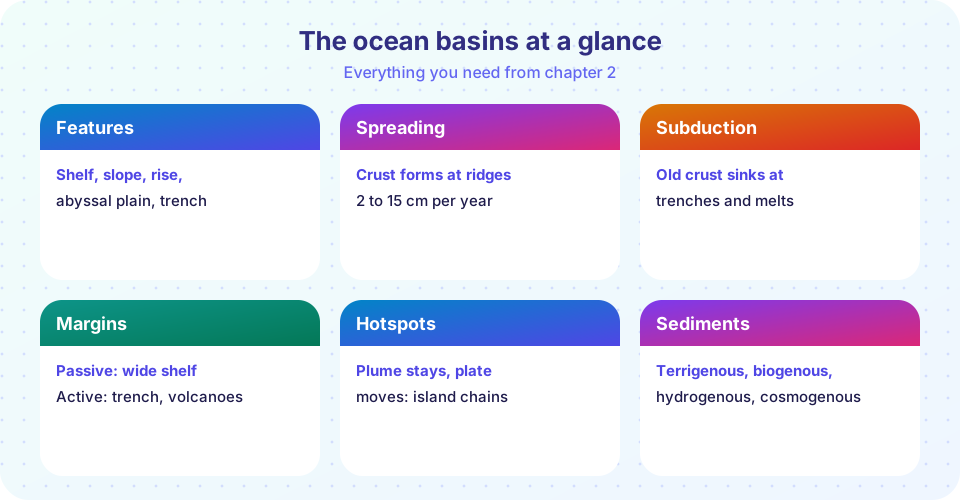
This review pulls chapter 2 together. The seafloor is one system: crust is born at ridges, travels, collects sediment, grows volcanoes and sinks at trenches. If you can tell that story in order and attach the right numbers to each step, you know the chapter.
What you will learn
- How the five lessons of chapter 2 fit together
- Which formulas and numbers to remember
- Where your understanding needs another look
Key terms
Seafloor spreading: new crust forms at ridges and moves away at 2 to 15 cm per year.
Depth-age rule: depth (m) = 2,500 + 350 × √age (Myr) for young crust.
Subduction: one plate sinks beneath another at a trench.
Hotspot: a fixed magma source; a moving plate carries older volcanoes away.
CCD: the carbonate compensation depth, about 4,000 to 5,000 m, below which carbonate shells dissolve.
Recap table
| Lesson | Core idea | Numbers to remember |
|---|---|---|
| Chapter 2 Overview | The basin is a cycle from birth to death | Shelf break about 130 m; abyssal plains 3,000 to 6,000 m |
| Seafloor Spreading and Plate Tectonics | Crust forms at ridges; stripes record reversals | 2 to 15 cm per year; oldest crust about 180 to 200 million years |
| Continental Margins and Trenches | Passive margins are wide and quiet; active margins have trenches | Average shelf width 80 km; trenches up to about 10,900 m |
| Ridges, Hotspots and Seamounts | Ridges make crust; hotspots make island chains | Ridges 65,000 km; vents 350 to 400 °C; Pacific plate 7 to 10 cm per year |
| Seafloor Sediments | Four sources; clay is slow, margins are fast | Red clay about 1 mm per 1,000 years |
Four calculations appear again and again:
- Distance from speed and time: 1 cm per year equals 10 km per million years.
- Depth from age:
2,500 + 350 √age. - Slope length:
drop / tan(angle). - Core age:
core length / accumulation rate.
Common misconceptions
"The Atlantic and Pacific both have many trenches." The Pacific is ringed by trenches, while the Atlantic has few, because it is mostly passive margin.
"Old ocean floor is covered in the thickest sediment everywhere." Age matters, but so does distance from land and productivity. A young crust near a big river can be buried deeper than old crust in a quiet, clay-poor area.
"Hotspots drift with the plates." The plume is much more stationary than the plates, which is why the volcano chain forms.
Try it
The first example is a chapter-2 calculator. Edit the inputs to see how age, depth and distance connect.
Press Run (or Ctrl + Enter) to see the console output here.
No output.
The second example sketches what happens to depth over the lifetime of a plate: it deepens with age, then the sediment thickens on top. The numbers are rounded demonstration values.
Press Run (or Ctrl + Enter) to see the result here.
Program input · what you'd type while the program runs
Type the answers before you press Run, one per line. Each time the program reads a line (with input()), it gets the next line from this box.
Check your understanding
Quick check · 10 questions
of 10 answered You scored / 10 · perfect!
-
1. At a mid-ocean ridge, what happens?
A ridge is a divergent boundary where magma rises and makes new oceanic crust. -
2. A plate moves at 4 cm per year. How far in 25 million years?
4 cm/yr = 40 km per million years; times 25 gives 1,000 km. -
3. What is the depth of 36-million-year-old crust according to the depth-age rule?
√36 = 6, so 2,500 + 350 × 6 = 4,600 m. -
4. Which feature is the real geological edge of a continent?
The shelf is a drowned part of the continent; the slope marks the transition to ocean crust. -
5. What sort of margin has a wide shelf and thick sediment but few earthquakes?
Passive margins lie inside plates, away from boundaries. -
6. Midway (28 million years old) is 2,400 km from Hawaii's hotspot. What is the plate speed?
2,400 km / 28 Myr ≈ 86 km per Myr = 8.6 cm/yr. -
7. Why do manganese nodules take so long to grow?
They are hydrogenous deposits that accrete extremely slowly in low-sedimentation areas. -
8. A 12 m core has sediment that accumulated at 3 cm per 1,000 years. Its bottom age is about...
1,200 cm / 3 cm per 1,000 yr = 400 thousand years. -
9. What dissolves shells of calcium carbonate below about 4,000 to 5,000 m?
Deep water is corrosive to calcite, so shells dissolve below the carbonate compensation depth. -
10. What do black smokers show?
Minerals precipitate when the hot vent fluid meets cold seawater, forming dark plumes.
Summary
- The seafloor cycles from birth at ridges to destruction at trenches, collecting sediment and volcanoes on the way.
- Remember: 1 cm/yr = 10 km/Myr; depth = 2,500 + 350√age; slope length = drop/tan(angle); core age = length/rate.
- Passive and active margins differ in shelf width, trenches and earthquake hazard.
- Next, we leave the floor and look at the water itself: its salt, temperature and density.
Track your progress
Create a free account to tick off lessons and pick up where you left off on any device.
of Oceanography lessons completed