


















Lesson 23 of 49 · Waves, Tides and Currents
Chapter 4 Review: Waves, Tides and Currents
Review chapter 4: wave speed and shoaling, tsunamis, tides and spring-neap cycles, Ekman transport, gyres and the deep overturning circulation, with a ten-question quiz.
You have followed ocean motion from a wave lasting seconds to a circulation that takes a thousand years. This review brings the formulas and facts together so that you can see the common thread: in every case something pushes the water (wind, gravity or density), Earth's rotation and the coasts shape the response and the time scale follows from the size of the system.
What you will learn
- The key formulas of chapter 4 and when each one applies
- How the five kinds of motion compare in time scale and driver
- Which topics to revisit before moving on to ocean-atmosphere interaction
Key terms
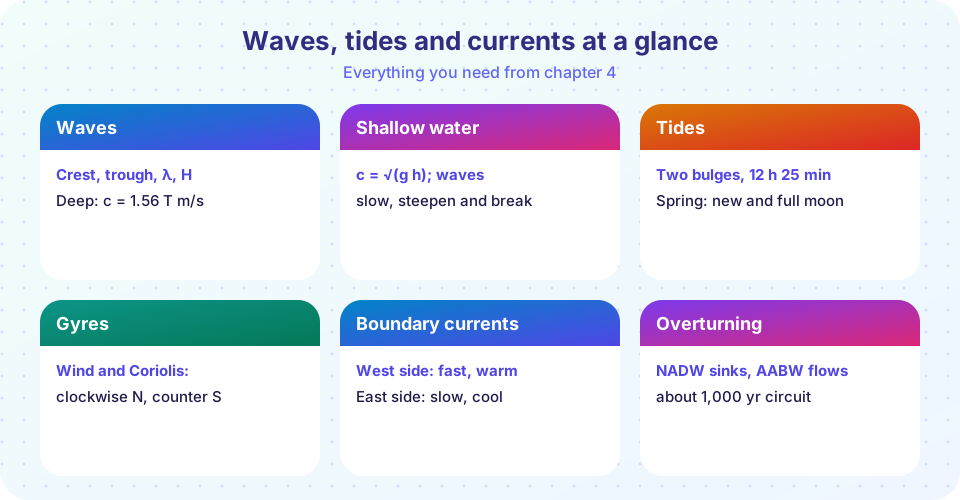
Deep-water wave: c = 1.56 T m/s, λ = 1.56 T² m; depth greater than λ/2.
Shallow-water wave: c = √(g h); includes tsunamis.
Spring and neap tides: large range at new and full moon, small at quarter moons.
Ekman transport: M = τ / (ρ f), 90° to the right of the wind in the Northern Hemisphere.
Overturning circulation: density-driven loop with a turnover time of about 1,000 years.
Recap table
| Lesson | Core idea | Formulas and numbers |
|---|---|---|
| Chapter 4 Overview | Motions span ten orders of magnitude in time | Waves seconds, tides hours, gyres years, deep flow centuries |
| Ocean Waves | Wind builds waves; shoaling steepens them | c = λ/T, c = 1.56 T, c_g = c/2, c = √(g h), breaking at H/h ≈ 0.78 |
| Tides | Two bulges; spring and neap | Lunar day 24 h 50 min; Moon : Sun about 2.2 : 1; spring/neap about 2.7 |
| Surface Currents and Gyres | Wind, Coriolis and continents make gyres | τ = ρ_air C_D U², f = 2Ω sin φ, M = τ/(ρ f) |
| Deep Ocean Circulation | Density drives overturning | Turnover V/Q about 1,400 years; AMOC about 17 Sv |
Compare the pieces:
| Motion | Driver | Time scale | Mathematical shortcut |
|---|---|---|---|
| Wind waves | Wind | 5 to 20 s | c = 1.56 T |
| Tsunami | Earthquake | 10 to 60 min | c = √(g h) |
| Tide | Moon and Sun | 12 h 25 min | M/d³ |
| Gyre | Wind and rotation | years | M = τ/(ρ f) |
| Overturning | Density | about 1,000 yr | V/Q |
Common misconceptions
"Water travels with a wave." Only the wave pattern and energy travel; water orbits in place.
"There is one high tide a day." Most coasts have two, about 12 h 25 min apart.
"Winds push water straight downwind." The net transport is at 90° to the wind because of the Coriolis effect.
"Deep water forms all over the ocean." It forms in a few small regions near the poles.
Try it
The first example is a formula drill covering the whole chapter. The code checks each answer from first principles.
Press Run (or Ctrl + Enter) to see the console output here.
No output.
The second example plots a swell wave train arriving at a beach: wave speed falls as the depth shrinks while the period stays constant, and the wavelength shortens. The numbers come from the shallow-water formula with a gently sloping beach.
Press Run (or Ctrl + Enter) to see the result here.
Program input · what you'd type while the program runs
Type the answers before you press Run, one per line. Each time the program reads a line (with input()), it gets the next line from this box.
Check your understanding
Quick check · 10 questions
of 10 answered You scored / 10 · perfect!
-
1. What is the deep-water wavelength for a wave with a 10 s period?
λ = 1.56 × 10² = 156 m. -
2. How fast does a tsunami move in 4,000 m of water?
c = √(9.81 × 4,000) ≈ 198 m/s ≈ 713 km/h. -
3. What happens to wave period as a wave moves into shallow water?
The period is fixed by the source; speed and wavelength drop. -
4. Why does the Moon have a larger tidal effect than the Sun?
The cube of distance dominates: the Moon's effect is about 2.2 times the Sun's. -
5. At which Moon phases do spring tides occur?
When Sun, Earth and Moon are aligned, solar and lunar tides add. -
6. A southward wind blows along the California coast. The Ekman transport of surface water is...
Transport is 90° to the right of the wind; for a southward wind that is westward, offshore. -
7. Which description fits a western boundary current such as the Gulf Stream?
Western intensification squeezes the return flow of the gyre into a thin, fast current. -
8. Where does Antarctic Bottom Water mainly form?
Cooling and brine rejection on the Antarctic shelves create the densest water. -
9. The ocean volume is 1.34 × 10¹⁸ m³ and the deep flux is 20 Sv. What is the approximate turnover time?
1.34 × 10¹⁸ / 20 × 10⁶ = 6.7 × 10¹⁰ s, about 2,100 years. -
10. Which is correct for a deep-water wave?
In deep water c = 1.56 T, so longer-period (longer) waves travel faster.
Summary
- Waves:
c = λ/T; deep-waterc = 1.56 T; shallow-waterc = √(g h); period stays constant when a wave shoals. - Tides: two bulges, 12 h 25 min apart; spring at new and full moon, neap at quarters; the Moon's effect is about 2.2 times the Sun's.
- Currents: Ekman transport is 90° to the wind; gyres turn clockwise in the north; western boundary currents are narrow and fast.
- Deep circulation: density-driven overturning with a turnover time of around 1,000 years.
- Next, chapter 5 shows how the ocean and atmosphere work as one system.
Track your progress
Create a free account to tick off lessons and pick up where you left off on any device.
of Oceanography lessons completed