


















Lesson 32 of 49 · Marine Life and Ecosystems
Coasts, Reefs and the Deep Sea
Tour the ocean's main habitats: estuaries, mangroves, seagrass, kelp forests, coral reefs and bleaching, hydrothermal vents, and life under extreme deep-sea pressure.
Imagine a map of the ocean that is colored by how much life each place supports. The map would not be even. A few narrow ribbons would glow: the shallow shores, the reef edges, the river mouths. Most of the open sea would look pale. And on the dark bottom, a few unexpected bright spots would appear around vents of hot water, in places where there is no sunlight at all.
This lesson visits the main habitats one at a time: the coastal nurseries, the coral reefs and the deep sea. Each has its own physical rules and its own living solutions, and each is changing under human pressure (chapter 7).
What you will learn
- Why estuaries, mangroves, seagrass meadows and salt marshes are called nurseries and carbon stores
- How kelp forests and coral reefs are built, and what coral bleaching is
- How hydrothermal vent communities live without sunlight, through chemosynthesis
- How pressure and cold shape life in the deep sea, and how to compute pressure at depth
Key terms
Estuary: a partly enclosed coastal body where river fresh water mixes with sea water.
Blue carbon: carbon stored in the sediments and plants of coastal wetlands such as mangroves, seagrass meadows and salt marshes.
Zooxanthellae: microscopic algae (Symbiodiniaceae) living inside coral tissue that supply the coral with energy.
Coral bleaching: the loss of these algae under stress, leaving the white skeleton visible through transparent tissue.
Chemosynthesis: making organic matter from chemical energy (such as hydrogen sulfide) instead of light.
Coastal nurseries
Estuaries and salt marshes
Where a river reaches the sea, fresh and salty water mix. The salinity changes with the tide and the season, so the animals and plants must tolerate large swings. In return, estuaries receive a steady supply of nutrients washed from the land. They are among the most productive habitats on Earth, and many commercial fish and shrimp spend their early life in them. Salt marshes, grass-covered mud flats flooded by the tide, trap sediment and absorb the force of storm waves.
Mangroves and seagrass
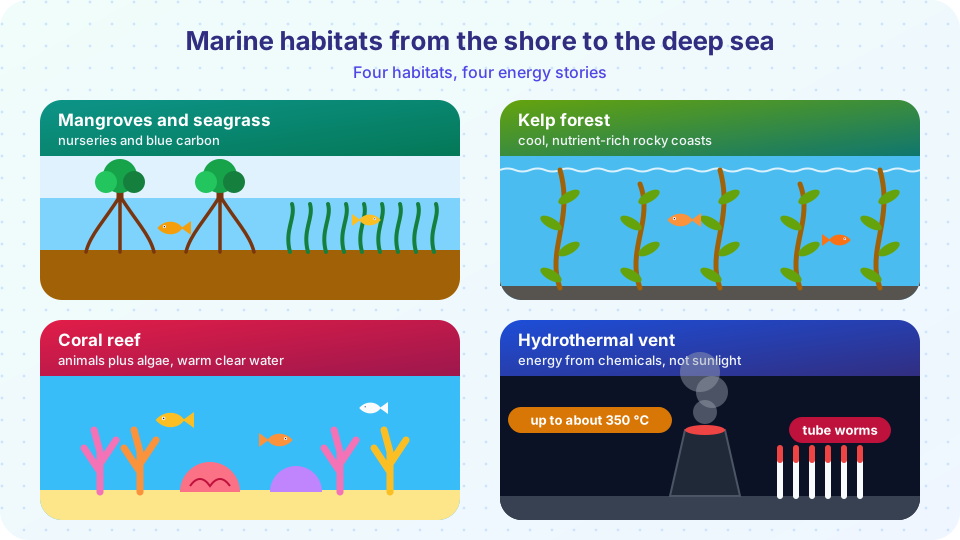
Mangroves are trees and shrubs that grow in the intertidal zone of tropical and subtropical coasts. Many have stilt-like roots and special tissues that exclude or excrete salt. Their tangled roots shelter young fish and slow waves, and cover roughly 150,000 square kilometers worldwide. Seagrasses are flowering plants (not algae) that evolved from land plants and returned to the sea. Their meadows stabilize sediment, feed turtles and manatees, and shelter juvenile fish.
Mangroves, seagrass and salt marshes bury organic matter in waterlogged, oxygen-poor mud where it decays very slowly. This stored carbon, called blue carbon, can stay for centuries. When the habitats are drained or cleared, the carbon can return to the air as carbon dioxide.
Kelp forests
On cold, nutrient-rich rocky coasts, giant kelp (Macrocystis) forms underwater forests that grow upward at up to half a meter a day and reach 30 to 45 meters. The kelp is a large brown alga anchored by a holdfast. It gives food and shelter to hundreds of species, and it is the habitat in which the sea otter's cascade (previous lesson) plays out.
Coral reefs
A coral reef is a structure built by animals. Each coral polyp is a small, soft animal related to sea anemones that takes calcium and carbonate from the sea water and builds a skeleton of calcium carbonate (the mineral aragonite). Thousands of generations build on the skeletons of their ancestors, and over centuries the reef grows. In 1842 Charles Darwin proposed that a fringing reef around a volcanic island becomes a barrier reef as the island subsides, and finally an atoll, a ring of coral around an empty lagoon. Later drilling confirmed his idea.
Corals thrive in clear, shallow tropical water, mostly between about 23 °C and 29 °C. The key to their success is a partnership. The coral tissue holds millions of microscopic algae, the zooxanthellae, which photosynthesize and pass most of the sugar they make to the coral. In return the coral provides shelter and nutrients. This is why a reef makes a rich "oasis" in clear, nutrient-poor water.
Reefs cover less than 0.2% of the sea floor but are home to a very large share of marine biodiversity. A frequently quoted estimate is about a quarter of marine fish species, though the exact share is debated. The Great Barrier Reef, off Australia, is about 2,300 km long and consists of nearly 3,000 individual reefs.
Bleaching
If the water stays a degree or so above the usual summer maximum for several weeks, the partnership breaks down. The zooxanthellae produce harmful chemicals in the heat and the coral expels them. Without its algae the coral turns white, loses its food supply and starves unless the heat subsides soon. NOAA's Coral Reef Watch measures the stress as degree heating weeks (DHW): the sum, over the past 12 weeks, of how many degrees Celsius the temperature has been at least 1 °C above the local summer maximum, in units of °C-weeks. A DHW of 4 or more is expected to cause significant bleaching, and 8 or more severe bleaching and some death. Mass bleaching events became more frequent and widespread after 1998, with several global-scale events since.
Reefs also suffer from ocean acidification (which makes it harder to build skeletons), pollution, sediment and destructive fishing. They are one of the ecosystems most at risk from climate change, which is why they feature strongly in chapter 7.
The deep sea
Most of the ocean floor lies below 3,000 m, in permanent darkness and cold. The deep sea was long thought to be a barren desert. Today we know it is full of life, although sparse.
Pressure
Pressure increases by about one atmosphere for each 10 meters of depth. It follows P = P₀ + ρ g h, with ρ about 1,027 kg/m³ for sea water. At 4,000 m the pressure is about 400 atmospheres, and at the bottom of the Challenger Deep in the Mariana Trench (about 10,900 m) about 1,100 atmospheres: roughly a thousand times the pressure at the surface. Animals without air-filled spaces are mostly unharmed by pressure, because it is the same inside and outside. Deep-sea fish use stabilizing molecules (such as trimethylamine N-oxide) to keep their proteins working, and no fish have been seen deeper than about 8,300 m. The first people to reach the Challenger Deep were Jacques Piccard and Don Walsh in the bathyscaphe Trieste in 1960.
Food from above
Away from vents, deep-sea animals depend on the slow rain of marine snow. Deep-sea animals are therefore small, slow and often extremely patient. Large food "falls" such as a dead whale bring a feast: a whale fall can feed a special community for decades. Many midwater animals make light: bioluminescence is used for attracting prey, camouflage and signaling, and it is a common feature of deep-water life.
Oases without sunlight
In February 1977, scientists diving in the submersible Alvin on the Galápagos Rift found hot springs on the seafloor crowded with giant tube worms, clams and mussels. The discovery changed biology. At hydrothermal vents, sea water seeps into the crust, is heated by magma and returns, loaded with dissolved minerals and hydrogen sulfide, at temperatures up to about 350 to 400 °C (the deep-sea pressure prevents the water from boiling). Bacteria use the energy from oxidizing sulfide to make organic matter in a process called chemosynthesis. The giant tube worm Riftia pachyptila has no mouth or gut: it houses chemosynthetic bacteria in an internal organ and feeds from them. Cold seeps where methane and sulfide leak from sediments support similar communities.
Vents appear along the mid-ocean ridges you studied in chapter 2. They show that energy for life does not have to come from the Sun, and they are important in the study of the origin of life and of the possibility of life on other worlds, such as the oceans under the ice of Europa and Enceladus.
Common misconceptions
"Corals are plants or rocks." They are animals that build a rock-like skeleton.
"Bleached coral is dead coral." Bleached coral is stressed and starving. It can recover if the water cools soon enough.
"Deep-sea life is crushed by pressure." Animals adapted to depth are fine, because the pressure inside their bodies matches the outside.
"All food chains start with sunlight." Vents and seeps run on chemical energy.
Try it
The first example computes the pressure at various depths, using P = P₀ + ρ g h with a constant density.
Press Run (or Ctrl + Enter) to see the console output here.
No output.
The second example is a coral-bleaching stress calculator. It builds a synthetic daily temperature series for a reef (a smooth seasonal curve plus noise, so it is a demonstration, not a record) for a normal summer and a warm summer, and computes degree heating weeks as defined above.
Press Run (or Ctrl + Enter) to see the result here.
Program input · what you'd type while the program runs
Type the answers before you press Run, one per line. Each time the program reads a line (with input()), it gets the next line from this box.
Check your understanding
Quick check · 5 questions
of 5 answered You scored / 5 · perfect!
-
1. What is blue carbon?
Waterlogged coastal sediments hold organic carbon for centuries. -
2. What do zooxanthellae do for a coral?
The algae pass sugars to the coral; losing them (bleaching) cuts the coral's food supply. -
3. Approximately what is the pressure at 4,000 m depth?
About one atmosphere per 10 m of depth, plus the atmosphere at the surface. -
4. How do hydrothermal-vent animals get energy?
Bacteria oxidize hydrogen sulfide and fix carbon, feeding tube worms and other animals. -
5. A degree heating week value of 8 °C-weeks means...
DHW of 4 or more signals significant bleaching, and 8 or more severe bleaching.
Summary
- Estuaries, mangroves, seagrass and salt marshes are nurseries and blue-carbon stores.
- Coral reefs are animal-built structures powered by algal partners; sustained heat causes bleaching, measured by degree heating weeks.
- Pressure rises by about 1 atmosphere per 10 m; the Challenger Deep reaches about 1,100 atmospheres.
- Hydrothermal vents run on chemosynthesis, showing that life can thrive without sunlight.
Track your progress
Create a free account to tick off lessons and pick up where you left off on any device.
of Oceanography lessons completed