


















Lesson 16 of 49 · Seawater Chemistry and Physics
Light and Sound in the Sea
Learn how light fades with depth, why the sea looks blue, how to find the euphotic depth, and how sound speed forms the SOFAR channel that carries sound across oceans.
Two kinds of waves are the oceanographer's main way of sensing the sea: light and sound. Light powers almost all life in the upper ocean, and it fades so fast that below about a kilometer the water is completely dark. Sound behaves in the opposite way. It travels far better in water than in air, and the ocean contains a natural channel that can carry the call of a whale across an entire basin.
This lesson explains both. You will calculate how deep sunlight reaches, see why red light vanishes first and use a standard formula for sound speed to understand how sonar and the deep sound channel work.
What you will learn
- How light is absorbed and scattered in water
- How to compute the euphotic depth from an attenuation coefficient
- Why the open ocean looks blue and coastal water looks green or brown
- How sound speed depends on temperature, salinity and depth
- How the SOFAR channel and sonar work
Key terms
Attenuation coefficient (K): the rate at which light intensity falls with depth, in units of 1/m.
Euphotic zone: the sunlit layer where there is enough light for photosynthesis, down to where about 1% of surface light remains.
Secchi disk: a white disk lowered into the water; the depth at which it disappears measures clarity.
SOFAR channel: the Sound Fixing And Ranging channel, a layer of minimum sound speed that traps sound.
Sonar: a method that uses sound to detect objects or measure distance (sound navigation and ranging).
How light fades
Light entering the sea is weakened by two processes: absorption, in which water molecules and dissolved or suspended material convert light energy to heat, and scattering, in which particles bounce light in other directions. Over a path of depth z, the intensity falls exponentially (the Beer-Lambert law):
I(z) = I₀ × e^(−K z)
where I₀ is the intensity at the surface and K is the attenuation coefficient in 1/m. The deeper you go, the less light remains, with each additional 1/K meters cutting the light to about 37% of what it was.
For clear open-ocean water, K for blue light is small, about 0.02 to 0.04 per meter. In turbid coastal water filled with sediment and plankton, K can be 0.2 to 1 per meter or more.
Worked example: how deep is the euphotic zone?
The euphotic depth is where light has fallen to 1% of the surface value. Set I/I₀ = 0.01:
0.01 = e^(−K z), so z = ln(100) / K = 4.6 / K
- Clear ocean,
K = 0.04 /m:z = 4.6 / 0.04 = 115 m. (With K = 0.025 it is about 185 m.) - Productive coastal water,
K = 0.3 /m:z = 4.6 / 0.3 ≈ 15 m.
So 200 m is a good round figure for the clearest oceans but a gross overestimate for coastal waters. And light at 50 m in the clear ocean with K = 0.04: e^(−2) = 0.135, about 14% of the surface value.
The color of the sea
White sunlight is a mix of colors, and water absorbs them unequally. Red and orange light is absorbed within the first 10 meters or so, yellow and green go deeper, and blue penetrates deepest, because water absorbs it least. Blue is also the color that gets scattered most, so what returns to your eye from the open ocean is mostly blue.
Things dissolved or suspended in the water change that color. Phytoplankton contain chlorophyll that absorbs blue and red and reflects green, so productive water looks green. Sediment and dissolved organic matter make coastal water turn greenish-brown. Satellites use this "ocean color" to measure chlorophyll across the globe.
Zones by light:
| Zone | Depth | Light |
|---|---|---|
| Euphotic (sunlit) | 0 to about 200 m (less in turbid water) | Enough for photosynthesis |
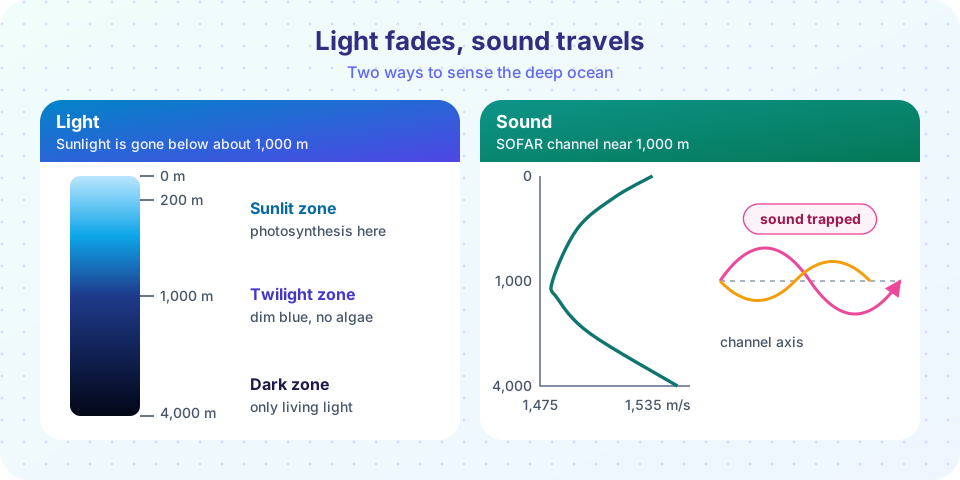
| Disphotic (twilight) | about 200 to 1,000 m | Faint blue light, no net photosynthesis |
| Aphotic (dark) | below about 1,000 m | No sunlight |
In the dark, many animals produce their own light by bioluminescence: chemical reactions that make cold light for hunting, signaling or camouflage. Studies of the open ocean suggest that a majority of animals living below 200 m can produce light.
Sound in the sea
Sound is a pressure wave that travels by compressing and expanding the water. It moves much faster in water than in air (about 1,500 m/s versus 343 m/s) and is absorbed far less, especially at low frequencies, so it can travel enormous distances.
What sets the speed of sound
A widely used approximation (Medwin's formula) is
c = 1449.2 + 4.6 T − 0.055 T² + 0.00029 T³ + (1.34 − 0.010 T)(S − 35) + 0.016 z
with T in °C, S in g/kg and z in meters. The rule of thumb:
- about 4 m/s faster for each °C of warming,
- about 1.3 m/s faster for each additional g/kg of salinity,
- about 1.6 m/s faster for each 100 m of depth (pressure).
Worked example. At the surface with T = 20 °C and S = 35: c = 1449.2 + 92 − 22 + 2.3 = 1521.5 m/s. At 4,000 m with T = 2 °C and S = 35: c = 1449.2 + 9.2 − 0.2 + 64 = 1522.2 m/s.
The SOFAR channel
In most oceans, temperature falls with depth in the thermocline, which slows the sound, while pressure increases deeper down, which speeds it up. The result is a minimum in sound speed at a depth of around 600 to 1,200 m (shallower toward the poles). Sound rays bend toward regions of lower speed, as sunlight bends in a lens, so sound that starts near the minimum is trapped and travels with little loss in the SOFAR channel. Pioneers in the 1940s showed that a small explosion in this channel could be heard thousands of kilometers away. In the 1991 Heard Island experiment, signals sent from the southern Indian Ocean were detected across the globe. Baleen whales such as fin and blue whales use low-frequency calls that probably use this effect.
Sonar and echo sounding
Active sonar sends a sound pulse and times the echo, giving the distance d = c t / 2. Multibeam sonar sends many beams at once and builds maps of the seafloor, and also finds fish schools and shipwrecks. Passive sonar simply listens. Modern oceanographers also use sound for acoustic tomography (measuring temperature over large areas by timing sound travel) and to track floats and animals. Human noise from ships and seismic surveys now raises the background noise in many regions, which is a concern for marine mammals that rely on sound.
Common misconceptions
"The ocean looks blue because it reflects the sky." Sky reflection contributes a little, but the blue is mainly from the water absorbing red light and scattering blue light.
"It is dark at 100 m." At 100 m in clear water about 2% to 8% of surface light remains, enough for photosynthesis and for you to see. True darkness starts near 1,000 m.
"Sound travels slower in water than in air." It is more than four times faster in water.
"Whales can talk to each other anywhere in the ocean." The SOFAR channel helps, and calls can travel hundreds or thousands of kilometers, but noise and absorption limit this, especially at higher frequencies.
Try it
The first example plots how much light reaches each depth for clear and turbid water and marks the 1% euphotic depth. The attenuation values are rounded typical numbers.
Press Run (or Ctrl + Enter) to see the result here.
Program input · what you'd type while the program runs
Type the answers before you press Run, one per line. Each time the program reads a line (with input()), it gets the next line from this box.
The second example is a sound-speed and sonar calculator.
Press Run (or Ctrl + Enter) to see the console output here.
No output.
Check your understanding
Quick check · 5 questions
of 5 answered You scored / 5 · perfect!
-
1. Which color of light is absorbed first in clear seawater?
Red and orange light are absorbed within the first 10 m or so; blue penetrates deepest. -
2. With K = 0.05 per meter, what is the euphotic depth (1% light)?
z = ln(100) / K = 4.6 / 0.05 = 92 m. -
3. What creates the SOFAR channel?
Temperature lowers the speed in the thermocline while pressure raises it below, so a minimum forms and traps sound. -
4. Roughly how fast does sound travel in seawater?
Sound travels at about 1,500 m/s in seawater, over four times faster than in air. -
5. An echo returns after 6.0 s. With c = 1,500 m/s, how far is the target?
d = c t / 2 = 1,500 × 6.0 / 2 = 4,500 m.
Summary
- Light fades exponentially:
I = I₀ e^(−Kz); the 1% (euphotic) depth is4.6 / K, about 100 to 200 m in clear water and 15 m in turbid coastal water. - Red light is absorbed first; blue goes deepest, so the clear ocean looks blue and chlorophyll turns it green.
- Sound speed rises with temperature, salinity and depth; the minimum near 1,000 m forms the SOFAR channel.
- Sonar uses
d = c t / 2to find ranges and map the seafloor.
Next: Chapter 3 Review
Track your progress
Create a free account to tick off lessons and pick up where you left off on any device.
of Oceanography lessons completed