


















Lesson 49 of 49 · Projects and Practice
Where to go next: further study in manufacturing
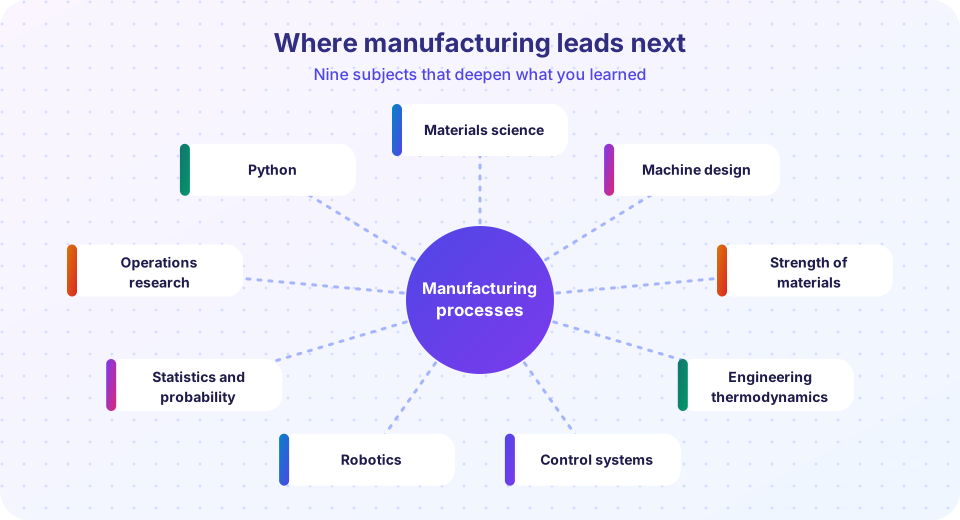
What to study after this course: how manufacturing connects to materials, machine design, strength, thermodynamics, control, robotics, statistics and operations research, plus projects and a study plan.
You now have a working picture of how things are made: how metal is cut, how parts are joined, how objects are built layer by layer, how quality is measured and how a factory is run. This lesson shows you where to go from here. Manufacturing sits at the crossroads of many subjects, so the best next step depends on what you want to do. A process engineer needs more metallurgy, a quality engineer more statistics, an automation engineer more control theory, and a designer more mechanics.
What you will learn
- How each part of this course connects to a deeper subject.
- Which related tracks on this site extend each topic.
- Project ideas that turn the formulas into skills.
- How to plan your study time.
Key terms
Design for manufacturing (DFM): designing a part so that it is easy and cheap to make with the intended process.
Process engineer: an engineer who selects, sets up and improves manufacturing processes.
Quality engineer: an engineer who plans inspection, studies variation and leads corrective actions.
Industrial engineer: an engineer who designs and improves systems of people, machines, materials and information.
How the subjects connect
| If you want to understand... | Study next | Why it helps |
|---|---|---|
| Why steel hardens, why welds crack, how alloys are made | Materials science | Explains the microstructures behind heat treatment, welding metallurgy and casting |
| How to design parts that can be made | Machine design | Covers fits, fasteners, gears, shafts and the design rules that tie to the process |
| How much force a bracket, a weld or a fixture can carry | Strength of materials | Stress, strain, bending and fatigue underlie every joint and every printed lattice |
| The heat flow in welding, casting and heat treatment | Engineering thermodynamics | Energy, heat transfer and cooling rates |
| How machine axes, motors and process variables are controlled | Control systems | Feedback loops, stability and tuning behind servo axes and temperature control |
| How robot arms are programmed and planned | Robotics | Kinematics, trajectories, sensors and safe operation |
| How to analyze process data and capability | Statistics and probability | Distributions, sampling, hypothesis tests and the theory behind control charts |
| How to plan, schedule and optimize production | Operations research | Optimization, queues, scheduling and inventory models |
| How to automate calculations and data collection | Python | Scripts like those in this course scale to real data |
Deepening each part of the course
Machining. The next topics are vibration and chatter (why long tools sing and how to avoid it), high-speed machining, thermal effects on accuracy, grinding and abrasive processes, and non-traditional methods such as EDM, laser and waterjet. Learning a CAM package and writing G-code by hand teaches how a program becomes motion. An excellent exercise is to machine, or have machined, a small part and compare the actual time and cost with your should-cost model.
Joining. Weld design, fatigue of welded joints, codes and qualification (procedure and welder qualification), non-destructive testing methods, and special processes such as laser, electron beam and friction stir welding. For adhesive bonding, study surface science and failure analysis.
Additive manufacturing. Topology optimization and lattice design software, process simulation of residual stress and distortion, powder metallurgy, qualification and certification of printed parts, and in-situ monitoring. A hands-on route is to print the same part at several layer heights and orientations and measure how strength, finish and time change.
Quality. Measurement system analysis (gauge R&R), design of experiments (DOE), Six Sigma problem-solving methods (define, measure, analyze, improve, control), failure mode and effects analysis (FMEA), standards such as ISO 9001, and advanced GD&T practice.
Automation and lean. PLC programming in the standard languages, industrial networks, machine vision, safety standards, simulation of production flow, value stream mapping with real data, and total productive maintenance (TPM). Study how Industry 4.0 ideas such as sensors, connected machines and data analysis build on the basics of this course, and where they add value and where they are hype.
Careers and credentials
Typical roles include manufacturing or process engineer, quality engineer, welding engineer, CNC programmer or machinist, additive manufacturing engineer, automation or controls engineer, industrial engineer, supply chain or operations analyst, and manufacturing technician. Professional credentials depend on the country and the field; examples include welding inspector certifications, Six Sigma belts, GD&T professional certification and machinist credentials. Check the requirements of the body that issues them before you plan.
Project ideas
- Should-cost challenge. Pick three parts you own, estimate how each is made, and build a cost model for each, then compare with the price.
- Capability study. Measure 25 subgroups of 5 parts (screws, 3D prints, anything you can measure), build an X-bar and R chart and compute Cpk.
- Design for AM. Redesign a bracket with a lattice and compare the mass and the print time with a solid version.
- Value stream map. Draw the flow of a simple process, such as preparing a meal or handling a request in a workshop, and mark the eight wastes.
- Ladder logic simulator. Extend the PLC scan program from the automation lesson with a timer and a second motor with an interlock.
- Inverse kinematics. Extend the two-link arm to follow a line and plot the joint angles.
A study plan
Learning is easier with a schedule. Decide how many hours per week you can give, estimate the hours each subject needs, and build the plan from that. The calculator below does the arithmetic.
One practical rule for ordering your study: learn the foundation that your chosen direction depends on before the specialty. Mechanics and materials come before design and welding metallurgy; statistics comes before capability studies and design of experiments; control theory comes before robot motion control. When you reach a topic that feels too hard, go back one step rather than pushing on.
Common misconceptions
"I must learn everything before I start." Choose one direction and learn the rest as needed; projects teach faster than lists of topics.
"Manufacturing is old-fashioned." It is where robotics, data, materials science and design meet, and it is changing quickly.
"Theory and practice are separate." The best engineers keep going back and forth: calculate, make, measure, then adjust the calculation.
Try it
Choose a goal and see which subjects to study first.
And a study-plan calculator.
Press Run (or Ctrl + Enter) to see the result here.
Program input · what you'd type while the program runs
Type the answers before you press Run, one per line. Each time the program reads a line (with input()), it gets the next line from this box.
Check your understanding
Quick check · 4 questions
of 4 answered You scored / 4 · perfect!
-
1. Which subject best explains why a weld's heat-affected zone becomes hard or soft?
Phase transformations and cooling rates determine the microstructures; materials science teaches them. -
2. Which subject gives the theory behind control charts and process capability?
Control charts rest on distributions, sampling and hypothesis testing. -
3. You want to program robot arms to move parts along planned paths. Which topic helps most?
Robotics covers kinematics, trajectories and sensors, which this course introduced with the two-link arm. -
4. At 5 hours per week, how many weeks does a 45-hour topic take?
45 hours / 5 hours per week = 9 weeks.
Summary
- Manufacturing connects to materials, design, strength, thermodynamics, control, robotics, statistics and operations research; choose the spoke that matches your goal.
- Each part of the course deepens into specific topics, from chatter and DOE to PLC programming and lattice design.
- Projects (cost models, capability studies, printed brackets, value stream maps) turn formulas into skills.
- Plan your study with hours per week and a clear final project.
Back to the start of the track: Manufacturing Processes
Track your progress
Create a free account to tick off lessons and pick up where you left off on any device.
of Manufacturing Processes lessons completed