


















Lesson 4 of 49 · Getting Started
Manufacturing Cost, Takt Time and Capacity
Break a part's cost into material, labor, machine and setup, calculate takt time, find how many machines you need, and measure efficiency with OEE.
A drawing says what a part looks like. A production plan says how many you need and by when. Between the two sits a handful of numbers that every engineer in a factory uses daily: the cost of one part, the cycle time of each machine, the takt time set by customer demand, and the efficiency with which equipment actually runs. This lesson teaches you to compute them and, more importantly, to read them. When cycle time exceeds takt time the line cannot keep up, and no amount of wishing will fix the arithmetic.
What you will learn
- Split the cost of a part into material, labor, machine, setup and overhead.
- Calculate takt time from demand and available time.
- Find how many machines or stations a target rate needs.
- Compute overall equipment effectiveness (OEE) from three ratios.
Key terms
Cycle time (CT): the time from the start of one part to the start of the next at a station.
Takt time: the pace the customer demands: available production time divided by demand. The word is German for "beat".
Machine hour rate: the cost of running a machine for one hour, including depreciation, power and maintenance.
Utilization: the share of available time a machine is actually producing.
OEE: overall equipment effectiveness, the product of availability, performance and quality.
The anatomy of a part's cost
The cost of a manufactured part is the sum of several streams. Naming them keeps you from forgetting any:
- Material. The mass bought times the price per kilogram, including the scrap. A part weighing 0.8 kg cut from 1.2 kg of stock pays for 1.2 kg unless the chips are sold back.
- Direct labor. The time operators spend on the part times their loaded hourly cost (wages plus benefits and payroll taxes).
- Machine cost. The machine hour rate times the time the part occupies the machine.
- Setup. Changing tools, fixtures and programs between batches takes time. That time is shared by the parts of the batch.
- Tooling. Dies, molds, cutters and gauges, spread over the number of parts they produce before wearing out.
- Overhead. Rent, supervision, quality, utilities and management. It is often added as a percentage of labor or machine cost.
Worked example
A small housing is machined in a CNC cell. The numbers are illustrative.
- Material: 3.20 per part.
- Cycle time: 150 seconds = 0.04167 hours.
- Machine hour rate: 60 per hour. Machine cost per part: 60 × 0.04167 = 2.50.
- Operator: 30 per hour, one operator per machine. Labor per part: 30 × 0.04167 = 1.25.
- Setup: 1 hour per batch of 500 parts, cost (60 + 30) × 1 / 500 = 0.18 per part.
Total: 3.20 + 2.50 + 1.25 + 0.18 = 7.13 per part before overhead and tooling. Notice how much of this the cycle time controls: two of the four lines scale with it. Cutting the cycle time by 20 percent saves 0.75 per part, which at 100,000 parts a year is 75,000.
Takt time: the customer's heartbeat
Takt time answers the question, "How often must we finish a part to meet demand?" The formula is:
takt time = available production time / demand
Available time excludes breaks, planned maintenance and meetings. It does not exclude unplanned downtime; that is a loss to be fought, not a planned allowance.
Worked example
A plant needs 120,000 housings a year and runs 250 days. Daily demand is 120,000 / 250 = 480 parts. It runs two shifts, each 7.5 hours of productive time, so available time per day is 15 hours = 54,000 seconds.
takt = 54,000 s / 480 = 112.5 s per part
Every 112.5 seconds a finished part must leave the line. Our CNC cell has a cycle time of 150 seconds. One machine produces a part every 150 seconds, which is too slow. The number of machines needed on paper is:
150 / 112.5 = 1.33
Machines come in whole numbers, so you need two. Utilization with two machines is 1.33 / 2 = 66.7 percent. The spare capacity is not waste; it covers breakdowns, quality problems and demand growth. Lean thinkers still ask whether the cell could be made faster to get below takt with one machine.
Cycle time, takt and bottlenecks
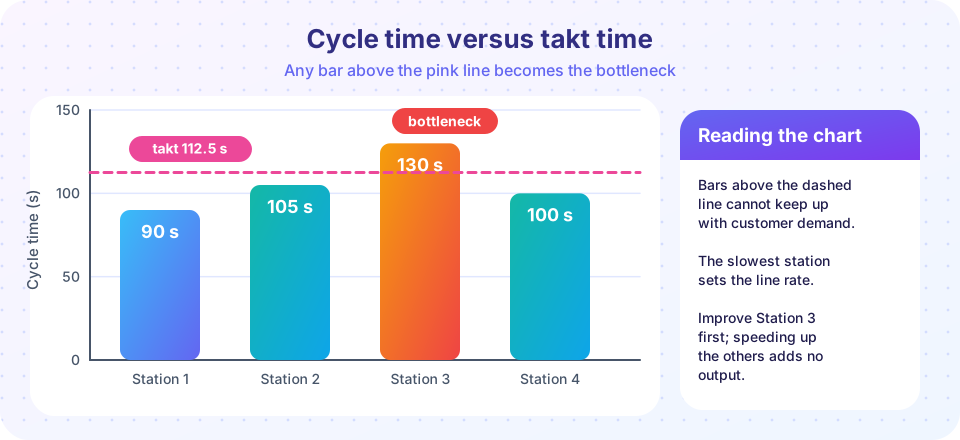
On a line with several stations in series, the slowest station sets the pace of the whole line. That station is the bottleneck. Anything that speeds up a non-bottleneck station does nothing for output, while every second saved at the bottleneck is a second gained by the line. A simple exercise: station times of 90, 105, 130 and 100 seconds against a takt of 112.5 s tell you instantly that the third station (130 s) cannot keep up, and that improving the others is pointless until it is fixed.
OEE: how much of the ideal do you really get?
Machines rarely run at their nameplate speed all day. Overall equipment effectiveness captures three kinds of loss with three ratios:
- Availability = running time / planned time. Breakdowns and changeovers reduce it.
- Performance = actual speed / ideal speed. Slow cycles and short stops reduce it.
- Quality = good parts / total parts. Scrap and rework reduce it.
OEE = availability × performance × quality
With availability 90 percent, performance 95 percent and quality 98 percent:
OEE = 0.90 × 0.95 × 0.98 = 0.838, or about 84 percent.
A common benchmark discussed in the lean community is 85 percent for a "world-class" discrete-parts process, but the figure is a rule of thumb, not a standard; your own trend matters more than a number from another company. OEE is also used to size capacity: if you need the equivalent of 1.33 perfectly efficient machines and your OEE is 0.84, you need 1.33 / 0.84 = 1.58, so two machines.
Putting it together
The four ideas of this lesson form one loop. Demand and available time give takt. Takt compared with cycle time tells you how many machines each station needs. The machines, labor and setup you then pay for give the cost per part. And OEE tells you whether the plan on paper will survive contact with the shop floor. If the result is too expensive, the loop also tells you where to push: shorten the cycle at the bottleneck, cut setup time so batches can be smaller, or raise availability by fixing the most frequent stoppage.
Notice also what the loop does not contain: opinions. Every number can be measured with a stopwatch, a counter and a purchase invoice. That is why experienced production engineers like these tools; they turn arguments about "how busy we are" into arithmetic everybody can check. When you meet a real plant, ask to see the cycle times, the takt and the OEE of its busiest station first.
Common misconceptions
"Takt time and cycle time are the same." Takt is set by the customer; cycle time is a property of the process. You want cycle time at or below takt.
"100 percent utilization is the goal." A machine at 100 percent has no slack: any disturbance delays everything downstream. Queue lengths grow sharply as utilization approaches 100 percent.
"Labor is the biggest cost." For many mass-produced parts, material is the largest line and direct labor is a small share.
Try it
Change the demand and shift pattern in the takt calculator and watch the number of machines needed change.
The Python example costs the housing and compares the effect of cycle time and OEE. Change the inputs to explore.
Press Run (or Ctrl + Enter) to see the result here.
Program input · what you'd type while the program runs
Type the answers before you press Run, one per line. Each time the program reads a line (with input()), it gets the next line from this box.
Check your understanding
Quick check · 5 questions
of 5 answered You scored / 5 · perfect!
-
1. A plant has 28,800 seconds of available time per day and demand of 240 parts per day. What is the takt time?
28,800 / 240 = 120 seconds per part. -
2. A station has cycle time 90 s and takt is 120 s. What is its utilization if it makes exactly the demanded rate?
90 / 120 = 0.75, so the station is busy 75 percent of the time. -
3. Availability 85 percent, performance 90 percent, quality 95 percent. What is the OEE?
0.85 × 0.90 × 0.95 = 0.727, about 73 percent. -
4. On a four-station line, which improvement raises output?
The slowest station sets the line rate, so only improving the bottleneck raises output. -
5. Which cost is shared among the parts of one batch?
Setup is done once per batch, so its cost divides by the batch size.
Summary
- Part cost = material + labor + machine + setup + tooling + overhead; cycle time drives several of these.
- Takt time = available time / demand; cycle time must be at or below takt.
- Machines needed = cycle time / takt (rounded up), more if OEE is below 100 percent.
- The bottleneck sets the line rate, so improve it first.
- OEE = availability × performance × quality.
Next: Chapter 1 Review
Track your progress
Create a free account to tick off lessons and pick up where you left off on any device.
of Manufacturing Processes lessons completed